
Short answer:
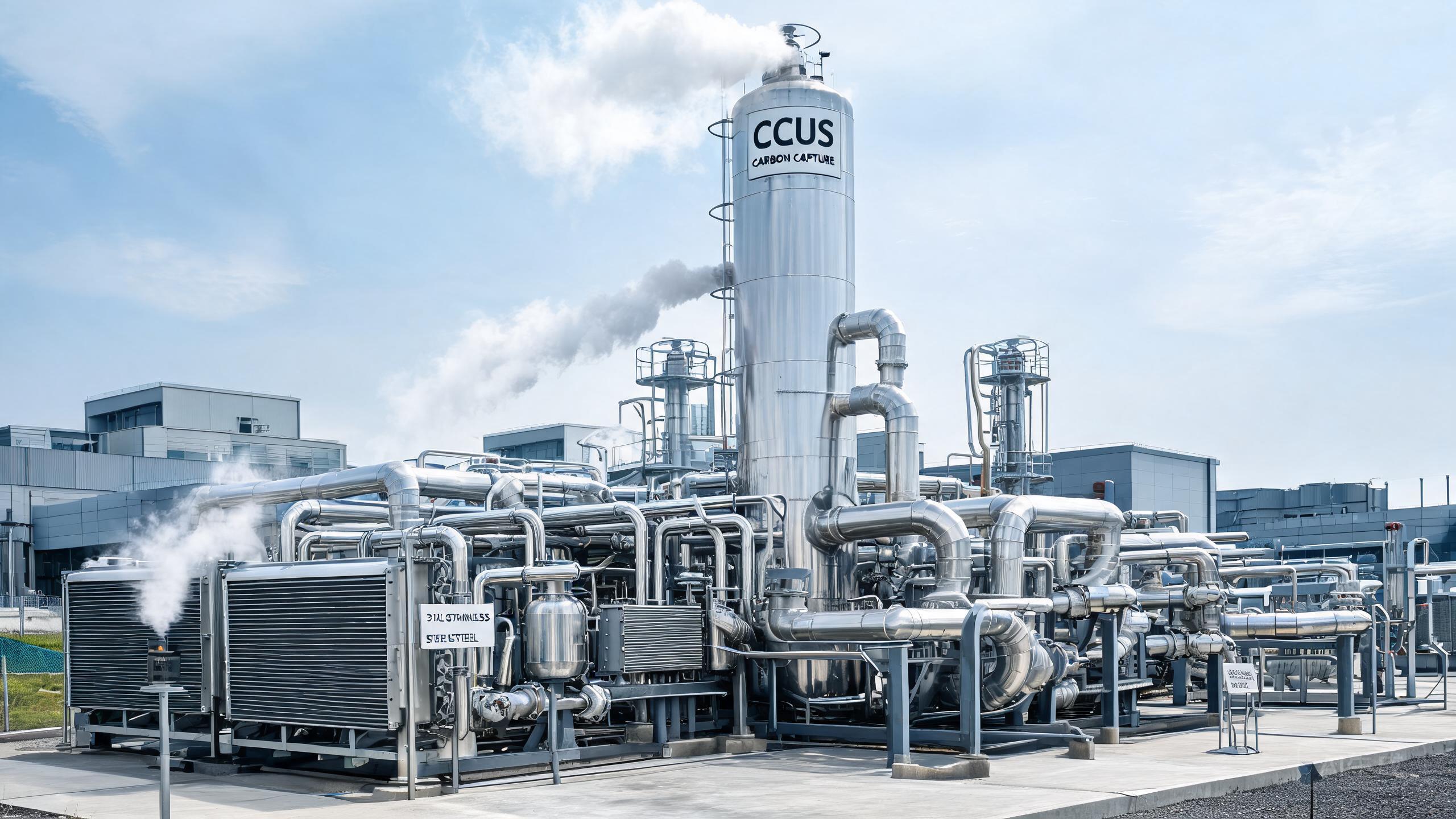
Carbon Capture, Utilization and Storage (CCUS) systems present one of the most corrosive environments stainless steel can face — hot amine solutions carrying dissolved CO2, H2S, and trace chlorides. The recommended grade hierarchy is: 316L is NOT suitable for amine absorber towers (corrodes 0.5-2.0 mm/year). 904L (N08904) works for standard monoethanolamine (MEA) or methyl diethanolamine (MDEA) absorbers up to 80°C. 254 SMO (S31254) handles extreme conditions — hot (>100°C) solutions with elevated H2S and chlorides. Duplex 2205 or 2507 are preferred for high-pressure pipelines and compressors where high strength is needed alongside corrosion resistance. ASTM A240 is the governing plate/sheet specification, and most new CCUS projects in China (60+ announced through 2030) standardize on 904L/254 SMO for tower internals.
Quick Comparison
| Grade | UNS Number | Cr | Ni | Mo | PREN | Typical Corrosion Rate in CCUS | Best For |
|---|---|---|---|---|---|---|---|
| 316L | S31603 | 16-18% | 10-14% | 2-3% | ~25 | 0.5-2.0 mm/year (FAIL) | NOT for CCUS absorbers |
| 904L | N08904 | 19-23% | 23-28% | 4-5% | ~35 | <0.1 mm/year | Standard MEA/MDEA absorbers ≤80°C |
| 254 SMO | S31254 | 19.5-20.5% | 17.5-18.5% | 6.0-6.5% | ~40 | <0.01 mm/year | Hot (>100°C), H2S-rich, high-Cl⁻ service |
| 2205 | S32205 | 21-23% | 4.5-6.5% | 3.0-3.5% | ~35 | <0.15 mm/year | High-pressure pipelines, compressors |
| 2507 | S32750 | 24-26% | 6-8% | 3-5% | ~40 | <0.05 mm/year | Ultra-high-pressure (≥10 MPa) components |
What Buyers Should Evaluate
- Amine type and concentration. MEA (30 wt%), MDEA (40 wt%), and mixed amines have different corrosive profiles. 904L handles MEA well but may struggle with hot blended amines containing piperazine (PZ) accelerators.
- CO2 and H2S partial pressure. At CO2 partial pressure >1.5 MPa, consider 254 SMO over 904L. H2S levels above 1,000 ppm significantly increase pitting risk — 254 SMO’s higher PREN is critical.
- Operating temperature. Each 10°C increase roughly doubles corrosion rate. Above 90°C lean amine, upgrade to 254 SMO.
- Chloride content in feed gas. Natural gas feed often carries 100-2,000 ppm chloride. Specify 254 SMO for chloride above 500 ppm.
- Welding requirements. Super austenitics (904L, 254 SMO) need ER385 filler and controlled heat input (≤1.5 kJ/mm). Duplex grades need ER2209/ER2553 and interpass temp ≤250°C.
- China-specific standard. Refer to GB/T 41332-2022 for carbon capture equipment materials — it aligns closely with ASTM A240 and ASME B31.3.
Common Purchasing Mistakes
Mistake: Specifying 316L “to save cost” on amine absorbers. We’ve seen three cases in 2024 where contractors selected 316L thinking it was “close enough” to 904L (same Mo range of 2-4% vs 4-5%). All three towers developed perforation leaks within 12-18 months. Fix: use 904L minimum for any amine-containing equipment in CCUS. The 2x higher upfront material cost is trivial compared to the downtime and replacement cost of a 5,000 m³ absorber tower.
Mistake: Chinese factory trick — Ni content short-weighting on 904L. 904L requires 23-28% nickel. Multiple mills in Jiangsu have supplied material labeled 904L with only 19-20% Ni — still austenitic, passes visual inspection, but has much lower corrosion resistance. Solution: mandatory PMI (Positive Material Identification) spectroscopy on every plate. Insist on EN 10204 3.1 mill test certificates that list every element. Have a third party (SGS or TÜV) verify 20% of shipments — 904L Ni content is the single most common specification shortcut we encounter in CCUS sourcing.
Mistake: Ignoring galvanic corrosion risk between tower internals. Carbon steel base plates under 904L stainless cladding develop crevice corrosion if the clad is not fully seal-welded. Similarly, ensure all internal fasteners are the same grade as the vessel shell — mixing 316L bolts with a 904L tower creates accelerated corrosion at the junction.
Mistake: Inadequate corrosion allowance. For CCUS service, use minimum 3mm corrosion allowance above the calculated minimum thickness. High-pressure (≥10 MPa) 2205/2507 components need 4-5mm allowance due to combined pressure and corrosion effects.
Recommended RFQ Wording
Grade: ASTM A240 / UNS [N08904 904L / S31254 254 SMO / S32205 2205 / S32750 2507]
Application: [amine absorber tower / high-pressure pipeline / compressor component / heat exchanger]
Operating conditions:
  - Medium: [amine type, concentration, H2S ppm, Cl⁻ ppm]
  - Temp range: [min - max °C]
  - Pressure range: [min - max MPa]
Form: [plate / pipe / coil / welded assembly]
Thickness: [nominal + Xmm corrosion allowance]
Surface: 2B mill finish, pickled and passivated
Quantity: [kg or pieces]
Delivery: [required date, incoterm]
Certification required:
  - EN 10204 3.1 mill test certificate (all elements listed)
  - SGS/TÜV PMI spectroscopy on ≥20% per heat
  - Corrosion test report per ASTM G48 (pitting) and ASTM G31 (immersion)
FAQ
Why is 316L stainless steel not recommended for amine absorber towers in carbon capture?
316L (UNS S31603) fails in modern amine absorber service due to severe corrosion from hot lean/rich amine solutions containing dissolved CO2 and H2S. The typical corrosion rate is 0.5-2.0 mm/year under 1.5 MPa CO2 partial pressure, far above the 0.1 mm/year economic limit. Use 904L (N08904) or 254 SMO (S31254) instead.
Which stainless steel grade handles the most aggressive CCUS environments?
254 SMO (UNS S31254), a super austenitic stainless steel with 6% molybdenum and 20% chromium, handles the most aggressive CCUS environments — hot (80-120°C) amine solutions with H2S, high chloride content (up to 5,000 ppm), and elevated CO2 pressure. It offers PREN ~40 and corrosion rates below 0.01 mm/year in CCUS service.
Why does carbon capture need different stainless grades than desalination?
CCUS environments involve chemical corrosion from amines, organic acids, and H2S combined with CO2-induced carbonic acid — this is a mixed-mode corrosion attack (general + pitting + stress corrosion). Desalination primarily faces chloride pitting. While there is grade overlap (2205, 2507), CCUS typically requires super austenitic grades (904L, 254 SMO) that resist both acid corrosion and chloride attack simultaneously.
CTA + Technical References
Send your grade, dimensions, annual volume and application to vip@still-steel.com, or contact us. Our CCUS-material specialists supply 904L and 254 SMO plate per ASTM A240 for amine absorber towers across China’s national carbon capture initiative.
References:
- ASTM A240 / A240M: Standard specification for chromium and chromium-nickel stainless steel plate, sheet, and strip for pressure vessels
- ASME B31.3: Process Piping
- GB/T 41332-2022: Materials for carbon capture equipment
- ASTM G48: Standard test method for pitting corrosion resistance of stainless steels
- ASTM G31: Standard guide for laboratory immersion corrosion testing of metals
- See also: Pulp and paper bleaching stainless steel
Technical References
- ASTM A240M - Standard Specification for Chromium and Chromium-Nickel Stainless Steel Plate, Sheet and Strip
- EN 10088-2 - Stainless steels. Technical delivery conditions for sheet/plate and strip
- ASM International - Handbook Series, Volume 1: Properties and Selection: Irons, Steels, and High-Performance Alloys