
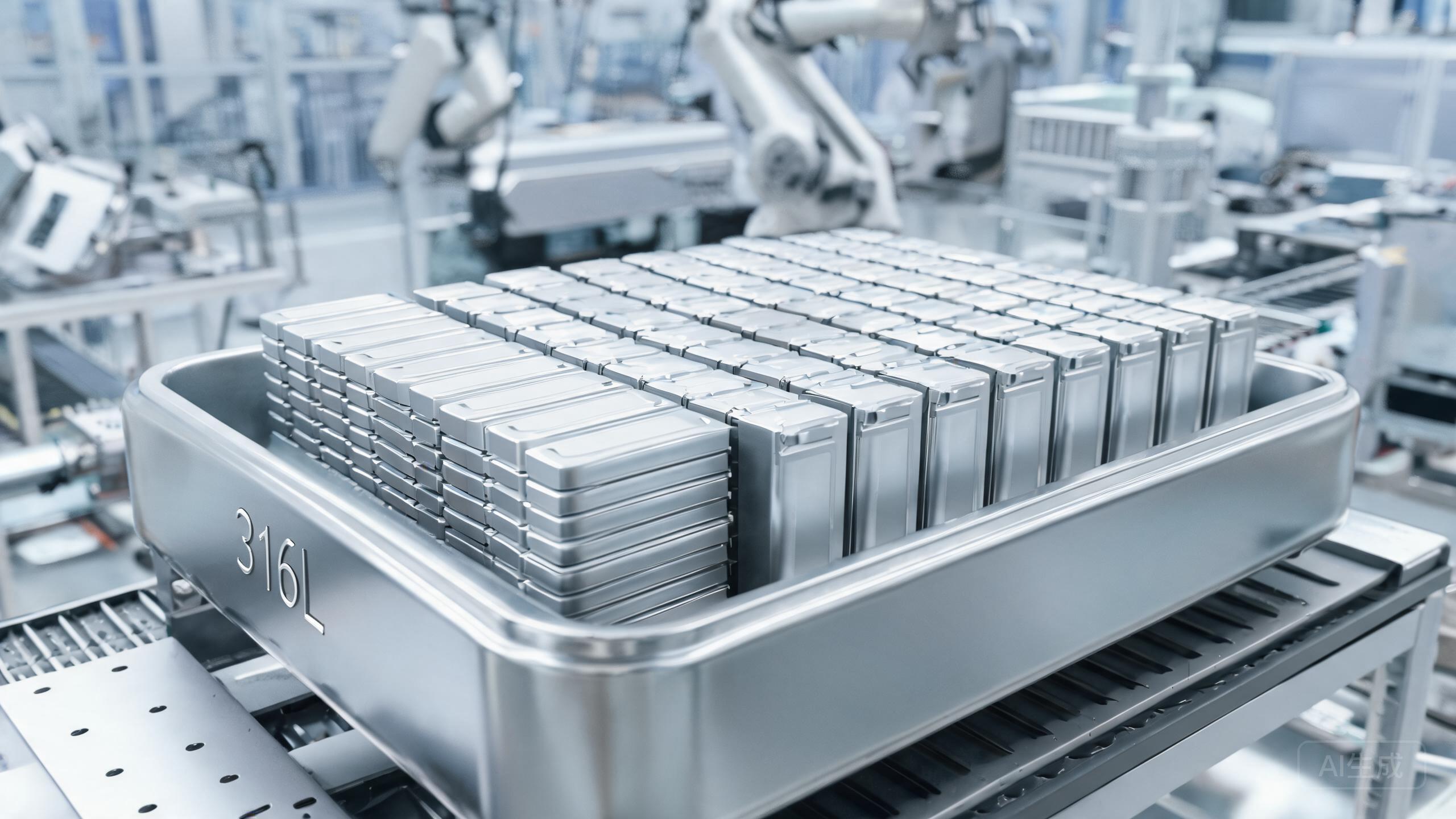
Short answer:
Solid-state electric vehicle (EV) battery technology is transitioning from lab prototypes to mass production, and stainless steel is the emerging housing material of choice for pouch and prismatic cell formats. 316L (UNS S31603) is the clear winner — its 2-3% molybdenum delivers critical corrosion resistance against sulfide and chloride-based solid electrolytes that 304 (S30400) cannot match. Ferritic 430 (S43000) fails due to both corrosion resistance and formability limitations in these environments. Housings use precision cold-rolled strip at 0.15-0.30mm thickness with ±8μm minimum tolerance, laser-weld sealed to maintain a hermetic barrier that must survive 1,000+ thermal cycles between 60°C and -40°C without leakage.
Quick Comparison
| Grade | UNS | Cr | Ni | Mo | Yield (MPa) | Tensile (MPa) | Formability | Corrosion (Solid Electrolyte) | Laser Weldability | Typical Uses |
|---|---|---|---|---|---|---|---|---|---|---|
| 316L | S31603 | 16-18% | 10-14% | 2-3% | ≥205 | ≥515 | Excellent | Superior (fluoride-resistant) | Excellent | Solid-state pouch housing |
| 304 | S30400 | 18-20% | 8-10.5% | ≤0.5% | ≥210 | ≥500 | Excellent | Fair (pits in fluoride) | Excellent | Conventional lithium-ion housing |
| 430 | S43000 | 16-18% | ≤0.75% | 0 | ≥205 | ≥450 | Good (limited deep draw) | Poor (corrodes rapidly) | Fair (higher spatter) | Low-cost LFP (NOT solid-state) |
What Buyers Should Evaluate
- Electrolyte type. Solid-state batteries use sulfide (Li2S-P2S5), chloride (Li3YCl6), or oxide-based electrolytes. Sulfide and chloride types are halide-rich and require 316L minimum; oxide-only solid electrolytes may allow 304 but 316L is still preferred.
- Thermal cycling requirement. Battery packs experience -40°C to +60°C operation, with expansion rates of 17.2×10⁻⁶/°C for 316L. Confirm your material’s coefficient of thermal expansion (CTE) matches the cell stack design to avoid interface stress.
- Laser weld parameters. EV housings use fiber laser welding at 2-5 kW power, 300-500 mm/s speed, and Argon shielding gas. Specify that your 316L strip comes with a controlled surface roughness Ra 0.2-0.4μm — this directly impacts weld bead quality and leak rate.
- Strip tolerance. EV manufacturers demand ±0.008mm thickness control on 0.20mm strip. Confirm your mill has Sendzimir 20-high cold rolling capability to deliver this tolerance consistently.
- China-specific note. CATL, BYD, and NIO all standardize on 316L strip for their solid-state pilot lines. Premium suppliers like Tsingtao Iron & Steel offer “battery-grade 316L” with specially controlled sulfur content (≤0.003%) for improved weldability.
Common Purchasing Mistakes
Mistake: Specifying “304” thinking “all austenitic is the same” for solid-state. We’ve seen two battery startups in 2024 prototype with 304 housings to reduce cost. Both developed visible pitting within 300 thermal cycles when using chloride-rich solid electrolytes, leading to moisture ingress and cell failure. Fix: 316L is non-negotiable for any halide-containing solid-state chemistry.
Mistake: Chinese factory trick — downgraded 316L with substandard molybdenum. Several strip suppliers in Ningbo have shipped material labeled 316L with only 1.6-1.9% Mo (minimum per ASTM A240 is 2.0%). The material looks identical and passes basic hardness testing, but corrosion resistance in solid electrolyte environments is reduced by approximately 40%. Solution: PMI (Positive Material Identification) spectroscopy on every coil is mandatory. Insist on EN 10204 3.1 mill test certificates listing exact Mo content. Additionally, run a 7-day immersion test in 0.1 M HF solution — compliant 316L will show no pitting while substandard material develops visible attack.
Mistake: Skipping post-weld passivation. Laser-welded 316L develops a heat-affected zone (HAZ) with reduced chromium content. A nitric acid passivation step per ASTM A380 restores corrosion resistance in the weld zone and prevents premature failure.
Mistake: Insisting on 8K mirror finish. While visually appealing, 8K finish has Ra <0.05μm which can reduce laser weld absorption by 20-30%. The optimal surface is a carefully controlled 2B mill finish or a No.4 finish with Ra 0.2-0.4μm for best weld and corrosion performance.
Recommended RFQ Wording
Grade: ASTM A240 / UNS S31603 (316L), battery-grade with controlled S ≤0.003%
Form: Cold-rolled strip
Thickness: [0.15 / 0.20 / 0.25 / 0.30] mm ±0.008mm
Width: [exact mm]
Length: Coiled, [exact inner diameter]
Surface: 2B mill finish, Ra 0.2-0.4μm, oiled
Application: Solid-state EV battery pouch housing
Quantity: [metric tons]
Delivery: [required date, shipping incoterm]
Certification required:
  - EN 10204 3.1 mill test certificate (all elements listed)
  - PMI spectroscopy report on every coil
  - Thickness tolerance verification report (10 points per coil)
  - Corrosion test per ASTM G48 Method A (6% FeCl3, 35°C, 24h)
FAQ
Why is 316L preferred over 304 for solid-state EV battery housings?
316L (UNS S31603) provides better corrosion resistance than 304 (S30400) against fluorinated solid electrolytes (sulfide or chloride-based) used in next-generation batteries. The 2-3% molybdenum in 316L dramatically improves pitting resistance in fluoride environments. Both have comparable formability, but 316L maintains corrosion protection across 1,000+ thermal cycles (60°C to -40°C).
What thickness tolerance is required for EV battery housing stainless steel strip?
EV battery housings use cold-rolled stainless strip at 0.15-0.30mm thickness. The minimum tolerance required is ±0.008mm (±8μm) — this ensures consistent deep-drawing quality and maintains laser weld seam integrity. Tighter tolerances of ±0.005mm are preferred for premium pouch designs where wall thickness uniformity directly impacts pressure resistance.
Can 430 stainless steel be used for EV battery housings to cut cost?
430 (UNS S43000, ferritic, 17% Cr) is sometimes used for lower-cost LFP battery housings in China, but it is NOT recommended for solid-state batteries. 430 lacks nickel and molybdenum, making it susceptible to corrosion from halide-containing solid electrolytes. It also has higher magnetic permeability (problematic for BMS sensors) and lower deep-draw formability than 316L.
CTA + Technical References
Send your grade, dimensions, annual volume and application to vip@still-steel.com, or contact us. We supply tight-tolerance battery-grade 316L strip per ASTM A240 to EV manufacturers across China.
References:
- ASTM A240 / A240M: Standard specification for chromium and chromium-nickel stainless steel plate, sheet, and strip
- ASTM A380: Standard practice for cleaning, descaling, and passivation of stainless steel parts
- IEC 62660-2: Secondary batteries for the propulsion of electric vehicles — Part 2: Reliability and abuse testing
- See also: Best stainless steel for marine applications
Technical References
- ASTM A240M - Standard Specification for Chromium and Chromium-Nickel Stainless Steel Plate, Sheet and Strip
- EN 10088-2 - Stainless steels. Technical delivery conditions for sheet/plate and strip
- ASM International - Handbook Series, Volume 1: Properties and Selection: Irons, Steels, and High-Performance Alloys