
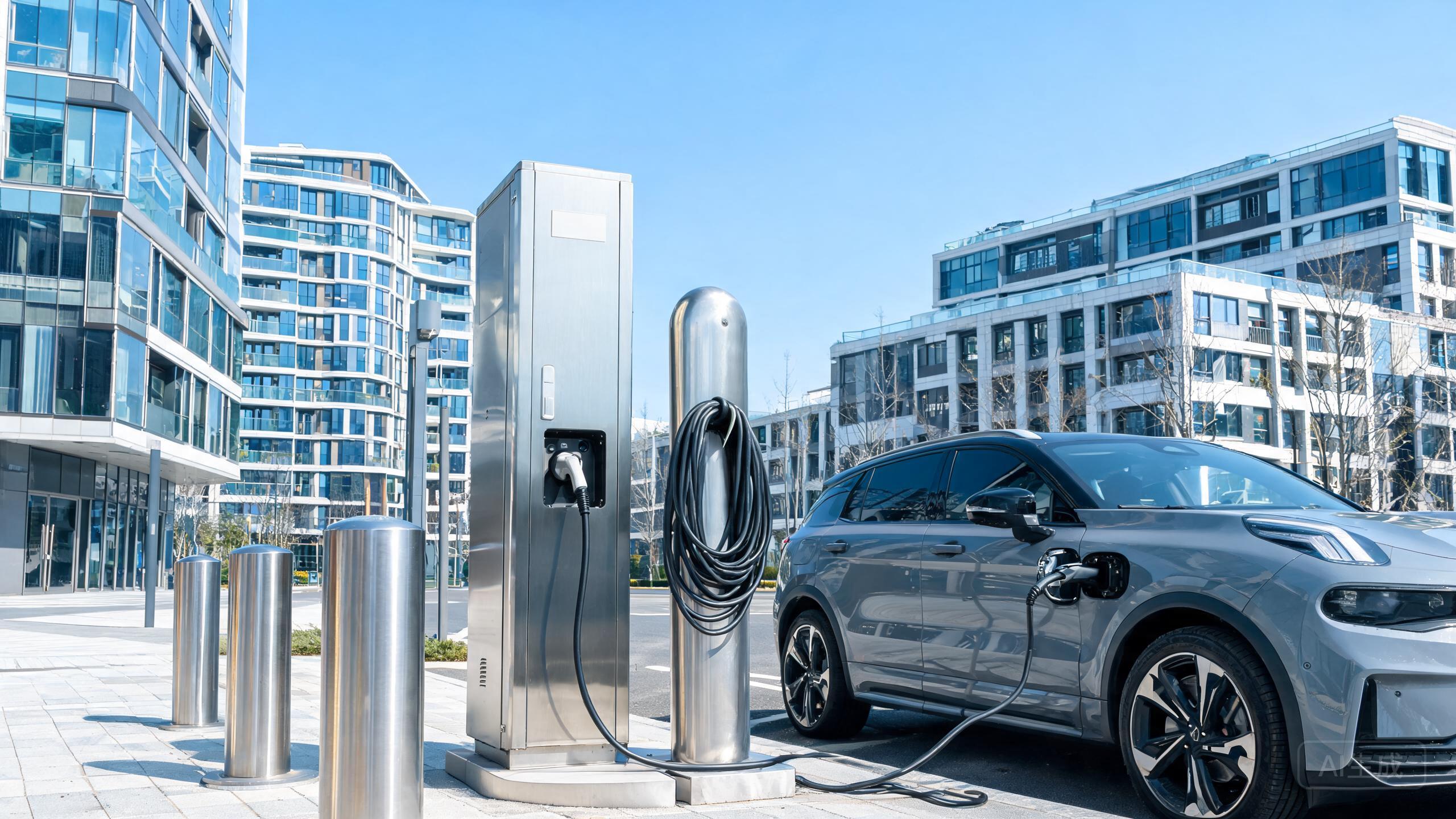
Short answer:
EV charging stations face one of the most demanding outdoor material environments — direct sun, rain, temperature cycling (-40°C to +55°C), road salt spray, and constant public contact — and stainless steel is the only material that combines durability, appearance, and zero-maintenance performance. 304L (UNS S30403) handles 90% of global installations in standard urban and highway environments. 316L (UNS S31603) is mandatory within 10km of coastlines, road salt zones, or industrial areas with chloride pollution. Sheet thickness ranges from 1.5mm (wall-mount DC) to 3.0mm (supercharger pedestals). Surface finish selection — 2B for most outdoor, No.4 for high-scratch areas, 8K mirror for premium urban installations — balances appearance and practicality. The global EV charging stainless market grew 45% in 2025 as China targets 50 million public chargers by 2030.
Quick Comparison
| Environment | Recommended Grade | Finish | Min Thickness | Service Life (years) | Maintenance |
|---|---|---|---|---|---|
| Urban / Highway (no salt) | 304L | 2B | 1.5mm | 15-20 | None |
| Coastal (10km from ocean) | 316L | No.4 or 2B | 2.0mm | 15-20 | Occasional wash |
| Road Salt Zones | 316L | No.4 | 2.0mm | 10-15 | Quarterly wash |
| Premium Urban / Showroom | 304L or 316L | 8K Mirror | 1.5mm | 15-20 | Occasional polish |
| Carbon Steel (reference) | Coated CS | Powder Coated | 2.0mm | 5-8 | Annual touch-up |
| Aluminum (reference) | 6061 | Anodized | 2.5mm | 8-12 | None (but discolors) |
What Buyers Should Evaluate
- Environmental chloride level. Measure or estimate ambient chloride deposition rate (mg/m²/day). <50 mg/m²/day = 304L. 50-200 mg/m²/day = 316L. >200 mg/m²/day = 316L with periodic washing.
- Salt spray testing. If your project targets coastal certification, specify ASTM B117 salt spray testing: 304L must pass 500 hours, 316L must pass 2000 hours with <1% rust area.
- Thermal expansion. Stainless steel expands 17×10⁻⁶/°C. Allow 2-3mm gap per meter between panels in DC supercharger stations to accommodate -40°C to +55°C cycling.
- China-specific note. China’s GB/T 20234-2023 charging station standard references GB/T 1220 for stainless steel materials. Most Chinese EV charger manufacturers (NIO, XPeng, Geely) standardize on 304L from TISCO or Baosteel.
- Mounting hardware. All mounting bolts and brackets must match the housing grade to avoid galvanic corrosion — 304L housing = 304L hardware; 316L housing = 316L hardware.
Common Purchasing Mistakes
Mistake: Specifying “stainless steel” without the exact grade. We’ve seen three RFQs in 2025 that say only “stainless steel EV charging station” — this resulted in receiving 201 stainless (S20100, low-nickel, low corrosion resistance) in two cases. 201 costs 30-40% less than 304L but corrodes through in 3-5 years outdoors. Fix: always write the full specification: “ASTM A240 / UNS S30403 (304L) cold-rolled stainless steel.”
Mistake: Chinese factory trick — downgraded 304L with insufficient nickel. Some mills in Shandong label their material as 304L but actually run nickel at 6.0-7.5% instead of the 9.0-13.0% minimum per ASTM A240. The visual appearance is identical, but PREN drops from ~19 to ~15, reducing corrosion resistance by 50-70% in outdoor service. These chargers develop brown rust stains within 12-18 months. Solution: PMI (Positive Material Identification) spectroscopy on every coil — nickel content must be ≥9.0%, chromium ≥18.0%. Insist on EN 10204 3.1 mill test certificates listing exact element percentages. For critical coastal installations, run ASTM B117 salt spray testing on a 20×20cm sample from every heat.
Mistake: Using too-thin stainless (1.0mm) to save cost. Thin stainless flexes under minor impact, and the sharp creases create stress concentrations that corrode faster. Minimum 1.5mm for wall-mounted units, 2.0mm for pedestal and fast-charger housings.
Mistake: Forgetting about cable management brackets. Charger cable brackets face the same outdoor corrosion as housings. They’re often specified in plain steel or aluminum — use the same grade stainless as the housing. Carbon steel brackets rust through in 2-3 years and can cause cable damage and safety hazards.
Recommended RFQ Wording
Grade: ASTM A240 / UNS S30403 (304L) for standard environments
  OR: ASTM A240 / UNS S31603 (316L) for coastal/salt environments
Application: [wall-mounted AC charger / pedestal DC fast-charger / supercharger]
Operating environment: [urban / coastal / road-salt / premium]
Chloride deposition rate: [mg/m²/day] if known
Form: Cold-rolled sheet
Thickness: [1.5mm for AC / 2.0-3.0mm for DC]
Width/Length: [exact mm]
Surface finish: [2B mill finish / No.4 brushed / 8K mirror]
Quantity: [m² or metric tons]
Certification required:
  - EN 10204 3.1 mill test certificate (Ni ≥9.0%, Cr ≥18.0% for 304L)
  - PMI spectroscopy on every heat
  - ASTM B117 salt spray test: 500h min for 304L, 2000h min for 316L
  - GB/T 20234-2023 compliance statement
Additional: All mounting hardware (bolts, brackets, rivets) must match the housing grade.
FAQ
Is 304L stainless steel sufficient for EV charging stations, or do I need 316L?
304L (UNS S30403) is fully sufficient for EV charging stations in standard outdoor environments — cities, highways, parking lots with minimal salt exposure. 316L (UNS S31603) is required for coastal regions (within 10km of the ocean), areas with road de-icing salts, or industrial zones with atmospheric chloride contamination. The 2-3% molybdenum in 316L provides critical pitting resistance where 304L would develop corrosion within 3-5 years.
What thickness of stainless steel should I use for EV charging station housings?
Standard EV charging station housings use 1.5-2.0mm cold-rolled stainless steel sheet. This provides sufficient rigidity for wall-mounted and pedestal units while keeping material cost competitive. Fast-charging (DC) stations with larger housings may use 2.0-3.0mm for the back panel and structural members. Avoid 1.0mm or thinner — it’s too flexible and prone to denting.
Why not use aluminum or carbon steel for EV charging stations?
Aluminum (6061 or 5052) costs 15-20% less but discolors rapidly from UV exposure, scratches easily, and shows fingerprint oil (staining) that’s impossible to clean. Powder-coated carbon steel is cheaper initially but requires touch-up every 3-5 years in outdoor service — stainless steel requires zero maintenance. Given that EV charging stations are brand ambassadors for the operator, stainless steel delivers the best long-term appearance and corrosion performance.
CTA + Technical References
Send your grade, dimensions, annual volume and application to vip@still-steel.com, or contact us. We supply 304L and 316L cold-rolled sheet per ASTM A240 for EV charging station manufacturers across China and export markets.
References:
- ASTM A240 / A240M: Standard specification for chromium and chromium-nickel stainless steel plate, sheet, and strip
- EN 10088-3: Stainless steels — Part 3: Technical delivery conditions for semi-finished products
- ASTM B117: Standard practice for salt spray (fog) apparatus
- GB/T 20234-2023: Connection set for conductive charging of electric vehicles
- See also: Best stainless steel for marine applications
Technical References
- ASTM A240M - Standard Specification for Chromium and Chromium-Nickel Stainless Steel Plate, Sheet and Strip
- EN 10088-2 - Stainless steels. Technical delivery conditions for sheet/plate and strip
- ASM International - Handbook Series, Volume 1: Properties and Selection: Irons, Steels, and High-Performance Alloys