
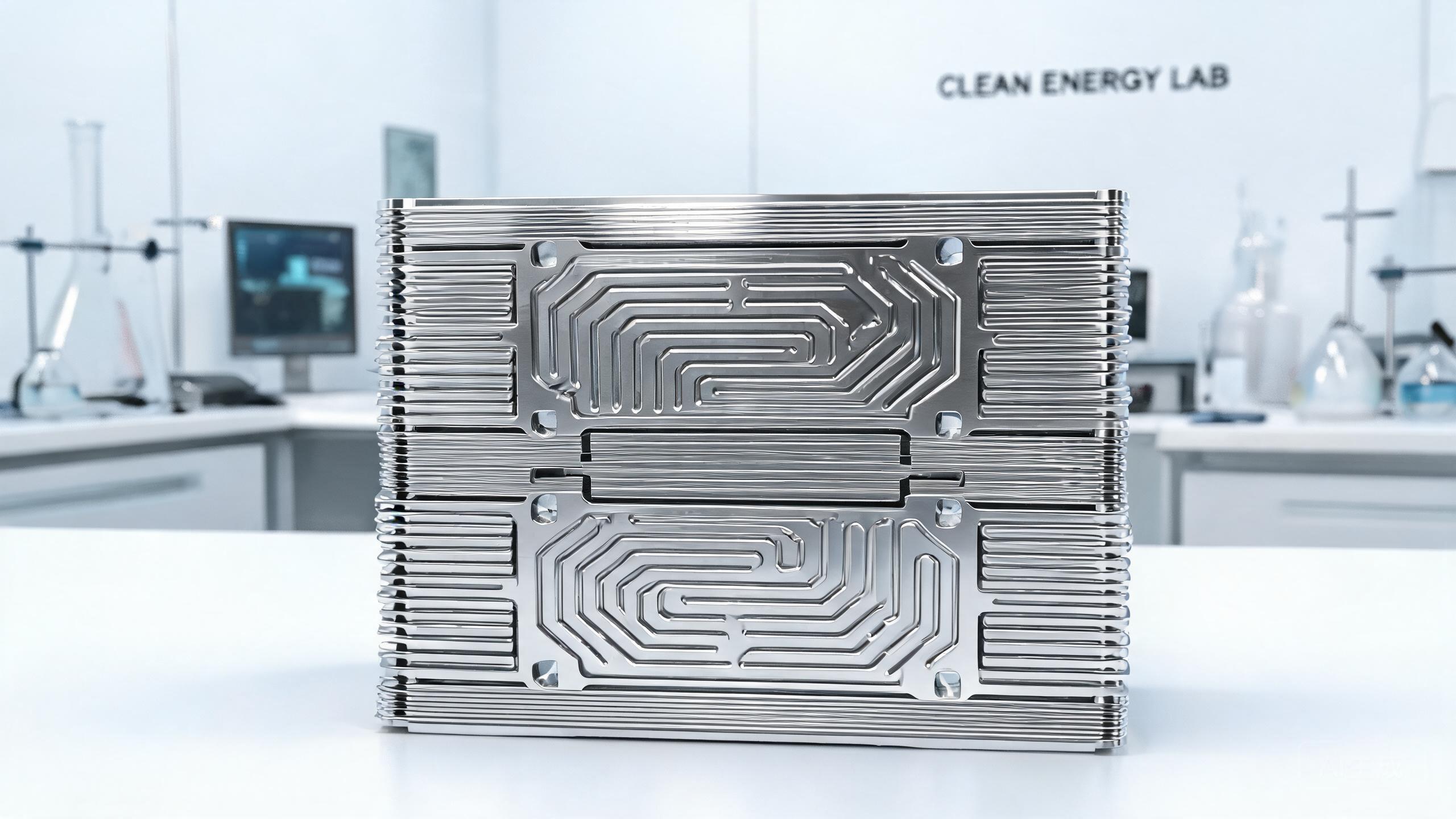
Short answer:
If you’re a fuel cell OEM or tier-1 supplier spec’ing PEM (Proton Exchange Membrane) bipolar plates and still paying titanium prices, you’re leaving 60-80% on the table. 316L stainless steel (UNS S31603) with a thin PVD gold or amorphous graphite coating delivers the corrosion resistance needed for PEM’s acidic environment (pH 3-4, 60-80°C) while holding contact resistance below the 10 mΩ·cm² industry threshold. The catch: you must specify a PVD coating — bare stainless builds up a passive oxide layer that raises contact resistance over time, degrading cell voltage by 5-15% after 5,000 hours. This is why every major fuel cell OEM (Toyota, Hyundai, Ballard, PEM Systems) has migrated from titanium to coated 316L since 2023.
Quick Comparison
| Material | Contact Resistance (mΩ·cm²) | Corrosion (pH 3, 80°C) | Unit Cost Index | Stampability |
|---|---|---|---|---|
| Titanium (bare, Ti-Gr 1) | 8-12 | Excellent | 300 | Good |
| 316L stainless (bare) | 30-50 | Fair (passive layer grows) | 50 | Excellent |
| 316L + PVD gold | 3-8 | Excellent | 100 | Excellent |
| 316L + PVD graphite | 5-10 | Good | 80 | Excellent |
| 304L + PVD gold | 5-10 | Good | 90 | Excellent |
| Graphite plate | 5-10 | Excellent | 120 | N/A (machined) |
The sweet spot is 316L + PVD graphite coating — hits all performance requirements at 1/3 the cost of titanium.
What Buyers Should Evaluate
-
Contact resistance spec. Mandate
≤10 mΩ·cm²measured per ASTM G6 against your actual gas diffusion layer material. Do not accept “equivalent to titanium” without measured data. -
Corrosion testing. Require 1,000-hour potentiostatic testing at 0.6 V vs. SCE in pH 3 sulfuric acid at 80°C. Current density must remain <1 μA/cm². 316L + gold clears this; bare 316L does not.
-
PVD coating specification. Gold: 50-200 nm thick, Ti adhesion layer 10-20 nm. Graphite: 100-300 nm amorphous carbon with Cr or Ti interlayer. Specify maximum surface roughness Ra ≤ 0.1 μm before coating.
-
Sheet thickness tolerance. Stamping 0.10-0.20 mm sheet into complex flow fields requires ±0.005 mm thickness tolerance across the full coil width. Ask for ASTM A240M cold-rolled, full-hard or 3/4-hard tempers.
-
Traceability. Every coil must have an EN 10204 3.1 mill test certificate. Confirm UNS S31603 on the certificate — not S31600 (regular 316).
-
Mass production lead time. PVD-coated stainless bipolar plates are commodity items in Asia now (Ningbo, Changzhou, Busan) — lead times of 30-45 days for 100K+ units are standard. European sources are 2-3x slower.
Common Purchasing Mistakes
-
Skipping the PVD coating to save 15% on unit cost. The oxide layer that forms on bare 316L increases contact resistance by 200-300% after 5,000 hours of operation. That translates to 10-15% lower voltage per cell — a stack-level power loss that costs you far more in warranty claims.
-
Buying 304L instead of 316L from a Chinese mill, lured by 5-10% lower base metal price. 304L has zero molybdenum, which means it cannot resist pitting in chloride-contaminated PEM environments. The PVD coating can delaminate over 10,000 hours, exposing bare 304L to accelerated corrosion.
-
Ignoring the coil’s residual stress. Full-hard tempers (H1/2, H3/4) have better formability for stamping complex flow fields, but higher residual stress. Specify stress-relief annealing at 760°C ± 10°C after stamping to prevent flatness warping.
-
Not specifying contact resistance measurement conditions. The value “10 mΩ·cm²” means nothing without the measurement pressure (typically 100 psi / 0.69 MPa contact pressure) and the counterface material (graphite cloth, per ASTM G6). Always specify both.
-
Trusting mill certificates without PMI. Some Chinese mills mark 316L certificates for coils that are actually 304L. Always run a portable PMI (Positive Material Identification) spectroscopy test on each incoming heat — it takes 30 seconds and costs <$5 per test. Cross-check the nickel (≥10%) and molybdenum (≥2%) content against the EN 10204 3.1 certificate.
Recommended RFQ Wording
State every technical requirement upfront. A good RFQ for 10,000 bipolar plates would include:
- “Material: 316L stainless steel per ASTM A240M (UNS S31603), cold-rolled, 2B finish, thickness 0.15 mm ± 0.005 mm (full width).”
- “Coating: PVD amorphous graphite, thickness 200 nm ± 30 nm, with 10 nm Cr interlayer. Final surface roughness Ra ≤ 0.1 μm.”
- “Contact resistance: ≤10 mΩ·cm² at 0.69 MPa contact pressure measured per ASTM G6 against graphite counterface.”
- “Corrosion: Pass 1,000-hour potentiostatic test at 0.6 V vs. SCE in pH 3 H₂SO₄ at 80°C, current density <1 μA/cm².”
- “Traceability: EN 10204 3.1 mill test certificate for each coil. PMI spectroscopy verification at buyer’s warehouse.”
- “Quantity: 10,000 pieces, 30-day lead time, FOB Shanghai.”
How Still Steel Supports the Project
Still Steel supplies 316L stainless coil and sheet for fuel cell bipolar plate manufacturers across Asia, Europe and North America. We maintain 200+ tons of 0.10-0.25 mm cold-rolled 316L inventory, slit to your exact width, and work directly with approved PVD coating partners to deliver finished, tested bipolar plates — contact resistance measured and EN 10204 3.1 documented at every step.
Send your plate dimensions, annual volume and performance specs to vip@still-steel.com, or discuss the requirement on WhatsApp.
Frequently Asked Questions
Why stainless steel instead of titanium for PEM fuel cell bipolar plates?
Cost is the dominant factor. Stainless steel bipolar plates cost 1/3 to 1/5 of equivalent titanium plates. 316L stainless (S31603) with a PVD gold or graphite coating provides corrosion protection in the PEM’s acidic environment (pH 3-4, 60-80°C) while maintaining contact resistance <10 mΩ·cm².
What contact resistance should I specify for stainless bipolar plates?
Industry standard is <10 mΩ·cm² measured against graphite or carbon cloth at 100 psi contact pressure. This requires a PVD coating — typically 50-200 nm of gold or amorphous graphite. Bare 316L contact resistance is 30-50 mΩ·cm² and grows with passive oxide formation.
What stainless steel grade is best for PEM bipolar plates?
316L (UNS S31603) is the industry standard. Its 2.0-3.0% molybdenum provides chloride corrosion resistance in the acidic PEM environment. 304L (S30403) is sometimes used for lower-cost cells but corrodes faster.
What thickness stainless steel sheet do bipolar plates use?
0.10-0.20 mm cold-rolled 2B finish sheet. The trend is toward thinner gauges (0.10-0.15 mm) to reduce stack weight and cost, but minimum thickness depends on the flow-field stamping depth and high-pressure rigidity requirements.
Technical References
- ASTM A240M - Standard Specification for Chromium and Chromium-Nickel Stainless Steel Plate, Sheet and Strip
- EN 10088-2 - Stainless steels. Technical delivery conditions for sheet/plate and strip
- PEM Materials Handbook, Ballard Power Systems
- DoE Hydrogen and Fuel Cell Technologies Office - Bipolar Plate Targets