
The bottom line
POSCO is preparing an anti-circumvention complaint against Malaysian stainless cold-rolled coil (CRC). It lands at the Korea Trade Commission (KTC) as early as late August, no later than early September 2026 — inside Q3.
If you run orders on the “China or Indonesia feedstock → processed in Malaysia → cleared in Korea” route, redo your sailing schedule, payment terms, and return clauses now. Because once the case is accepted, goods arriving after that date can be taxed retroactively.
What happened
The story first broke via Korea’s SteelDaily, then echoed by SteelOrbis, SMM, and the China Special Steel Enterprises Association. The read is consistent: POSCO is finalizing scope and evidence with the KTC and will file an anti-circumvention dumping complaint on Malaysian CRC. The filing date is not fixed, but the trade talk puts it between late August and early September.
Anti-circumvention is not ordinary anti-dumping. Ordinary AD taxes forward from the effective date. Anti-circumvention can reach backward — to goods that arrive after the case is accepted. Worse: if circumvention is found, Korea will not set a fresh Malaysia rate. It applies the existing AD rate of the raw-material origin country. Cold-roll Chinese slab in Malaysia, and you pay the China rate.
| Item | Detail | Source |
|---|---|---|
| Complainant | POSCO | SteelOrbis / SMM, 2026-08-05~08-08 |
| Authority | Korea Trade Commission (KTC) | cited |
| Target | Malaysian stainless CRC | cited |
| Expected filing | Late Aug – early Sep 2026 (within Q3) | SteelMint, 08-08 |
| Review period | ~1 month; can compress to 1 week with strong evidence | cited |
| Rate logic | No new Malaysia rate — applies the raw-material origin country’s current AD rate | cited |
| Korea’s existing AD cover | Mainland China, Indonesia, China-Taiwan flat products | cited |
| Rule expansion | From 2026, covers “third-country processing & assembly,” not just minor modification | cited |
| Retroactive risk | Goods arriving after the acceptance notice may be back-charged | cited |
The probe looks at four things: where the feedstock came from, how much processing happened in Malaysia, the value-added rate, and how export volumes to Korea shifted after the last AD round. The fourth point is the killer. The data is already on the table.
Korea’s CRC import mix flipped hard this year (Korea Customs preliminary data, via SteelDaily / BigMint):
| Period | Total CRC | China | Malaysia | China-Taiwan | Indonesia | Vietnam |
|---|---|---|---|---|---|---|
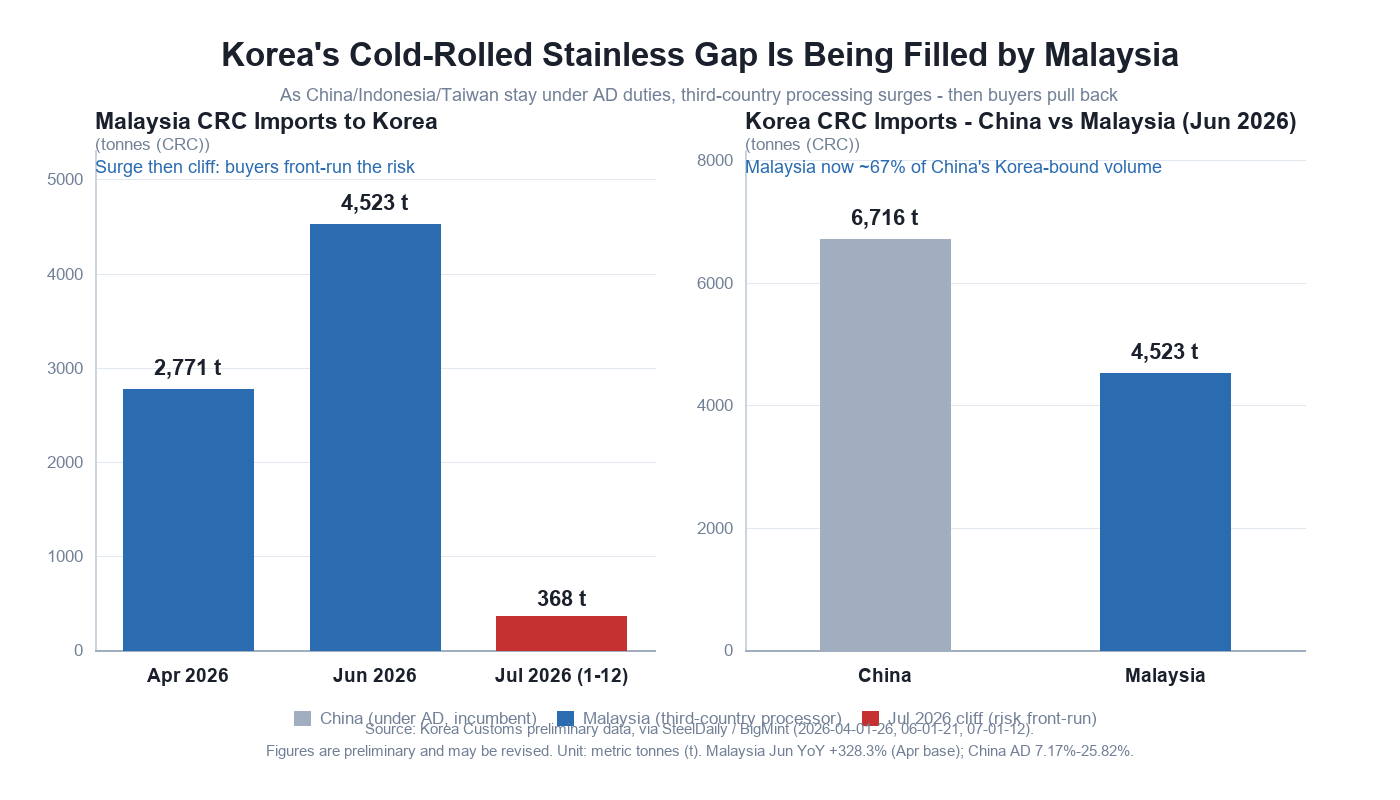
| Apr 2026 (1–26) | 16,536 t | 9,090 t (−19.7%, 55%) | 2,771 t (+328.3% YoY; prior-yr 647 t) | 1,015 t (−63.0%) | 1,421 t | 99 t (prior-yr 10,730 t) |
| Jun 2026 (1–21) | 17,221 t | 6,716 t (−25.9%) | 4,523 t (prior-yr 720 t) | 4,339 t (+232.2%) | −97% YoY | −99.7% YoY |
| Jul 2026 (1–12) | 4,902 t | 3,430 t (70%, −38.3%) | 368 t (−59.8% YoY) | 259 t (−85.7%) | — | — |
The price column tells its own story. June 2026 average CRC import price was 2,151 USD/t (+10.6% YoY) — Malaysia at 2,178 USD/t, China-Taiwan at 2,293 USD/t. Malaysian material is not cheap. What it sells is the absence of an anti-dumping duty.
History repeats — and this is act five
Trade barriers run a recurring script: Country A gets taxed → a low-cost B fills the gap → B becomes the next target. The last two years map onto it almost line by line.
| Case | Time | What happened | Gap filled by | What happened to the filler |
|---|---|---|---|---|
| China-Taiwan vs Vietnam CRC | 2026 | Vietnam CRC to Taiwan >17,000 t H1; Jun alone 6,196 t, ~11× Feb; landed ~80–100 USD/t below local | Vietnam replaced restricted sources | Jul 2026: Yieh Loong, Tang Eng re-filed AD vs China & Vietnam — filler hit the same year |
| EU stainless CRC | 2024 | Extended 19.3% AD + 20.5% CVD to China-Taiwan, Turkey, Vietnam | The three took China’s capped share | Added “melt & pour” monitoring vs Indonesia — enforcement shifted from product to origin |
| Vietnam dropped CRC AD | 2024 | Decision 3011/QD-BCT removed AD on China, Indonesia, Malaysia CRC | — | China→Vietnam exports +127,000 t (+52.3%) Jan–Oct — proof that “cut tariff, freight floods in” |
| Korea stainless flat AD | 2021→2026 | 7.17%–25.82% on China, Indonesia, China-Taiwan | Vietnam, Indonesia briefly took up; both cut to −97%/−99.7% in 2026 | Malaysia stepped in → POSCO now eyes Malaysia |
| Japan nickel-bearing CRC | 2026-07-09 | Temp AD 3.6%–42.1% on China, China-Taiwan (Jul 9 – Nov 8) | TBD | Northeast Asia tightening in sync |
Malaysia is act five of the same play. The only difference: Korea widened its anti-circumvention rule this year from “modification” to “third-country processing.” It wrote the ending in advance.
What it means for buyers
- Cost. Malaysian quotes (2,178–2,339 USD/t) were never cheap. Once China’s AD rate is applied, landed cost can jump double digits in one move. The price edge is gone. Only the risk remains.
- Timing & clearance. The easiest thing to miss. Signing before the case is accepted is not safety — what decides retroactive duty is the arrival/clearance date, not the signing date. Malaysia-to-Korea sea freight plus clearance runs two to three weeks. That is your exposure window.
- Compliance. The probe wants feedstock origin proof, process steps, value-added math. A certificate of origin is no longer a piece of paper. It has to survive tracing.
- Stocking. Korean buyers will rush before acceptance, then turn to domestic or clean sources. That gap is a window for suppliers holding clean material.
Impact by product & region
| Product / grade | Korea angle | Spillover | Read |
|---|---|---|---|
| 304 CRC / plate | Highest risk if via Malaysia (China feedstock → China rate) | Displaced Malaysian capacity seeks Southeast Asia, Middle East | ⚠️ High risk — recheck channel now |
| 316L CRC / plate | Same, and high unit price = bigger retro sum | Low substitutability; tight Korean domestic supply | ⚠️ High risk, but a gap = opportunity |
| 430 CRC (400 series) | Korea AD covers flat products; 400 series included | China Aug 400-series plan 69.20万t, +21.32% YoY — export pressure | ⚠️ Medium-high risk |
| 201 CRC (200 series) | Low Korea demand share | China Aug 200-series plan −2.86% MoM | 🟡 Limited impact |
| HR coil / plate | This complaint targets CRC only; HR not in scope | Korea Jul HR imports: China 37.9% | 🟢 Safe for now, but same AD frame may widen later |
| Region | Impact |
|---|---|
| Korea | Import sources keep narrowing; average import price up; domestic leverage grows |
| Malaysia | Toll-processing re-export model hit; capacity needs a new outlet |
| China | Direct supply relatively “cleaner,” but still carries existing AD rates |
| Other SE Asia | Displaced Malaysian volume may pressure regional prices |
| EU | From Oct 1, “melt & pour” tracing tightens the same re-export path |
What to do now
- Pull a list today of every Korea-bound order in transit or queued. Flag expected arrival date. Anything arriving after September, fed from China / Indonesia / China-Taiwan feedstock and processed in Malaysia — flag it red and recheck.
- Add a tariff-risk clause to contracts. State who bears retroactive duties if circumvention is found, how it is calculated, and who pays return freight. “Returnable” is not enough — returns cost money.
- Get your origin and process evidence ready. Feedstock invoices, melt records, process notes, value-added math. Organize now; it is calmer than scrambling post-acceptance.
- Send Korean customers a risk note. Not to scare them — to shift from “cheap supplier” to “supplier who knows the rules.” At a moment like this, expertise is itself a premium.
- Watch the EU in parallel. The “melt & pour”细则 drops Aug 31, effective Oct 1 — same logic as Korea. China’s flat-product country quota to the EU is tiny (HR Cat8 9,515 t + CRC Cat9 40,431 t ≈ 49,946 t/yr). Clear EU orders in the first two weeks of each quarter to grab quota.
Inference (marked, falsifiable)
- Likely accepted, faster than you think. POSCO is Korea’s stainless core and already aligned scope with KTC. Under the “1-week with strong evidence” rule, if filed late August, acceptance before mid-September looks likely. Falsifiable by one signal: a KTC acceptance notice.
- Malaysia CRC to Korea: spike, then cliff. The climb from 2,771 t (Apr) to 4,523 t (Jun) is already slowing — July 1–12 alone was 368 t (−59.8% YoY), buyers hedging early. Expect a short pre-acceptance clearance rush in Aug–Sep, then a collapse toward zero — following Vietnam’s −99.7% path.
- The gap finds the next exit, but options are thin. China, Indonesia, China-Taiwan taxed; Vietnam gone; Malaysia closing. Left: India, Thailand, Korean domestic. Import dependence drops; average price keeps rising (already +10.6% YoY in June).
- Retro duty bites the importer first. Even with “return on adverse ruling,” the buyer eats freight, storage, demurrage. From August, Korean buyers will push tariff-risk clauses into contracts and shift to D/P and usance L/C.
Data sources
POSCO complaint plan: SteelOrbis / SMM / cssc.org.cn / SteelMint, 2026-08-05~08-08 (media, not official). KTC review: SteelOrbis / SteelMint. Korea AD 7.17%–25.82%: KTC measures (from 2021). Korea Apr/Jun/Jul CRC imports: Korea Customs preliminary via SteelDaily / BigMint. Vietnam→Taiwan Jun CRC 6,196 t (~11× Feb): Taiwan mill AD filings. China→Vietnam +127,000 t (+52.3%) Jan–Oct: post-3011/QD-BCT customs. Japan temp AD 3.6%–42.1% (Jul 9–Nov 8): METI / MOF. EU China flat quota Cat8 9,515 + Cat9 40,431 ≈ 49,946 t/yr: EU 2026/1457, (EU) 2026/1384. Inference rows: based on precedent pattern.
How Still Steel Supports the Project
Still Steel supplies stainless steel coil, strip and sheet with slitting, cut-to-length, brushing, polishing and protective-film services.
Send the grade, dimensions, annual volume and application to vip@still-steel.com, or discuss the requirement on WhatsApp.