
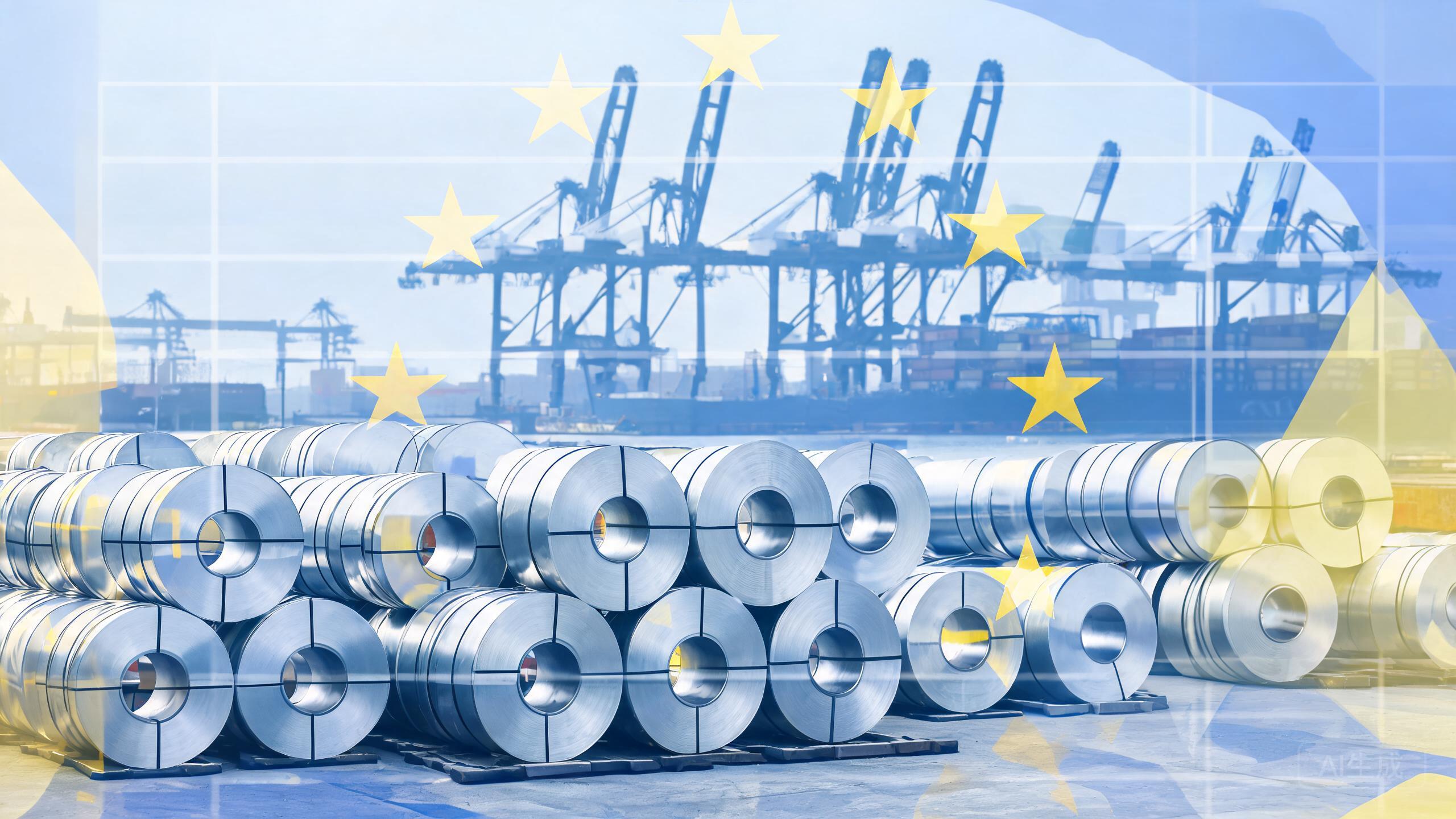
EU Carbon Tariff (CBAM) 2026 for Stainless Steel Buyers
On 1 January 2026, the EU Carbon Border Adjustment Mechanism (CBAM) closed its two-year transition period. What was once a reporting formality became a mechanism that directly affects the cost of importing steel into the EU — and, by extension, which suppliers win the order. For stainless steel buyers, distributors, and OEMs sourcing from Asia, the “carbon tariff” is no longer a policy footnote. It is a line item.
China is the world’s largest stainless steel producer and exporter, and the EU is one of its key destination markets (see the August 2026 China stainless supply and demand update). How CBAM is priced, how default values are set, how mature the verification system is, and how far it reaches downstream will together decide what every tonne of imported stainless steel is actually worth between now and 2034.
The bill is now real money
CBAM boils down to one idea: imported products should carry the same carbon cost as products made inside the EU.
EU steelmakers pay for carbon allowances; importers previously did not. To close that gap, CBAM makes the EU importer buy “CBAM certificates” linked to EU carbon prices, in proportion to the embedded emissions of the imported goods. Carbon already paid in the country of origin can be deducted; what was not paid, or was paid at a lower rate, is settled at the EU border.
The price anchor is already set: the Q1 2026 CBAM certificate price is 75.36 EUR per tonne of CO₂-equivalent, and Q2 is 75.28 EUR ([1][5]). For contrast, China’s domestic carbon price is around 80 RMB per tonne — the EU price is nearly seven times higher.
The short-term bite is smaller than the headline suggests. Because free allowances are still being handed out, in 2026 an importer pays certificates for only about 2.5% of embedded emissions. But that free lunch shrinks every year: by 2030 the payable share is about 48.5%, and by 2034 it reaches 100% ([1]). This is a slow boil — the big invoices arrive years from now, and the window to plan is open now.
Default values: why stainless looks “inflated”
The carbon cost hinges on how embedded emissions are declared — either using the EU’s country default values, or submitting actual emissions verified by an accredited verifier ([2]).
The catch is that default values are punitive by design: in 2026 the EU adds a +10% loading on top of the calculated value, rising to +30% from 2028 ([1][4]). The intent is to push producers to build real emission-monitoring and verification systems fast.
Stainless falls under the CBAM iron-and-steel category as the high-alloy route, covering HS codes 7218-7223 — blooms, hot-rolled coil and plate, cold-rolled strip and sheet, bars, wire rod, and stainless wire ([1]). For Chinese-mainland cold-rolled product, the default emission is about 5.59 t CO₂e per tonne; with the 2026 +10% loading that becomes roughly 6.1-6.5 t ([1][4]).
Translated into today’s cost: at 75.36 EUR/t and the 2.5% payable share, Chinese-mainland cold-rolled carries about 11.6 EUR/t of carbon cost ([1]). That looks modest — but measured at the full 100% CBAM factor, the implied carbon liability reaches roughly 463 EUR/t ([1]). That is where the “hundreds of euros per tonne” figure comes from.
China’s own audited crude-steel emission is about 1.60 t CO₂e/t, while the EU default sits near 1.91 t; some stainless grades are set as high as 5-6 t. The China Iron and Steel Association has publicly called the defaults clearly discriminatory versus China’s real figures ([2]). Without credible third-party verification data, a mill is simply billed on this “inflated” default.
Country divergence: green content is rewriting competitiveness
Once emissions are priced, stainless sourcing competes on two axes — cost and carbon content:
- European scrap-EAF routes have the lowest embedded emissions and are the greenest CBAM benchmark ([1]).
- Chinese-mainland and Indian origins have relatively lower defaults, but still above the EU benchmark; and whether China’s domestic carbon price will be accepted for deduction at the EU border is still uncertain ([1]).
- Some origins using nickel-pig-iron-to-stainless integrated routes with coal-heavy, high-carbon smelting show markedly higher embedded intensity, lack a CBAM-deductible carbon price, and therefore face the highest default-based cost ([1]).
- Re-rolling: some processing hubs buy high-carbon slabs and merely re-roll them. If the emissions trace back to high-carbon smelting, the finished product’s embedded emissions stay high — and attract extra compliance burden around melt-and-pour origin proof ([1]).
In short, the real edge is no longer the country default — it is the ability to show credible, traceable, third-party-verified actual emissions. Prove your real emissions are well below the default, and the carbon cost drops sharply ([1]).
The real bottleneck: verifiers are scarce
More urgent than the carbon cost itself is the shortage of verification capacity.
CBAM requires embedded emissions to be validated by an accredited verifier. As of 30 June 2026, EU national accreditation bodies (NABs) reported that of 27 member states plus Norway, 24 NABs had agreed to offer CBAM verification — yet only 9 were ready to accept verifier applications, 8 would accept third-country applicants, and just 3 had actually accepted third-country applications (Italy’s Accredia, the Netherlands’ RvA, and Sweden’s Swedac) ([1]).
That means even if a Chinese stainless mill is willing to pay for on-site verification, the available channels today are extremely limited. 2026 is less a “grace period” than the critical window to build the emission-data system and secure verification capacity.
The bigger move: from “materials tax” to full-chain “carbon audit”
Watch the reach. The EU plans to extend CBAM in 2028 to 180+ downstream products — auto parts, appliances, machinery ([3]). A robot vacuum cleaner that is not itself energy-intensive will still be assessed item-by-item for the embedded carbon in its controlled-aluminium shell and controlled-steel motor. For stainless steel, this downstream transmission also means structural swings in EU-bound demand.
Policy update: the July 2026 (EU) 2026/1740 default-value correction
On 31 July 2026 the EU published Implementing Regulation (EU) 2026/1740, effective the next day and retroactive to 1 January 2026 ([4][5]). It is a purely technical correction: it replaces Annexes I and IV of the earlier default-value regulation to fix transcription and omission errors from a rushed table merge. It does not change the charging logic, product scope, or free-allowance phase-out. Its value is making sure the default values are correct when 2026 certificates are bought from February 2027 ([5]).
The three points most relevant to stainless ([5]):
- The “default-with-surcharge” columns were deleted. The +10% to +30% surcharge columns for 2026/2027/2028 are gone; the registry now calculates them automatically from the “total default emission.” The surcharge rate is unchanged, but formal quotes and 2027 certificate math should follow the registry output — especially re-checking the cost figures for HS 7218-7223.
- Production-route identifiers were fixed. Missing or wrong route markers had blocked correct free-allowance calculation; where a country’s 4/6-digit HS group has a route but an individual 8-digit code lacks its benchmark, that 8-digit code’s CBAM benchmark and route are now independent. Stainless defaults link to production route (casting, slab, rolling), so check your product’s route label when declaring.
- Retroactive from 2026-01-01. The ongoing 2026 annual CBAM declaration (deadline 2027-09-30) and later one-off certificate purchase should use the corrected Annex I — a “rules certainty” win that locks the basis for costing.
Bottom line: this regulation is not a new tightening — it makes the bill’s math accurate. For stainless, it is a more reliable basis for 2026-2027 costing; for suppliers ready to use real emissions data rather than defaults, it is a genuine advantage ([5]).
Recommended RFQ Wording
When requesting stainless steel for the EU market, ask each supplier for third-party-verified actual embedded emissions per grade and production route, and confirm the HS code falls within 7218-7223. Require an EN 10204 3.1 mill test certificate, a material test certificate (MTC) and melt-and-pour heat numbers with country of origin so the data survives customs scrutiny.
Also include order quantity, acceptable quantity variation, destination, required delivery date and whether partial shipments are allowed. If a requirement is critical, make it measurable and place it on the purchase order rather than only in an email conversation.
How Still Steel Supports the Project
Still Steel supplies stainless steel coil, strip and sheet and provides slitting, cut-to-length, brushing, polishing and protective-film services. We can compare available mill material with your drawing, prepare trial quantities and preserve heat-number traceability through service-center processing.
Send the grade, dimensions, annual volume and application to vip@still-steel.com, or discuss the requirement on WhatsApp.
What this means for buyers
Objectively, CBAM is not an instant ceiling for Chinese stainless: only 2.5% is payable in 2026 and certificate buying is deferred to 2027, leaving room to adjust. But the slow variables — shrinking free allowances, rising default loadings, scarce verification, and expanding downstream scope — compound like a snowball.
The rational response for a buyer is not to argue fairness, but to hedge the uncertainty with action:
- Ask suppliers for verified actual embedded emissions, per grade and production route, with third-party audit.
- Prioritize traceability — melt-and-pour origin, route, and documentation that survives customs scrutiny.
- Plan for the 100% phase so your landed-cost model does not break in 2034.
- Diversify toward lower-carbon feedstock and process where the supply chain allows.
Carbon cost is a bill that is late, but will not be absent. The suppliers who turn it into a green competitiveness advantage are the ones who will still be on your vendor list in the second half of the decade. For the wider trade picture into the EU, see our review of the EU steel safeguard in H1 2026.
If you source stainless steel and need material backed by documented, traceable emission data and mill-test documentation, talk to us about grades, finishes, and the paperwork that keeps your EU shipments compliant.
Technical References
- EU CBAM — official European Commission page
- German Emissions Trading Authority (DEHSt) briefing on the CBAM default-value correction
- SMM stainless steel CBAM coverage
References
- SMM (Shanghai Metals Market), “The carbon bill has arrived, but the verification system is still being built: what CBAM means for stainless exporters” — https://hq.smm.cn/stainless-steel/content/104031151
- China Council for the Promotion of International Trade (Zhejiang), “Slow boil: why Chinese firms became the ‘sandwich layer’ paying the EU carbon tariff — and how to break out” — https://www.ccpitzj.gov.cn/col/col1229557691/art/2026/art_0caeb28048964e26a2f09c832f71fe83.html
- Dentons (via CCPIT), “CBAM — compliance restructuring under the EU’s green trade barrier and China’s response” — https://www.eccpit.com/news/Y21zcG86MjI5NjA
- EU Official Journal, Commission Implementing Regulation (EU) 2026/1740 (2026-07-31) — https://eur-lex.europa.eu/legal-content/EN/TXT/?uri=CELEX:32026R1740
- German Emissions Trading Authority (DEHSt), briefing on the EU correction of CBAM standard-values implementing regulation (2026-08-05) — https://www.dehst.de/SharedDocs/news/DE/cbam-aenderung-standardwerteverordnung.html