
Short answer:
Stainless steel for solar and wind power is used sparingly but at the points that decide availability: tracker torque tubes and coastal clamps, A4-70/A4-80 fasteners, cable trays, sensor housings, and offshore splash-zone ladders and platforms. Inland solar work runs on 304L; coastal solar and onshore wind hardware move to 316L; offshore splash zone needs 2205 or 2507 plate, not 316L. The problems that generate warranty claims are rarely about the base metal chemistry — they are cut edges that were never passivated, weld heat tint left inside hollow sections, stainless-to-aluminium galvanic couples, crevices under clamps and rubber pads, and fasteners that gall or crack under salt and load.
Quick Comparison
| Grade | UNS | Cr / Ni / Mo / N | PREN | Yield / Tensile (MPa) | Relative cost* | Best use in solar and wind |
|---|---|---|---|---|---|---|
| 304 / 304L | S30400 / S30403 | 18-20 / 8-10.5 / — / — | 18-19 | 205 / 515 | 1.0 | Inland tracker tubes, cable tray, indoor hardware |
| 316L | S31603 | 16-18 / 10-14 / 2-3 / — | 24-26 | 170 / 485 | 1.35 | Coastal racking, clamps, fasteners, hydraulic tubing |
| 2304 | S32304 | 21.5-24.5 / 3-5.5 / 0.05-0.6 / 0.05-0.2 | 24-25 | 400 / 600 | 1.30 | Cost-driven coastal structures with moderate chloride |
| 2205 | S32205 | 22-23 / 4.5-6.5 / 3-3.5 / 0.14-0.20 | 34-36 | 450 / 620 | 1.55 | Offshore splash zone, highly loaded coastal brackets |
| 2507 | S32750 | 24-26 / 6-8 / 3-5 / 0.24-0.32 | 42-43 | 550 / 795 | 2.30 | Subsea-adjacent hardware, high-stress offshore joints |
*Indicative ratio against 304 at equal tonnage, before alloy surcharge. Values are ASTM A240 minimums for annealed product; 304L and 316L yield strength rises with cold work but so does SCC susceptibility.
Where Stainless Is Used, and Where It Is Not
Solar PV
Module frames and most rails are aluminium. Stainless enters at the torque tube, bearing housings, damper brackets, clamps and foundation interface. Inland utility farms use 304L tube at 2.0-3.0 mm wall. Coastal and floating PV move to 316L, and 2205 appears where the bracket is both highly loaded and permanently wet. Putting stainless everywhere is not economical; the goal is to keep the joints that cannot be replaced at year 12 out of carbon steel.
Wind power
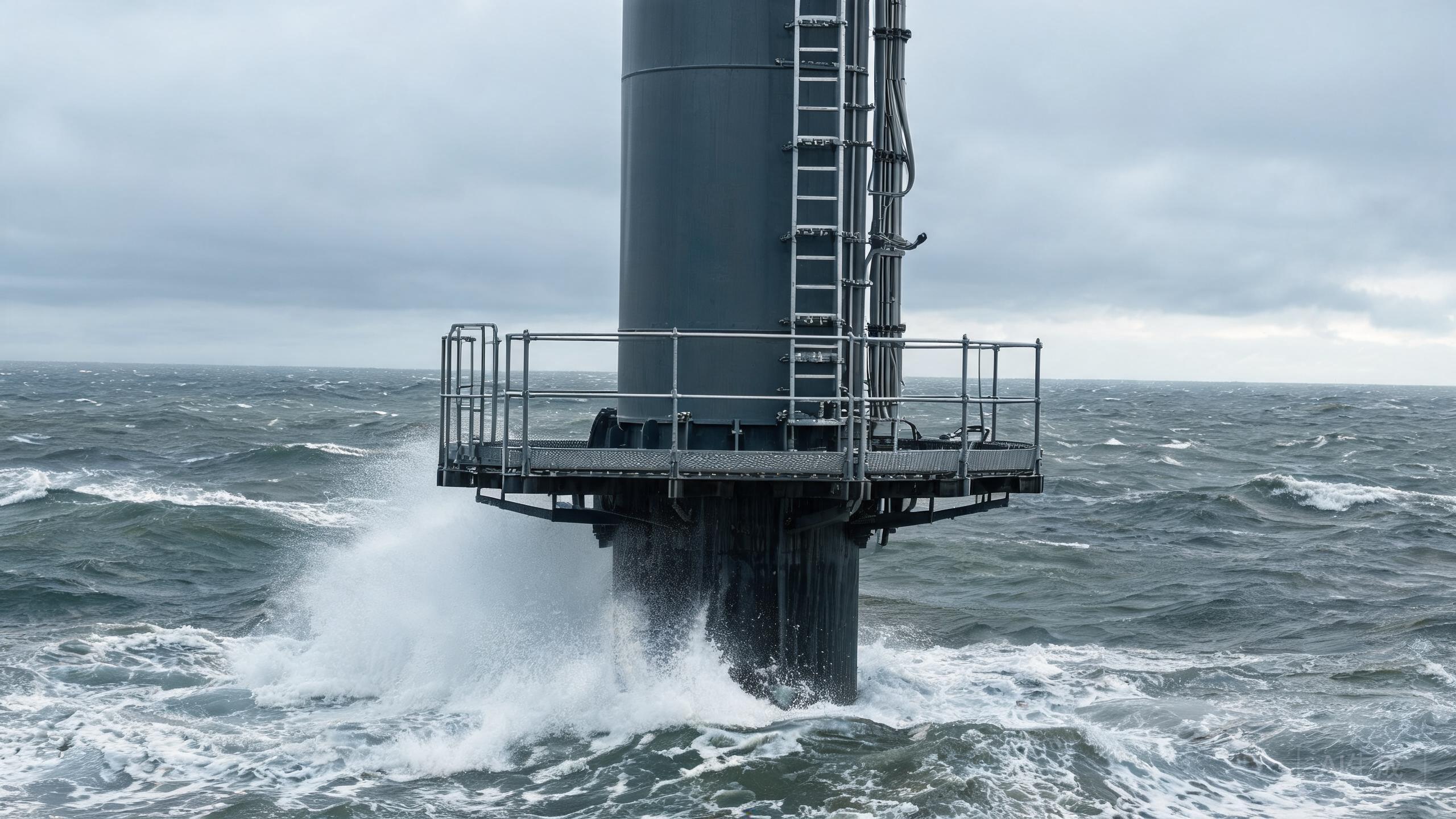
Onshore turbines use stainless for A4-70/A4-80 fasteners, cable trays, sensor housings and 316L hydraulic tubing — small tonnage, high consequence. Offshore, the splash zone is the dividing line: above it, 316L and galvanised carbon steel with a maintained coating system; inside it, 2205 or 2507 plate, because repainting is not an option and 316L crevices under bolted clamps are where failures start. For the metallurgy behind those choices, see duplex 2205 vs 2507 and lean duplex and grade selection for marine exposure.
What Buyers Should Evaluate
- ISO 9223 category and chloride deposition. C3 inland is 304L territory; C4 coastal applies to most onshore wind and coastal PV; C5 splash or heavy de-icing salt requires duplex. Ask for the site’s chloride deposition rate in mg/m²/day, not just “near the sea”.
- PREN floor. PREN = Cr + 3.3 Mo + 16 N. Set a minimum: 18-19 for 304, 24-26 for 316L, 34-36 for 2205. A 316L heat with 1.7% Mo lands near 21 and should be rejected even though the certificate says 316L.
- Edge and weld condition. This is the real differentiator between two suppliers quoting the same grade. Specify deburred edges, back-purged tube welds, and pickling/passivation per ASTM A967. Unpassivated laser kerf is the single most common origin of rust on new racking.
- Galvanic design. Stainless-aluminium couples need isolating washers and sleeves. At the coast, avoid stainless fasteners in aluminium rails unless the joint is sealed and the aluminium is coated.
- Fastener grade and hardness. A4-70 (316 cold-worked) is standard; A4-80 raises strength but also SCC risk in chloride service. Offshore high-strength joints are better served by duplex fasteners or coated carbon steel with controlled torque than by over-hardened austenitic bolts.
- Fatigue details, not just corrosion. Wind brackets vibrate for 25 years. Sharp weld toes, unsealed tube ends and abrupt section changes crack before they corrode. Specify weld toe grinding or a smooth transition on dynamic brackets.
Five Problems That Show Up in the Field
1. Cut-edge pitting on laser-cut and sheared parts. Laser cutting leaves a recast layer with depleted chromium and a rough profile that traps chloride. Because the edge never had a passive film, pitting starts there first — often within one wet season at C4/C5 sites. Fix: deburr to ≤0.1 mm, pickle and passivate finished assemblies per ASTM A967, and specify edge quality on the drawing rather than on the purchase order note.
2. Weld heat tint inside hollow sections. Tracker torque tubes and platform railings are welded on the outside and often left un-purged inside. The internal heat tint cannot be reached by pickling paste, so it becomes a permanent corrosion site. Fix: back-purge with argon, use a low-carbon grade, and require a borescope photo of internal welds for offshore work.
3. Galvanic corrosion at stainless-aluminium joints. Stainless is the cathode, aluminium the anode. Sea spray or wash water sitting in the clamp gap dissolves the aluminium rail around the fastener, and the joint loosens before any rust is visible. Fix: isolating washers and sleeves, sealed joints, and a small stainless-to-aluminium area ratio.
4. Crevice corrosion under clamps, pads and gaskets. A rubber pad under a stainless clamp creates a stagnant chloride crevice that survives every rainstorm. 304 fails within 2-3 years, 316L within 5-8, and 2205 typically survives the design life. Fix: drain the detail, seal the crevice fully or leave it fully open, and use duplex where the crevice is unavoidable.
5. Galling and chloride SCC at fasteners. A4-70/A4-80 bolts gall during installation when torque is applied dry, and cold-worked austenitic bolts under sustained offshore load can crack in chloride service. Fix: anti-seize or a lubricated torque specification, matched nut grade, and duplex or coated fasteners for high-strength splash-zone joints.
Common Purchasing Mistakes
Mistake: Ordering “stainless” and letting the mill choose the grade. A Chinese trader quoting “stainless steel for solar bracket” will often supply 201 (UNS S20100) because it is 30-40% cheaper and still non-magnetic-looking under a quick check. 201 pits through outdoors in 3-5 years. Fix: specify ASTM A240 / UNS S30403 or S31603, and put the UNS number on the drawing.
Mistake: Accepting nickel and molybdenum shortfalls. Some Shandong and Ningbo mills ship 304L at 6.5-7.5% Ni (specification 8.0-10.5%) and 316L at 1.6-1.9% Mo (specification 2.0-3.0%). Appearance, hardness and even a basic certificate can look normal; PREN falls by 4-6 points and coastal life halves. Solution: PMI spectroscopy on every heat plus EN 10204 3.1 certificates showing actual analysis. For 2205, add ASTM G48 Method A — a genuine 2205 should show no pitting at 35°C in 6% FeCl₃ within 24 h.
Mistake: Using 316L in the splash zone to avoid duplex lead time. 316L is easier to buy, but splash-zone brackets are exactly where crevice corrosion and chloride SCC converge. A 2205 plate order with 4-6 weeks lead time is cheaper than a crane campaign at year 8. Fix: fix the grade by exposure class at the design stage, then buy to that grade.
Mistake: Buying mill finish and trusting the fabricator. “2B, pickled” on the mill certificate says nothing about the laser-cut edge or the weld your fabricator just made. Fix: require a passivation certificate per ASTM A967 for finished parts, and inspect weld toes and cut edges — not the face of the sheet.
Mistake: Mixing fastener systems. Zinc-plated bolts in a 316L assembly rust at the head within a year and stain the structure; 304 bolts in a 2205 splash-zone bracket become the anode. Fix: one grade family per joint, isolating washers at aluminium interfaces, and a written torque specification.
Recommended RFQ Wording
Grade: ASTM A240 / UNS [S30403 / S31603 / S32205 / S32750]
Application: [solar tracker torque tube / coastal clamp / offshore splash-zone bracket / wind fastener]
Site exposure: ISO 9223 [C3 / C4 / C5]; chloride deposition [mg/m2/day]; distance to coast [km]
Form: [cold-rolled coil / sheet / welded tube / plate / round bar]
Size: [OD x wall] or [thickness x width x length], tolerance [±mm]
Surface: [2B / No.4 / pickled and passivated per ASTM A967]
Edge: [slit / laser-cut / deburred], burr height ≤0.1 mm
Fabrication: welds back-purged with argon; internal welds free of heat tint
Fasteners: [A4-70 / A4-80 / 2205], isolating washers at aluminium interfaces
Quantity: [metric tons / pieces]
Certification required:
  - EN 10204 3.1 mill test certificate with actual Cr, Ni, Mo, N
  - PMI spectroscopy report for every heat
  - ASTM G48 Method A (6% FeCl3, 35°C, 24 h) for 2205 / 2507 / coastal 316L
  - ASTM B117 salt spray report: 500 h (304L), 2,000 h (316L)
  - Passivation certificate per ASTM A967 for finished assemblies
Delivery: [date, incoterm, port]
FAQ
Is 316L good enough for offshore wind splash-zone components?
316L is not the right choice for splash-zone ladders, platforms or bolted brackets. Continuous salt spray plus sustained stress makes 316L prone to crevice corrosion under clamps and chloride stress-corrosion cracking at weld toes. Duplex 2205 (UNS S32205) is the practical minimum for splash-zone plate at 3-6 mm, and 2507 (UNS S32750) is used where higher strength or tighter crevices demand it. Reserve 316L for tubing, sensor housings and hardware above the splash zone.
Why does stainless steel rust at the cut edges of solar racking?
Laser cutting and shearing leave a thin recast layer with lower chromium and a rougher profile that holds chloride and moisture. The edge never had a passive film to begin with, so pitting starts there first, often within one wet season at coastal sites. Pickle and passivate finished parts per ASTM A967, specify a deburred edge, and avoid burrs above 0.1 mm on clamp and rail interfaces.
Can stainless steel bolts be used with aluminium solar rails?
Yes, but only with galvanic isolation. Stainless is the cathode and aluminium becomes the anode, so the rail corrodes around the fastener, especially when sea spray or washing water sits in the joint. Use isolating washers and sleeves, keep the stainless-to-aluminium area ratio small, and avoid bare stainless washers in direct contact with mill-finish aluminium.
What thickness is typical for stainless solar and wind structures?
Solar tracker torque tubes normally run 2.0-3.0 mm wall; coastal racking plates and clamps 2.0-4.0 mm. Offshore wind splash-zone plate is 3-6 mm, with ladders and platform grating sized by structural load rather than corrosion allowance. Thickness is set by wind load and fatigue, not by a corrosion allowance — stainless does not corrode uniformly, it pits locally.
CTA
Send the exposure class, part drawing and annual tonnage and we will confirm grade, thickness and test package before the fabrication is quoted. Contact vip@still-steel.com, use the contact form, or message us on WhatsApp. Still Steel supplies 304L, 316L, 2304, 2205 and 2507 sheet, coil, plate and tube per ASTM A240 / EN 10088-2, with EN 10204 3.1 certificates, PMI verification and ASTM G48 testing on request.
Technical References
- ASTM A240M - Standard Specification for Chromium and Chromium-Nickel Stainless Steel Plate, Sheet and Strip
- EN 10088-2 - Stainless steels. Technical delivery conditions for sheet/plate and strip
- ASTM A967 - Standard Specification for Chemical Passivation Treatments for Stainless Steel Parts
- ASTM G48 - Standard Test Methods for Pitting and Crevice Corrosion Resistance of Stainless Steels by Use of Ferric Chloride Solution
- ISO 9223 - Corrosion of metals and alloys: Corrosivity of atmospheres, classification, determination and estimation
- IEC 61400-3-1 - Wind energy generation systems, Part 3-1: Design requirements for fixed offshore wind turbines