
Short answer:
New energy stainless steel is specified in 5 applications: solar trackers and coastal racking, wind-turbine fasteners and offshore splash-zone hardware, battery and energy-storage housings, electrolyzer and fuel-cell components, and EV charger enclosures. The grade decision is driven by chloride exposure and by the form the part takes — not by how green the project is. 304/304L covers inland, low-chloride work; 316L is the default within roughly 10 km of a coast; 2205 or 2507 is used where chlorides, heat and stress meet. The 5 applications below fail for the same short list of reasons: unpassivated cut edges, aluminium-to-stainless galvanic couples, weld heat tint on thin sheet, crevices under clamps, and mills that ship 201 as 304.
Quick Comparison
| Application | Typical stainless parts | Default grade | Form / thickness | Dominant risk | Design life |
|---|---|---|---|---|---|
| Solar PV | Tracker torque tubes, clamps, coastal racking | 304L inland / 316L coastal | Tube 2.0-3.0 mm wall; sheet 1.5-2.0 mm | Weld tint and cut-edge pitting | 25 years |
| Wind power | A4-70/A4-80 fasteners, cable tray, sensor housings, splash-zone ladders | 316L / 2205 offshore | Bar M8-M36; plate 3-6 mm | Crevice corrosion, chloride SCC | 20-25 years |
| Battery & storage | Module cans, busbars, racking, fire barriers | 304 / 316L | Cold-rolled strip 0.2-0.5 mm | Weld sensitization, electrolyte attack | 10-15 years |
| Green hydrogen | Electrolyzer cell frames, gas-water separators, storage vessels, bipolar plates | 316L / 2205 / 904L | Plate 1.0-10 mm | Hot KOH at 80°C, hydrogen | 20 years |
| EV charging | Enclosures, pedestals, cable brackets | 304L / 316L | Sheet 1.5-3.0 mm | Road salt, cosmetic corrosion | 15 years |
Indicative only — final grade must follow the site’s ISO 9223 corrosivity category and the part’s stress state.
The 5 Applications, and What Each One Demands
1. Solar PV — trackers, racking and clamps
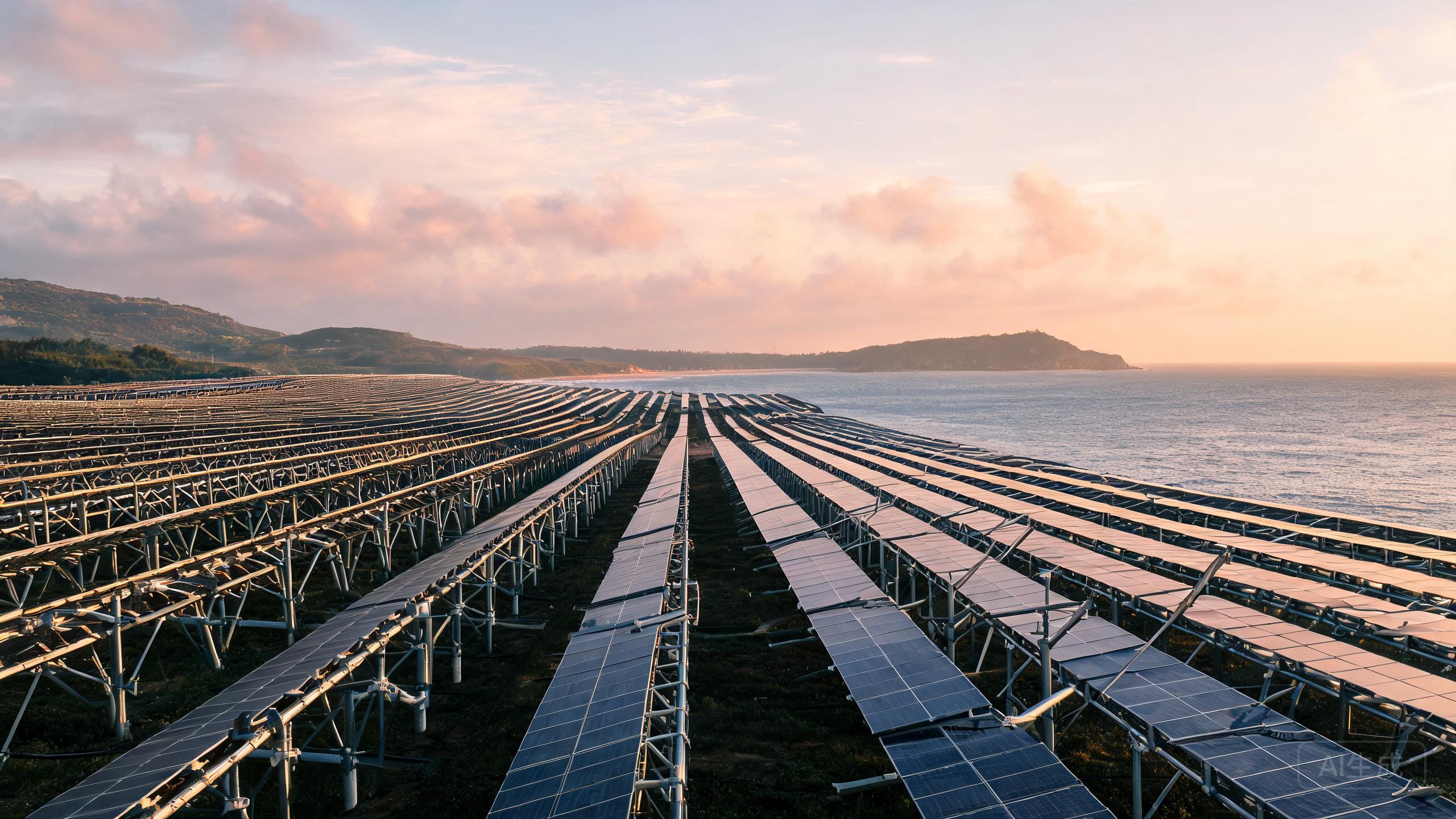
Most module frames are aluminium, so stainless enters at the torque tube, bearing housing, clamp and foundation interface. Inland utility-scale farms normally use 304 or 304L tube with a 2.0-3.0 mm wall; coastal sites move to 316L and, in the splash-zone or on highly loaded dampers, 2205. The recurring failure is not the panel but the joint: laser-cut clamp edges and un-purged tube welds lose their chromium oxide film and start pitting in the first wet season. Specify pickled and passivated finished assemblies per ASTM A967, not just mill 2B sheet.
2. Wind power — fasteners, trays and splash-zone steel
Onshore turbines use stainless mainly for A4-70/A4-80 fasteners, cable trays, sensor housings and hydraulic tubing in 316L. Offshore, the exposure jumps: ladders, platforms, bolted brackets and cable guards in the splash zone need 2205 or 2507 plate at 3-6 mm, because 316L suffers crevice corrosion and chloride stress-corrosion cracking under sustained load and salt spray. IEC 61400-3-1 design rules assume a 25-year life; a bracket that needs replacement at year 8 is a crane campaign, not a maintenance item.
3. Battery and energy storage — thin strip, clean welds
Module cans, busbars and rack trays use cold-rolled strip from 0.2 mm to 0.5 mm. The material problem is weld-related: 304 with 0.05-0.08% carbon sensitizes in the heat-affected zone, and residual heat tint becomes a corrosion site when electrolyte leaks or condensation appears. Use 304L/316L with C ≤0.03%, laser-weld under argon, and passivate the seam. Thickness tolerance matters as much as grade — ±0.01 mm on 0.3 mm strip keeps the weld overlap consistent.
4. Green hydrogen — caustic, hydrogen and pressure
Alkaline electrolyzers run 25-30% KOH at 70-90°C, which rules out 304 for wetted parts. 316L handles cathode frames and gas-water separators; 2205 is common for cell frames and piping where chloride ingress from cooling water is possible; 904L or 254 SMO appears in aggressive FEED and CCUS-adjacent duty. Bipolar plates in PEM stacks need low interfacial contact resistance, so 316L or 441 is usually coated rather than used bare. For the electrolyzer-side detail, see stainless for alkaline water electrolyzers and fuel-cell bipolar plate grades. High-strength cold-worked fasteners in hydrogen service deserve a separate review — austenitic grades are far less susceptible than martensitic 410/420, but hardness still has to be capped.
5. EV charging — an outdoor enclosure problem
Charger housings are 1.5-2.0 mm 304L sheet inland and 2.0-3.0 mm 316L within about 10 km of the coast. The failure mode is cosmetic and fast: brown rust streaks at laser-cut vents and weld spots, fingerprint staining on 8K mirror, and galvanic attack where zinc-plated brackets touch the shell. Match all brackets, bolts and rivets to the housing grade, and avoid 1.0 mm sheet — it dents, and the crease becomes a corrosion notch.
What Buyers Should Evaluate
- Chloride exposure, not geography alone. Classify the site per ISO 9223. C3 inland, C4 coastal/industrial, C5 splash or heavy de-icing salt. 304 stops being economical at C4; 316L is the floor; 2205 starts at C5 with mechanical load.
- PREN. PREN = Cr + 3.3 Mo + 16 N. Typical values: 304 about 18-19, 316L about 24-26, 2304 about 24-25, 2205 about 34-36, 2507 about 42-43. A “316L” coil with 1.7% Mo instead of 2.0-3.0% drops to PREN 21 and behaves like 304.
- Form, thickness and tolerance. Thin strip (0.2-0.5 mm) needs ±0.01 mm or tighter; structural tube needs wall tolerance per EN 10088-2 or ASTM A480. Check whether the mill can supply the width you actually slit, not just the parent coil width.
- Weldability and post-weld treatment. Carbon ≤0.03% for L-grades; nitrogen 0.14-0.20% for 2205; back-purge gas and pickling/passivation per ASTM A380/A967 for any visible weld. Ask whether the fabricator passivates, because most new-energy corrosion complaints originate after fabrication, not at the mill.
- Galvanic compatibility. Stainless-to-aluminium couples are common on PV and charger assemblies. Use isolating washers, avoid small stainless screws in large aluminium plates, and never mix zinc-plated bolts into a 316L structure.
- Verification. EN 10204 3.1 with actual element values, PMI on every heat, ASTM G48 Method A (6% FeCl₃, 24 h) for duplex, and ASTM B117 hours if the buyer’s specification calls for it.
Common Purchasing Mistakes
Mistake: Writing “stainless steel” without a UNS number. We have seen RFQs for “new energy stainless steel bracket, 2 mm” that were quoted and filled with 201 (UNS S20100). It is 30-40% cheaper, magnetic, and pits through outdoors in 3-5 years. Fix: write “ASTM A240 / UNS S30403, cold-rolled sheet, 2.0 mm” — grade plus standard plus form.
Mistake: Accepting a mill’s “new energy grade” as a specification. There is no such grade in ASTM A240 or EN 10088-2. Some Chinese traders use the phrase to move 304 with 6.5-7.5% Ni (specification is 8.0-10.5%) or 316L with 1.6-1.9% Mo (specification is 2.0-3.0%). Appearance and hardness are unchanged; pitting resistance is not. Solution: PMI spectroscopy on every coil — Ni ≥8.0% and Cr ≥18.0% for 304L, Mo ≥2.0% for 316L — plus EN 10204 3.1 certificates showing actual analysis. For coastal or duplex supply, add ASTM G48 Method A on a sample from each heat.
Mistake: Buying mill finish and assuming the fabricator will handle passivation. Laser cutting leaves a nitrogen-contaminated edge; welding leaves heat tint. Both are chromium-depleted and pit first. Fix: put “pickled and passivated per ASTM A967, free of heat tint” in the purchase order, and inspect edges, not just faces.
Mistake: Using the housing grade for the hardware, or the reverse. A 316L enclosure with zinc-plated bolts rusts at the bolt heads within a year; a 304 bolt in a 2205 offshore bracket becomes the anode. Fix: one grade family per assembly, with isolating washers where aluminium is involved.
Mistake: Saving 15% with 1.0 mm sheet. Charger and inverter enclosures in 1.0 mm flex, dent and crease. The crease is a crevice, and the crevice is where corrosion starts. Minimum 1.5 mm for wall-mounted units, 2.0 mm for pedestals and coastal work.
Recommended RFQ Wording
Grade: ASTM A240 / UNS S30403 (304L)  OR  UNS S31603 (316L)  OR  UNS S32205 (2205)
Application: [solar tracker clamp / wind fastener / ESS module can / electrolyzer frame / EV charger enclosure]
Site corrosivity: ISO 9223 category [C3 / C4 / C5]; distance to coast [km]
Form: [cold-rolled coil / sheet / tube / plate / round bar]
Thickness: [mm] with tolerance [±mm]
Width x length: [mm]
Surface: [2B / No.4 / pickled and passivated per ASTM A967]
Edge condition: [slit / laser-cut / sheared], burr height ≤[mm]
Fasteners: same grade family as the structure; isolating washers at aluminium interfaces
Quantity: [metric tons / pieces]
Certification required:
  - EN 10204 3.1 mill test certificate with actual Ni, Cr, Mo, N
  - PMI spectroscopy report for every heat
  - ASTM G48 Method A (6% FeCl3, 35°C, 24 h) for 2205 / coastal 316L
  - ASTM B117 salt spray: 500 h (304L) / 2,000 h (316L), report rust area
  - Passivation certificate per ASTM A967 for finished parts
Delivery: [date, incoterm, port]
FAQ
Which stainless steel grade is standard for new energy projects?
304 or 304L (UNS S30400 / S30403) is the default for inland, low-chloride applications such as tracker hardware, cable trays and indoor battery racks. 316L (UNS S31603) is the practical minimum within about 10 km of a coastline or where de-icing salt and industrial chloride deposition are present. 2205 (UNS S32205) is specified for offshore splash zones, coastal structural brackets and hot caustic service in electrolyzers. Grade follows chloride exposure and part geometry, not the project label.
Is 304 stainless steel enough for coastal solar or wind sites?
Usually not. At chloride deposition rates above roughly 50 mg/m²/day, 304 develops pitting and tea-staining on cut edges and weld heat tint within 2-5 years. Use 316L for coastal racking, clamps and fasteners, and 2205 for splash-zone or highly stressed brackets. Confirm the site’s ISO 9223 corrosivity category (C4 or C5) before fixing the grade.
Why does stainless steel rust on new energy equipment within a year?
Three causes dominate: unpassivated laser-cut or welded edges where chromium was burned away, weld heat tint left on thin sheet without pickling, and mills shipping 201 or low-nickel 304 as “304”. Any of them produces brown rust in coastal or road-salt service within 6-18 months even though the base metal is genuine stainless. Verify with PMI spectroscopy and require EN 10204 3.1 certificates listing Ni, Cr and Mo.
What certification should I require for new energy stainless steel?
Require an EN 10204 3.1 mill test certificate with actual chemical analysis, PMI spectroscopy on every coil or plate, and ASTM G48 Method A pitting testing for duplex or coastal 316L. For outdoor enclosures and structures, add ASTM B117 salt spray data — 500 hours for 304L and 2,000 hours for 316L — and a statement of the delivery condition (2B, No.4, pickled and passivated).
CTA
Tell us the application, site corrosivity and annual tonnage and we will confirm the grade, form and test package before you quote the fabrication. Write to vip@still-steel.com, send the RFQ through our contact form, or discuss it on WhatsApp. Still Steel supplies 304/304L, 316L, 2205 and 2507 sheet, strip, plate and tube per ASTM A240 / EN 10088-2 with EN 10204 3.1 documentation and PMI verification on every heat.
Technical References
- ASTM A240M - Standard Specification for Chromium and Chromium-Nickel Stainless Steel Plate, Sheet and Strip
- EN 10088-2 - Stainless steels. Technical delivery conditions for sheet/plate and strip
- ASTM A967 - Standard Specification for Chemical Passivation Treatments for Stainless Steel Parts
- ASTM G48 - Standard Test Methods for Pitting and Crevice Corrosion Resistance of Stainless Steels by Use of Ferric Chloride Solution
- ISO 9223 - Corrosion of metals and alloys: Corrosivity of atmospheres, classification, determination and estimation
- IEC 61400-3-1 - Wind energy generation systems, Part 3-1: Design requirements for fixed offshore wind turbines