
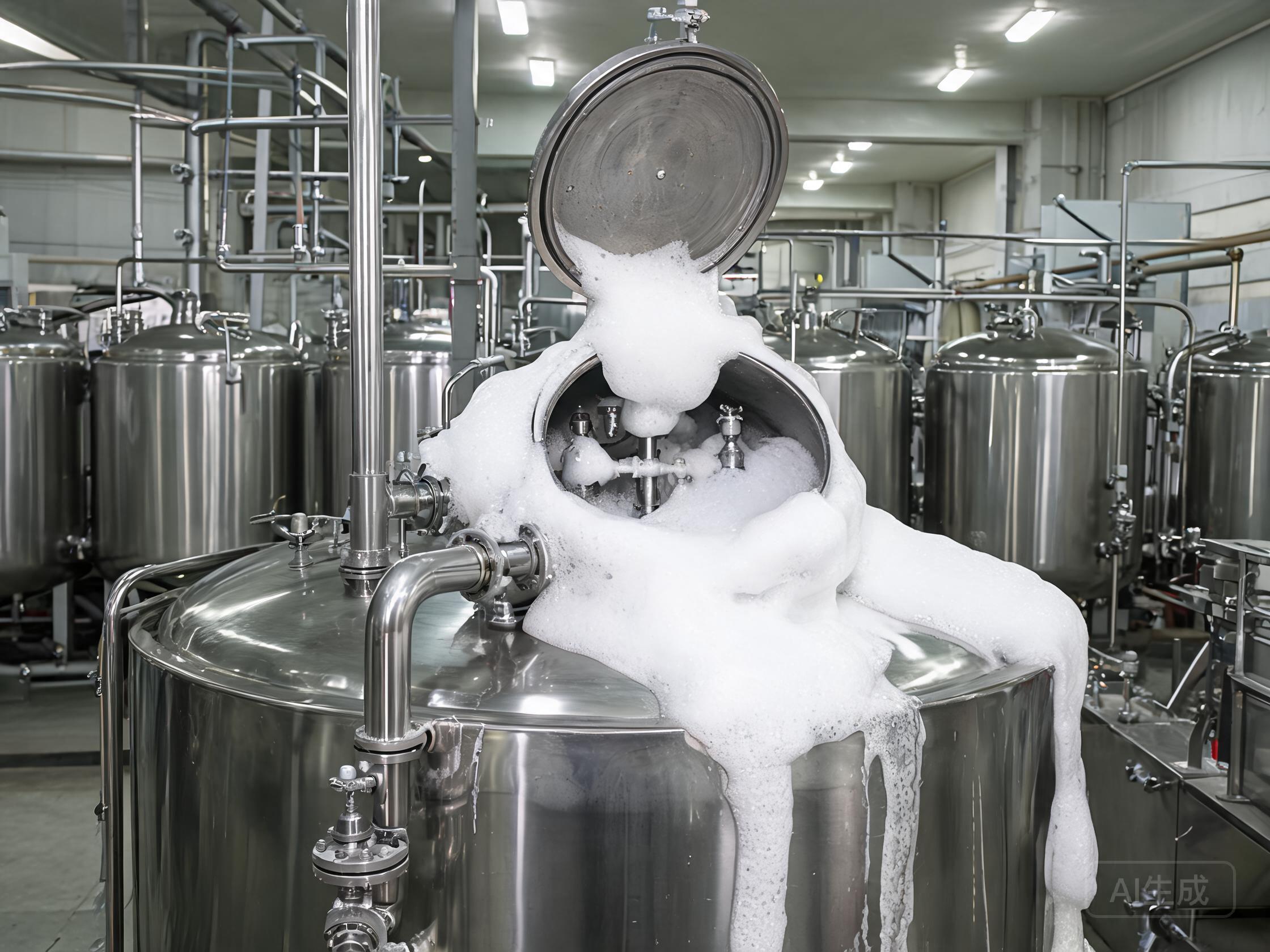
Short answer: CIP foaming is not a detergent problem. It is a surface finish and grade problem. Foam clings to No.4 brushed finishes and rough welds because they trap air bubbles. Use 316L polished to Ra ≤0.8 μm, slope your tank bottoms at 1.5°, and keep free chlorine below 25 ppm if you insist on 304. When the foam will not drain, your microbiologist will find Listeria where the bubbles stay.
Food processing plants run a CIP (Clean-in-Place) cycle every four hours on tanks, piping, heat exchangers and fillers. The standard mix is 2% NaOH (caustic soda) at 60°C, followed by an acid rinse and sanitizer. When the system foams, the foam traps product residue against the cold rolled stainless steel wall. After the CIP cycle supposedly ends, bacteria grows in the protein film under the foam you did not see. The FDA inspector finds it. Your recall letter goes out.
Quick Comparison
| Cleaning agent | 304 cold rolled | 316/316L cold rolled | 2205 duplex |
|---|---|---|---|
| Water + 2% NaOH, 60°C | Excellent | Excellent | Excellent |
| 0.5% HNO3, 50°C | Fair, pitting risk | Excellent | Excellent |
| NaOCl 50 ppm free Cl, 25°C | Poor, pitting | Good | Excellent |
| Peracetic acid 0.3% | Good | Excellent | Excellent |
The critical limit is free chlorine above 25 ppm. 304 stainless steel pits under chlorine even at low concentrations. 316L adds 2–3% molybdenum which stops the pitting. 2205 duplex doubles the molybdenum and chromium for the harshest brewery or dairy CIP cycles.
What Buyers Should Evaluate
- Match the grade to your worst CIP chemical. Do not average cycles. If you run one 50 ppm chlorine sanitizer a week, use 316L or 2205 everywhere that sees CIP.
- Surface finish is not cosmetic. Ra ≤0.8 μm (No.4 fine brushed) minimum. Ra ≤0.4 μm electropolished if you fill with baby formula or injectables. Rough finishes trap foam and hide bacteria.
- Weld inside the tank must be ground flush and polished. A 2 mm weld bead is a foam magnet and a microbiological hazard no FDA auditor accepts.
- Drain slope matters. Tank bottom at 1.5° minimum. Piping horizontal run at 0.5° per meter. If your tank has a flat bottom, the last 10% of CIP liquid sits and the foam does not drain.
Common Purchasing Mistakes
- Buying 304 because it is 15% cheaper, then running a 50 ppm chlorine sanitizer because your QA manager forgot you signed up for that cycle. Pitting shows up in six months. The fix is a full tank replacement, not a polish.
- Accepting a “No.4 finish” without a roughness measurement. One Chinese mill’s No.4 is Ra 1.6 μm. Another is Ra 0.4 μm. Specify the Ra number on the order and ask for the roughness report.
- Ordering sheet with a protective film but forgetting to specify adhesive residue-free. After the film comes off, the adhesive polymerizes into a film that no CIP cycle removes. You scratch it with a scouring pad and ruin the Ra value.
- Skipping EN 10204-3.1 and PMI. Chinese mills occasionally send 201 when you ordered 304 — the nickel content is 1–2% instead of 8%, and caustic CIP eats it through.
- Specifying thickness but not flatness. CIP tanks use cold rolled sheet that must form cleanly without springback. If the coil is wavy, the tank wall has crevices where foam hides.
Recommended RFQ Wording
Cold rolled stainless steel sheet for food contact CIP equipment, grade 316L (or 304 if CIP is 2% NaOH only), thickness 2.0 mm ±0.05 mm, width 1250 mm, surface No.4 brush polished Ra ≤0.8 μm, FDA 21 CFR food contact compliant, ASTM A240, EN 10204-3.1 test report with PMI analysis, surface roughness measurement report, adhesive-free protective film, quantity 15 tonnes, destination [your factory], delivery within 25 days.
State the exact CIP chemistry and the product being processed (milk, beer, juice, meat) so the supplier can confirm the grade before slitting. Put the Ra number, the film type and the certificate requirements on the purchase order, not just in email.
Frequently Asked Questions
Why does my CIP system keep foaming even though I use low-foam detergent?
Foam forms when a protein-rich solution (milk, whey, egg) is cleaned with caustic on a surface with poor drainability. A rough No.4 finish or weld bead trap bubbles. The fix is 316L with a polished surface (Ra <0.8 μm) and a sloped drain bottom.
Should I use 304 or 316 cold rolled stainless steel for CIP tanks and piping?
304 works for neutral CIP (water + 2% NaOH) up to 60°C. 316 or 316L is required if you add 0.5% HNO3 or any chlorine-based sanitizer (NaOCl, peracetic acid) above 25 ppm free chlorine. Match the grade to your worst-case cleaning cycle.
What surface finish is FDA-acceptable for food contact CIP equipment?
ASTM A240 specifies food contact surfaces must be free of crevices, pits and weld cracks. A polished Ra ≤0.4 μm (electropolished or mechanically polished No. 8) is standard for CIP tanks. EN 10204-3.1 and a surface roughness report should come with the sheet.
How Still Steel Supports the Project
Still Steel supplies cold rolled stainless steel sheet and strip in the right grade and thickness for your food processing CIP equipment with EN 10204-3.1 test reports. We provide slitting, cut-to-length, surface finishing and protective film application so you receive process-ready material. Send your specification and quantity to vip@still-steel.com, or discuss on WhatsApp.
Technical References
- ASTM A240 / A240M flat-rolled stainless steel for food contact and general applications
- EN 10088-2 cold rolled stainless steel sheet and strip
- ASME BPE bioprocessing equipment standard
- EHEDG European Hygienic Engineering & Design Group guidelines
- FDA 21 CFR Part 175.300 food contact surfaces
- 3-A Sanitary Standards for food processing equipment
Reference documents support general selection and fabrication principles. The final material decision must follow the applicable contract, standard, regulation and engineering review for the specific product.