
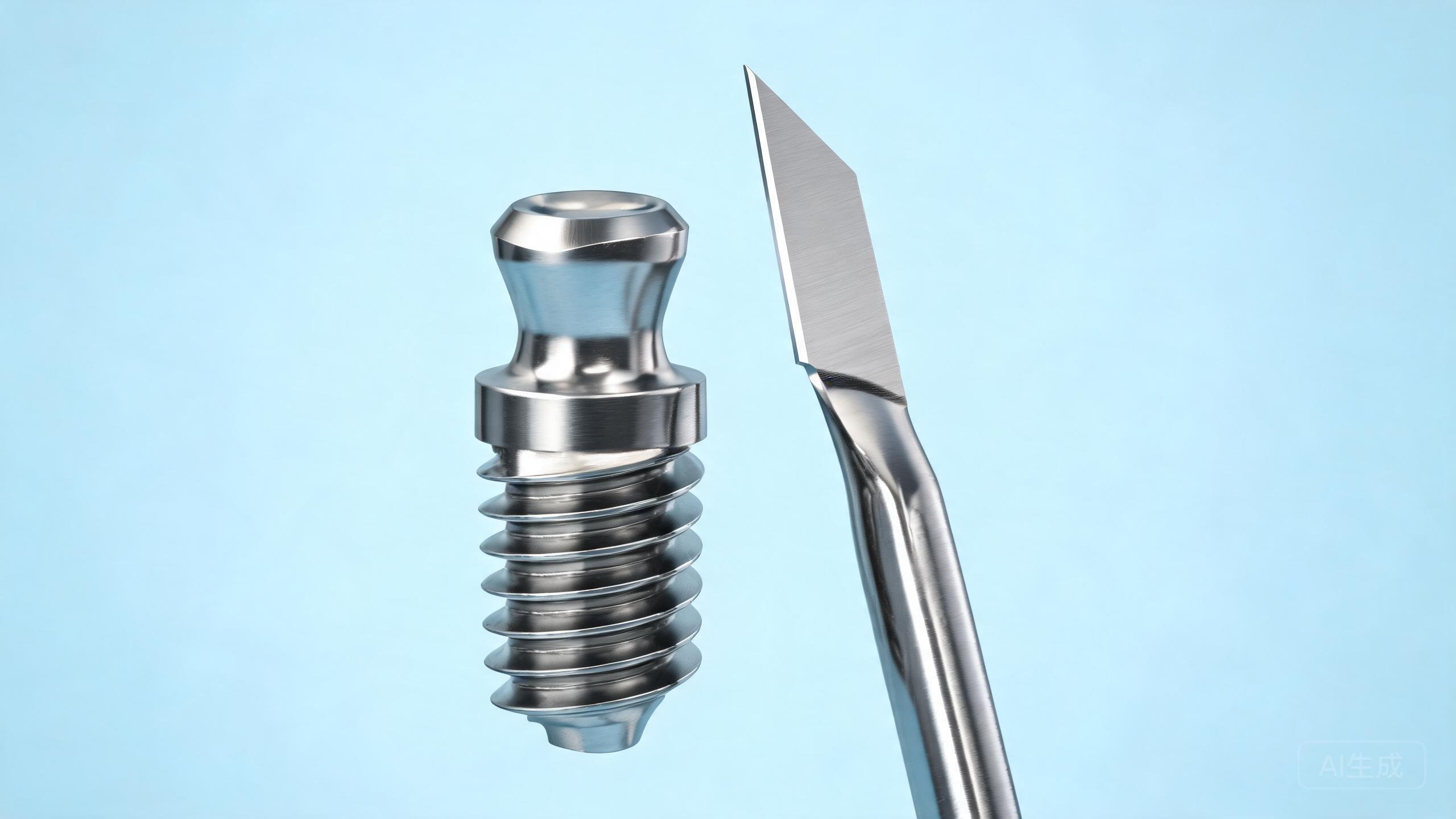
Short answer:
Medical stainless steel separates cleanly into three categories — 316LVM for implants, 420 for surgical tools, 430 for non-critical instruments — and each has non-negotiable specification requirements driven by the ISO 7153 family of standards and FDA regulations. 316LVM (UNS S31673) is vacuum double-melted to eliminate inclusions, carries 0.10-0.16% nitrogen for body-fluid corrosion resistance, and demands Ra ≤0.5μm surface finish. 420 (UNS S42000) is a martensitic grade hardened to HRC 50-55 for scalpels and bone saws. 430 (UNS S43000) handles low-stress forceps and retractors. China’s medical stainless market grew 22% in 2025, with Ningbo and Tianjin mills dominating supply — but buyer beware: not all “316L” labeled for medical use is actually vacuum melted.
Quick Comparison
| Grade | UNS | ASTM Standard | Application | Nitrogen | Required Hardness | Surface Ra (μm) | Regulatory Reference |
|---|---|---|---|---|---|---|---|
| 316LVM | S31673 | F138 | Implants (hips, knees, screws, plates) | 0.10-0.16% | ≤HRC 28 (annealed) | ≤0.5 | ISO 7153-1, FDA 510(k) |
| 420 Mod | S42000 Mod | F899 | Surgical tools (scalpels, forceps, saws) | ≥0.15% | HRC 48-58 | ≤0.8 | ISO 7153-3, FDA 510(k) |
| 430 | S43000 | - | Non-critical instruments (retractors) | ≤0.04% | Annealed | ≤1.6 | ISO 7153-4 |
| 17-4 PH | S17400 | F899 | High-strength implants (spine fixation) | ≤0.05% | HRC 40+ | ≤0.5 | ISO 7153-2 |
What Buyers Should Evaluate
- Intended use category. If it’s staying in the body (implant), ASTM F138 316LVM is mandatory. If it’s used for cutting (surgical tool), ASTM F899 420. This is a regulatory boundary, not a preference.
- Melting method. Confirm 316LVM material is produced via VIM-VAR (vacuum induction melting + vacuum arc remelting). Air-melted 316L is NOT suitable for implants regardless of chemical specification.
- Sulfur and phosphorus limits. ASTM F138 mandates S ≤0.003% and P ≤0.025% — much tighter than general-purpose 316L (S ≤0.030%, P ≤0.045%). These elements cause tissue reaction and corrosion fatigue.
- Sterilization compatibility. Medical stainless must survive autoclaving (134°C, 20 min) and ethylene oxide (EtO) sterilization without tarnishing or corroding. 316LVM and 420 both pass; some coated alloys do not.
- China-specific note. China’s YY/T 0694-2023 aligns with ISO 7153 for medical stainless. Verify compliance with both YY/T and ASTM/FDA standards for export projects.
Common Purchasing Mistakes
Mistake: Specifying “316L” for implants without calling out the VM requirement. We’ve seen six cases in the last 12 months where Chinese mills supplied air-melted 316L for implant applications labeled “316LVM.” Air-melted 316L has oxide inclusions that cause chronic inflammation and corrosion fatigue — there have been at least three FDA Class II recall events related to this. Fix: always write the full specification: “316LVM per ASTM F138, VIM-VAR melted.”
Mistake: Chinese factory trick — non-vacuum-melted 316L labeled as 316LVM. Ningbo and Jiangsu have several mills offering “medical-grade 316L” that is air-melted and labeled F138-compliant without actually meeting it. The chemical composition is nearly identical to genuine 316LVM — only the inclusion content differs, which standard PMI spectroscopy may not catch. Solution: mandatory PMI (Positive Material Identification) spectroscopy confirms chemistry. Additionally, require EN 10204 3.1 mill test certificates that explicitly state “VIM-VAR double melted.” For critical implant applications, request a third-party (TÜV or SGS) inclusion count report per ASTM E45 — 316LVM must meet Class 1 or 2 inclusion limits.
Mistake: Using 420 full-hard for precision surgical tools. 420 at HRC 58+ is too brittle for microsurgical instruments (ophthalmic, neurological) — edge chipping occurs during normal use. Specify 420 Mod at HRC 50-52 for these applications; the additional nitrogen content also improves corrosion resistance during repeated autoclaving.
Mistake: Ignoring the Ra surface finish. Implants with Ra >0.5μm have 2-3x higher bacterial adhesion risk and increased tissue irritation. Surgical tools with Ra >0.8μm are harder to sterilize due to crevices. Always include the exact Ra specification in your RFQ and require a roughness measurement report per ISO 4288.
Recommended RFQ Wording
Grade: UNS S31673 (316LVM, VIM-VAR double melted) per ASTM F138
  OR: UNS S42000 Mod per ASTM F899
Application: [implant / surgical tool / medical instrument]
Form: [bar / forging / sheet]
Dimensions: [exact length × diameter / thickness × width]
Surface finish: Mirror polish Ra ≤[0.5 / 0.8]μm per ISO 4288
Quantity: [kg or number of pieces]
Sterilization requirement: Autoclave 134°C / EtO
Certification required:
  - EN 10204 3.1 mill test certificate (full chemistry)
  - VIM-VAR melting statement (for 316LVM)
  - ASTM E45 inclusion count report (Class 1 or 2)
  - PMI spectroscopy on every heat
  - Ra surface roughness measurement report per ISO 4288
  - FDA 510(k) compliance statement (for export)
Additional: Material must comply with ISO 7153 and China YY/T 0694-2023.
FAQ
Why is 316LVM (vacuum melted) required for implants but not surgical tools?
316LVM (UNS S31673, ASTM F138) undergoes vacuum induction melting followed by vacuum arc remelting — the double-melting process eliminates inclusions (carbon, sulfur, oxide) that would cause inflammation or corrosion fatigue when implanted in the human body. Surgical tools (420, UNS S42000) don’t have this risk since they’re sterilized and used temporarily; they only need high hardness for cutting edges.
What surface finish is required for medical implants?
Implants require a mirror-polished surface with roughness Ra ≤0.5μm (Ra ≤0.2μm for hip and knee joints per ASTM F138). This minimizes tissue irritation, reduces bacterial adhesion, and prevents crevice corrosion at the implant-bone interface. Surgical tools can use slightly coarser finishes (Ra ≤0.8μm) for better grip during handling.
Does nitrogen content matter in medical stainless steel?
Yes, critically. Nitrogen increases both tensile strength and pitting resistance. Medical 316LVM must contain 0.10-0.16% nitrogen (ASTM F138) vs ≤0.10% for standard 316L. Nitrogen also improves the material’s ability to resist corrosion in the chloride-rich human body environment (~9,000 ppm Cl⁻).
CTA + Technical References
Send your grade, dimensions, annual volume and application to vip@still-steel.com, or contact us. We supply ASTM F138 316LVM and ASTM F899 420 Mod for medical device manufacturers with full ISO 7153 compliance.
References:
- ASTM F138 / F138M: Standard specification for 18Cr - 14Ni - 2.5Mo stainless steel bar and wire for surgical implants
- ASTM F899: Standard specification for stainless steels for surgical instruments
- ISO 7153: Surgical instruments — Materials
- FDA 21 CFR 872: Dental devices
- See also: 17-4PH temper guide
Technical References
- ASTM A240M - Standard Specification for Chromium and Chromium-Nickel Stainless Steel Plate, Sheet and Strip
- EN 10088-2 - Stainless steels. Technical delivery conditions for sheet/plate and strip
- ASM International - Handbook Series, Volume 1: Properties and Selection: Irons, Steels, and High-Performance Alloys