
Short answer:
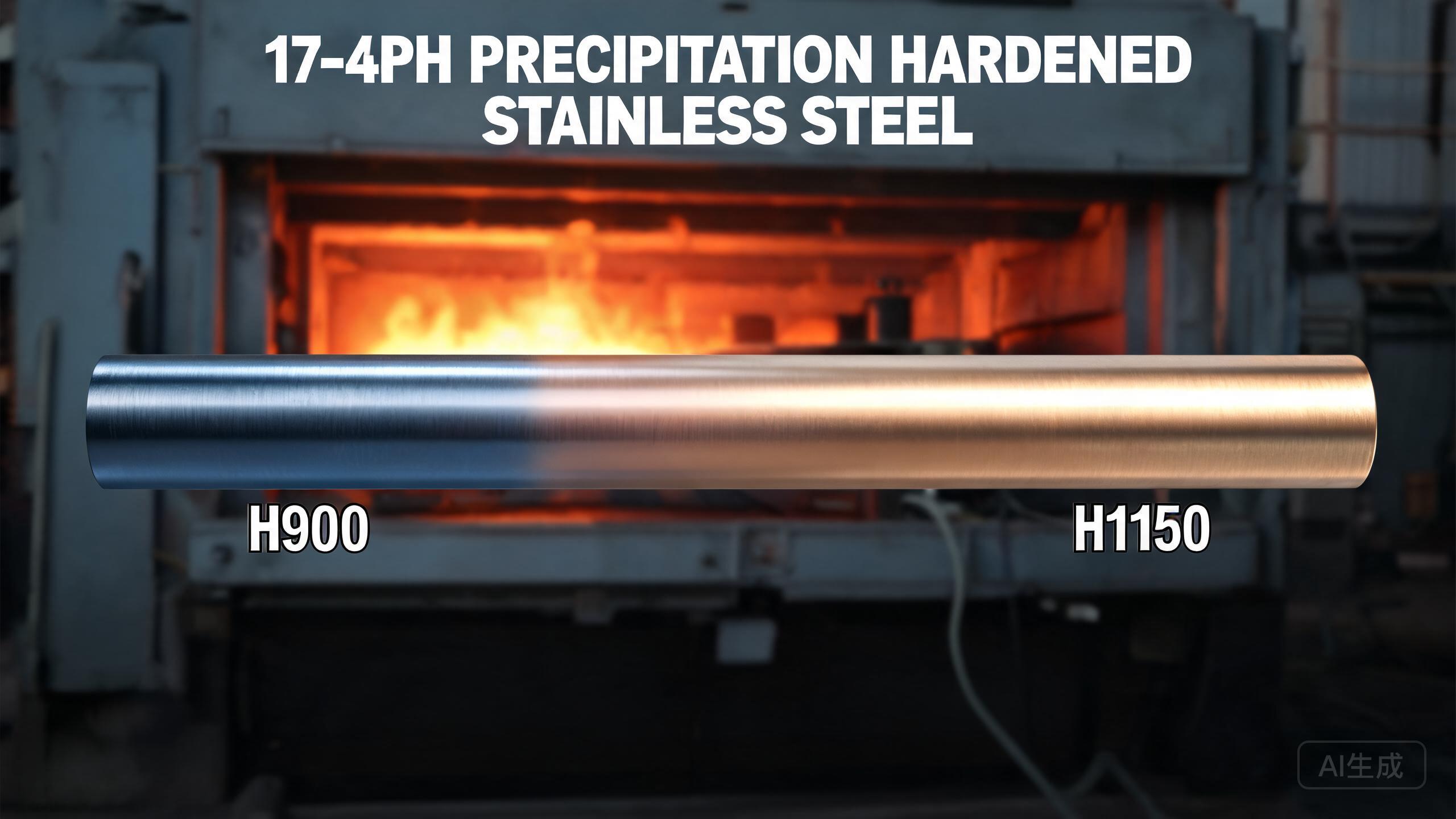
17-4PH (UNS S17400, also known as Stainless 630) is the workhorse precipitation hardening stainless steel for aerospace, defense, and industrial high-strength applications. Unlike austenitic grades that harden only via cold work, 17-4PH achieves its remarkable strength through copper-rich precipitation during aging — and the temper temperature you choose dictates a 2x swing in hardness (HRC 32 to HRC 44+) with corresponding tradeoffs in toughness, corrosion resistance, and fabricability. H900 is your pick for ultimate strength (surgical instruments, bearing components). H1025 balances strength and toughness (most aerospace components). H1100/H1150 improve toughness and corrosion resistance at the cost of hardness (welded assemblies, marine hardware).
Quick Comparison
| Temper | Temp (°C) | Temp (°F) | Time | Hardness (HRC) | Tensile (MPa) | Yield (MPa) | Charpy V (J) | Corrosion Resistance | Typical Uses |
|---|---|---|---|---|---|---|---|---|---|
| H900 | 482 | 900 | 1h air | 44 | ≥1310 | ≥1170 | ~20 | Standard | Surgical tools, bearing races, high-strength fasteners |
| H1025 | 552 | 1025 | 1h air | 40 | ≥1170 | ≥1000 | ~40 | Good | Aerospace structural parts, valve bodies |
| H1100 | 593 | 1100 | 1h air | 35 | ≥1070 | ≥830 | ~60 | Better | Welded aerospace components, marine hardware |
| H1150 | 621 | 1150 | 4h air | 32 | ≥1000 | ≥790 | ~80 | Better | General industrial, pump shafts, couplings |
| CH900 | 482 + CR | 900 + CR | 1h air | 48+ | ≥1515 | ≥1380 | ~15 | Standard | Ultra-high-strength applications (special order) |
| Condition A | Solution | Solution | — | HRC 30 | ≥1000 | ≥690 | ~90 | Good | Annealed, ready for machining or forming |
What Buyers Should Evaluate
- Strength vs toughness tradeoff. Plot your minimum required tensile strength against minimum Charpy toughness on the comparison table. The temper that satisfies both is your answer — don’t over-specify H900 if H1025 has adequate strength and your application requires impact resistance.
- Corrosion environment. 17-4PH tempers above H1025 have slightly lower corrosion resistance due to coarser precipitates. For marine or chemical service, prefer H1100 or H1150.
- Weldability. H1025 and higher tempers should NOT be welded after aging. Weld in Condition A (solution treated), then age the entire assembly. This is critical for aerospace compliance with AMS 5640.
- Machinability. Condition A (HRC 30) machines best — 60-70% of the machinability of 410 stainless. Post-aging machining requires slower speeds and may introduce residual stresses.
- China-specific note. Forged 17-4PH from Chinese mills typically costs 25-35% less than imported bar from Carpenter or VDM. Verify compliance with AMS 5640 or ASTM A564 before sourcing.
Common Purchasing Mistakes
Mistake: Specifying “17-4PH” without calling out the temper. We’ve seen multiple RFQs in 2025 that say simply “17-4PH bar” — this creates a 30% price delta between H900 and Condition A material, and delivers completely different mechanical properties. Fix: always include the full specification: “17-4PH, H1025 temper, AMS 5640.”
Mistake: Chinese factory trick — fake H900 hardness. Some mills in Henan sell 17-4PH that is only H1100-tempered but label it H900, trusting that buyers will only spot-check hardness at one end of the bar. The core of thick sections (≥50mm diameter) may not have achieved full H900 hardening. Solution: PMI (Positive Material Identification) spectroscopy confirms 17-4PH chemistry. Additionally, require hardness testing at three positions (surface, mid-radius, center) per ASTM E18 on every bar. Insist on EN 10204 3.1 mill test certificates with individual Brinell/Rockwell hardness values, not just a range.
Mistake: Welding after H900 aging. Welding an H900-aged part destroys the precipitation hardening in the HAZ and creates brittle martensite on cooling. This causes cracking in service. The correct procedure: weld Condition A material, then solution treat and age the entire assembly.
Mistake: Ignoring hydrogen embrittlement risk. High-strength 17-4PH (H900, CH900) is susceptible to hydrogen embrittlement if acid pickled or electroplated without proper baking. Specify post-plating baking at 190°C for 24 hours to drive off hydrogen.
Recommended RFQ Wording
Grade: UNS S17400 (17-4PH), per buyer specification
Temper: [Condition A / H900 / H1025 / H1100 / H1150 / CH900]
Form: [bar / forging / plate / sheet]
Dimensions: [exact length × diameter / thickness × width × length]
Quantity: [number of pieces or kg]
Surface: [black bar / ground / machined / polished]
Certification required:
  - AMS 5640 or ASTM A564/A564M
  - EN 10204 3.1 mill test certificate (chemistry + mechanical properties)
  - Hardness test per ASTM E18 (3 positions per bar: surface, mid-radius, center)
  - PMI spectroscopy on every heat
Additional: [AMS 2300 ultrasonic testing if forging application]
FAQ
Which 17-4PH temper delivers the highest strength?
H900 temper (482°C / 900°F, 1 hour air cool) delivers the highest hardness and strength: HRC 44, tensile ≥1310 MPa (190 ksi), yield ≥1170 MPa (170 ksi). CH900 temper (482°C + cold rolling) pushes hardness above HRC 48 with tensile ≥1515 MPa (220 ksi). However, higher strength means lower toughness — H900 Charpy V-notch is only ~20 J.
Why would you choose a lower temper like H1150 over H900?
Lower tempers trade hardness/toughness for corrosion resistance and fabrication ease. H1150 (621°C / 1150°F) delivers HRC 32, tensile ≥1000 MPa (145 ksi) but much better Charpy toughness (~80 J) and improved corrosion resistance due to finer precipitates. Choose H1100 or H1150 when your application requires weldability, impact resistance, or prolonged exposure to corrosive environments.
Is 17-4PH the same as Stainless 630?
Yes. Stainless 630 is the AISI industry name for 17-4PH (UNS S17400). Both terms refer to the same precipitation hardening martensitic stainless steel with 17% Cr, 4% Ni, 4% Cu, and Nb. AMS 5640 is the aerospace specification; ASTM A564/A564M is the general industrial specification.
CTA + Technical References
Send your grade, dimensions, annual volume and application to vip@still-steel.com, or contact us. We supply certified 17-4PH bar and forgings per AMS 5640 and ASTM A564 with full temper documentation.
References:
- ASTM A564/A564M: Standard specification for hot-rolled and cold-finished age-hardening stainless steel bars and shapes
- AMS 5640: Age hardenable stainless steel, bars, wires, and forgings 17Cr - 4Ni - 4Cu - Nb
- ASTM E18: Standard test method for Rockwell hardness of metallic materials
- ASM Handbook Volume 4: Heat Treating
- See also: 17-7PH vs PH 13-8 Mo aerospace comparison
Technical References
- ASTM A240M - Standard Specification for Chromium and Chromium-Nickel Stainless Steel Plate, Sheet and Strip
- EN 10088-2 - Stainless steels. Technical delivery conditions for sheet/plate and strip
- ASM International - Handbook Series, Volume 1: Properties and Selection: Irons, Steels, and High-Performance Alloys