
Short answer:
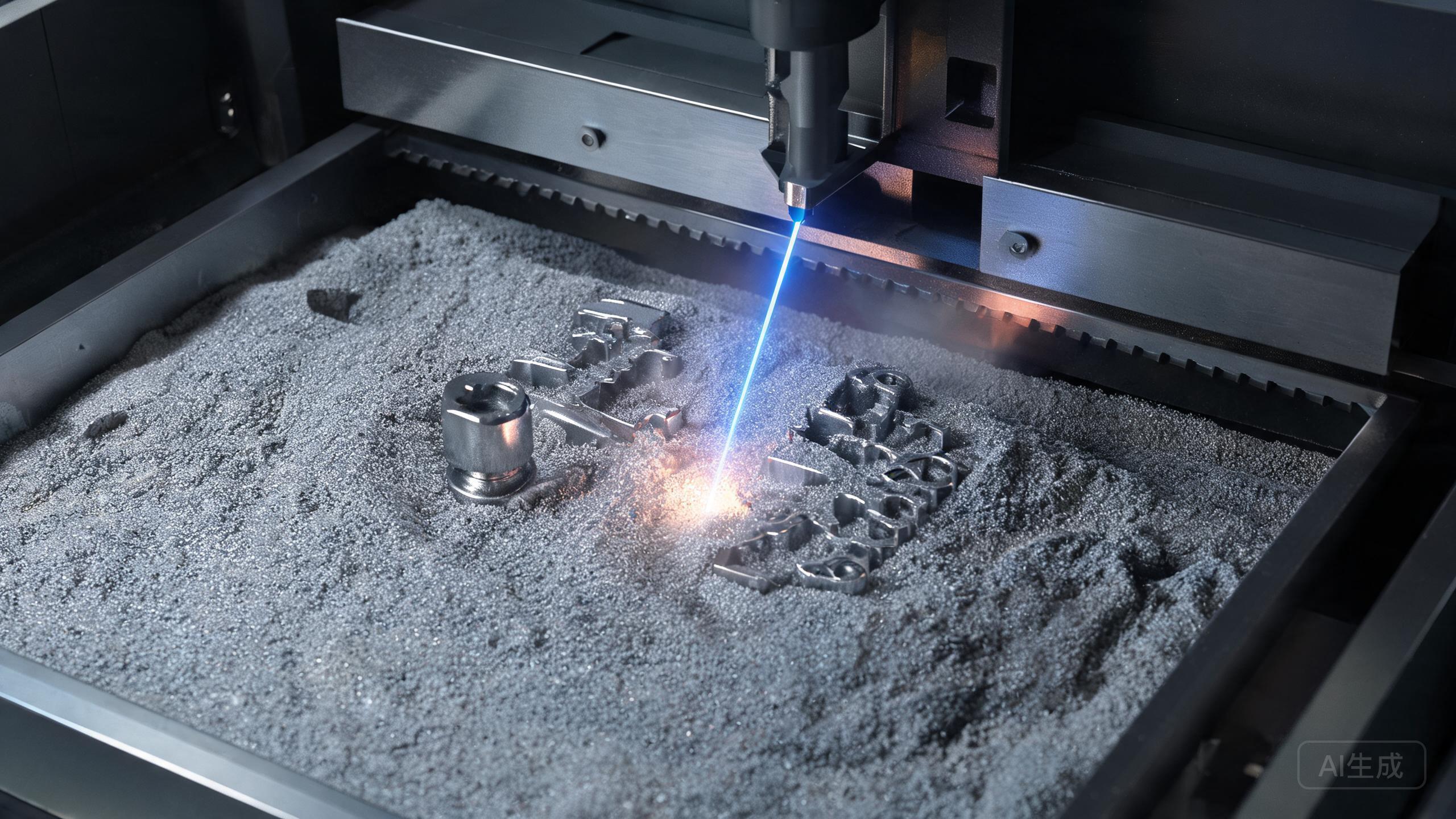
Stainless steel additive manufacturing (3D printing via LPBF — Laser Powder Bed Fusion) has moved from prototyping to production, with 316L, 17-4PH, and Invar 36 powders dominating the landscape. 316L (UNS S31603) is the workhorse — 60% of all stainless AM parts, used for medical implants, aerospace brackets, and automotive components. 17-4PH delivers HRC 44+ after precipitation hardening for tooling and high-strength parts. Invar 36 (N08909) with near-zero thermal expansion is unique to LPBF tooling and precision aerospace components. Powder quality is everything: D50 15-45μm spherical powder with ≤0.03% oxygen, post-processed via Hot Isostatic Pressing (HIP) to achieve >99.9% density. ASTM F2924-17 is the governing specification for LPBF stainless materials.
Quick Comparison
| Powder | UNS | D50 (μm) | Sphericity | Tensile (as-built) | Tensile (post-HIP) | Post-Print Treatment | Typical Uses |
|---|---|---|---|---|---|---|---|
| 316L | S31603 | 15-45 | ≥98% | ≥580 MPa | ≥540 MPa | HIP (optional) | Medical implants, aerospace brackets, automotive |
| 17-4PH | S17400 | 15-45 | ≥98% | ≥1100 MPa | ≥1200 MPa | HIP + H900 aging | Tooling, injection mold inserts, high-strength parts |
| Invar 36 | N08909 | 15-45 | ≥95% | ≥430 MPa | ≥430 MPa | HIP | Precision tooling, satellite structures |
| 15-5PH | S15500 | 15-45 | ≥98% | ≥1100 MPa | ≥1150 MPa | HIP + H900 | Aerospace fasteners, hydraulic components |
What Buyers Should Evaluate
- Application requirements. 316L for corrosion resistance and ductility; 17-4PH for high hardness/strength; Invar 36 for thermal expansion control. Match powder to your primary requirement — don’t over-specify.
- Powder atomization method. Gas-atomized powder (titanium crucible, argon gas) is the standard — spherical particles, uniform size distribution, low oxygen. Water-atomized powder is cheaper but has irregular shapes and higher oxygen content — not recommended for critical applications.
- HIP requirement. For high-criticality parts (pressure vessels, load-bearing brackets), specify Hot Isostatic Pressing at 1120°C / 150 MPa / 2 hours — this eliminates internal porosity and improves fatigue life by 2-3x.
- Post-print heat treatment. 316L needs no heat treatment. 17-4PH must be solution treated at 1050°C + aged at 482°C (H900) to achieve full hardness. Invar 36 is used as-built or with stress relief at 300°C.
- China-specific note. Xi’an, Shenzhen, and Beijing have the largest LPBF service bureaus in China. Premium powder suppliers include Oerlikon (imported), China Steel, and Xiamen Tungsten. Powder typically costs 3-5x the price of wrought stainless plate.
Common Purchasing Mistakes
Mistake: Specifying “stainless powder” without atomization method or powder size. We’ve seen RFQs from 3D printing bureaus that say only “316L stainless powder” — this results in receiving water-atomized powder with D50 50-80μm (too coarse) and oxygen content 0.05-0.08% (too high). These prints have 2-5% porosity, poor surface finish, and reduced mechanical properties. Fix: always specify: “Gas-atomized 316L powder, D50 20-35μm, sphericity ≥98%, oxygen ≤0.03%, per ASTM F2924-17.”
Mistake: Chinese factory trick — water-atomized powder labeled as gas-atomized. Some powder suppliers in Jiangsu label water-atomized 316L as “gas-atomized” to command the 2-3x higher price. Water-atomized powder has irregular, non-spherical particles that flow poorly and pack inconsistently in the powder bed. Prints made with this powder have 3-5x higher porosity than gas-atomized equivalents. Solution: PMI (Positive Material Identification) spectroscopy confirms chemistry. Then examine the powder under a scanning electron microscope (SEM) — gas-atomized powder shows perfectly spherical particles; water-atomized shows irregular, potato-shaped particles. Measure flow rate per ASTM B213 — gas-atomized 316L flows at ≥15 s/50g; water-atomized typically >25 s/50g. Insist on EN 10204 3.1 equivalent test reports including sphericity and flow rate measurements.
Mistake: Forgetting HIP for fatigue-critical parts. An aerospace bracket supplier in 2024 skipped HIP on 17-4PH LPBF parts to save $200/part. Three of 500 brackets developed fatigue cracks within 500 hours of service testing. HIP eliminates internal porosity that acts as crack initiation sites. The $200/part HIP cost was trivial compared to the $2M recall.
Mistake: Ignoring build orientation. LPBF parts have anisotropic properties — tensile strength in the Z (vertical) direction is 10-20% lower than in the XY plane. For parts under Z-direction loading, specify a build orientation that orients the major stress plane in the XY direction, or use HIP to mitigate the anisotropy.
Recommended RFQ Wording
Powder: Gas-atomized [UNS S31603 (316L) / S17400 (17-4PH) / N08909 (Invar 36)]
Specification: ASTM F2924-17 for metal additive manufacturing materials
Powder requirements:
  - D50 particle size: 20-35μm
  - Sphericity: ≥98% (gas atomized)
  - Oxygen content: ≤0.03%
  - Apparent density: ≥4.5 g/cm³
Application: [medical implant / aerospace bracket / tooling insert / precision fixture]
Post-treatment required: [HIP optional / HIP required / solution treat + H900 aging]
Quantity: [kg of powder / number of printed parts]
Certification required:
  - Full mill test certificate (chemistry, particle size, flow rate, oxygen)
  - PMI spectroscopy on every batch
  - ASTM B213 flow rate test report
  - SEM image showing particle morphology (gas-atomized spherical)
  - Tensile test report per ASTM E8 on LPBF + HIP test coupons
FAQ
What is the most popular stainless steel powder for 3D printing?
316L (UNS S31603) is by far the most popular stainless steel for Laser Powder Bed Fusion (LPBF), representing ~60% of all stainless AM parts produced globally in 2024. Its fully austenitic structure, excellent weldability, good corrosion resistance, and moderate strength (tensile ≥515 MPa H900 equivalent) make it the default choice for medical implants, aerospace brackets, automotive components, and tooling. 17-4PH is the second most popular for high-strength applications.
Why is Invar 36 (N08909) used in 3D printing?
Invar 36 has near-zero coefficient of thermal expansion (CTE 1.2×10⁻⁶/°C) across a wide temperature range (-273°C to 200°C), making it unique among stainless steels. 3D printed Invar is used for: precision tooling inserts that maintain dimensional accuracy through heat cycling, satellite and telescope structural components where thermal expansion must be controlled, and high-precision gages and fixtures. Its CTE is 15x lower than 316L (17.2×10⁻⁶/°C).
What powder characteristics are critical for stainless steel 3D printing?
Three factors determine print quality: (1) Sphericity ≥98% — irregular powders cause inconsistent powder bed density and poor flowability. (2) Particle size distribution D50 15-45μm — too fine = poor flowability, too coarse = poor surface finish. (3) Low oxygen content ≤0.03% — high oxygen causes porosity and reduced mechanical properties. ASTM F2924-17 defines these requirements for metal additive manufacturing powders.
CTA + Technical References
Send your grade, dimensions, annual volume and application to vip@still-steel.com, or contact us. We supply certified gas-atomized stainless steel powders for LPBF applications, as well as full 3D printing + HIP + heat treatment services.
References:
- ASTM F2924-17: Standard specification for additive manufacturing materials — metal powder bed fusion materials — stainless steels
- ISO 5436-2: Geometrical product specifications (GPS) — Surface texture: Profile method; Surfaces having stratified functional properties
- ASTM B213: Standard test method for flow rate of metal powders
- ASTM E8: Standard test methods for tension testing of metallic materials
- See also: 17-7PH vs PH 13-8 Mo aerospace comparison
Technical References
- ASTM A240M - Standard Specification for Chromium and Chromium-Nickel Stainless Steel Plate, Sheet and Strip
- EN 10088-2 - Stainless steels. Technical delivery conditions for sheet/plate and strip
- ASM International - Handbook Series, Volume 1: Properties and Selection: Irons, Steels, and High-Performance Alloys