
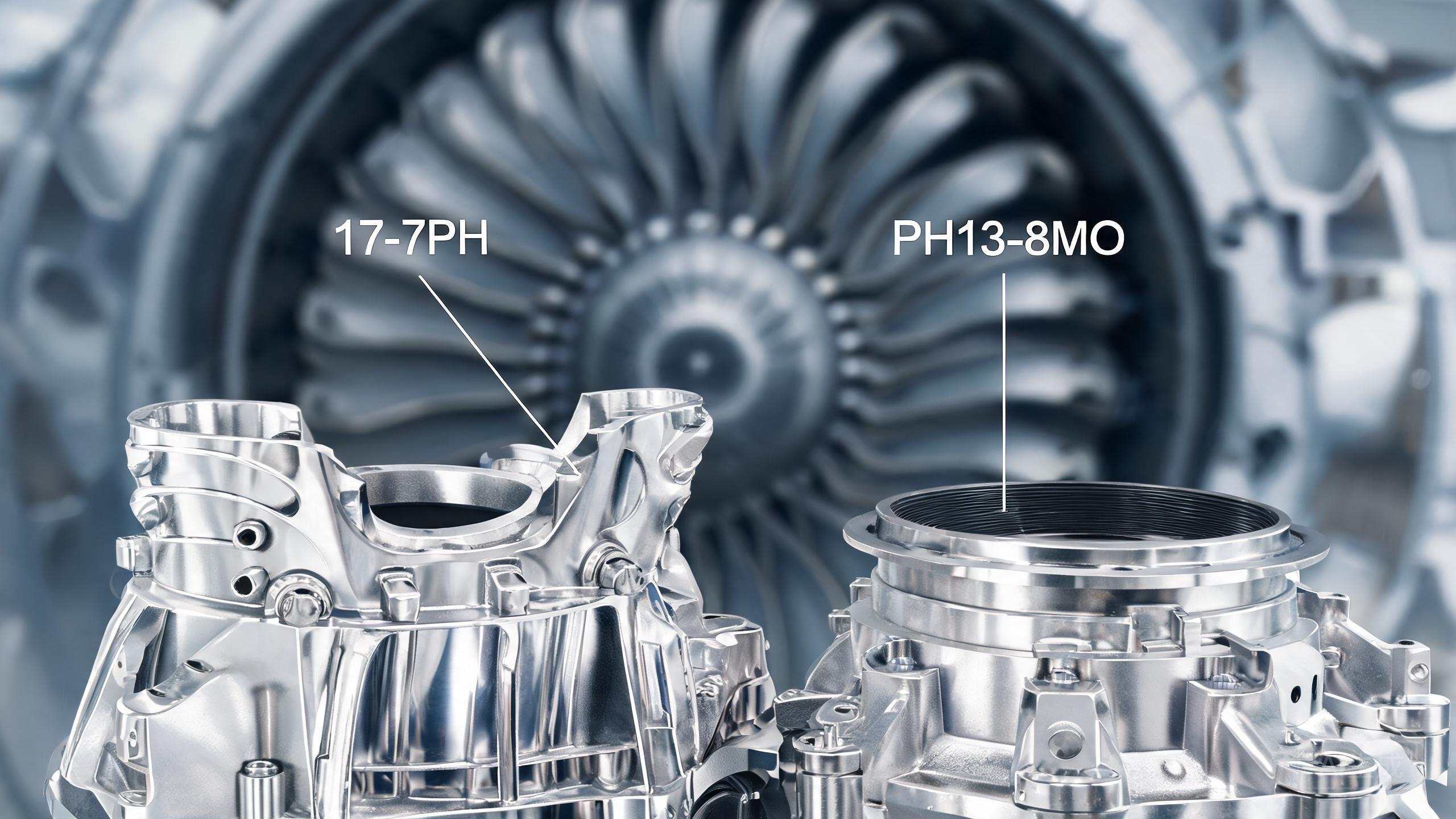
Short answer:
Aerospace precipitation hardening stainless steel comes down to one decision point: do I need the strength and toughness premium of PH 13-8 Mo, or is 17-7PH sufficient? 17-7PH (UNS S17700, AMS 5528) delivers HRC 44 and tensile ≥1400 MPa at H900 temper — the workhorse for fasteners, brackets, and secondary structural components. PH 13-8 Mo (UNS S13800, AMS 5864) is vacuum double-melted, adds 2.0-3.0% molybdenum for corrosion resistance, delivers HRC 50+ and tensile ≥1700 MPa, and has 50% better fracture toughness — reserved for landing gear, turbine components, and primary structural members where every kilogram of weight saving counts. China’s aerospace supply chain now produces both grades, with Western mills (Carpenter, VDM) still dominant for certification-critical applications.
Quick Comparison
| Property | 17-7PH (S17700) | PH 13-8 Mo (S13800) | 17-4PH (S17400) |
|---|---|---|---|
| Chromium | 16.0-18.0% | 12.25-13.25% | 15.5-17.5% |
| Nickel | 6.5-7.75% | 7.5-8.5% | 3.0-5.0% |
| Molybdenum | ≤0.5% | 2.0-3.0% | ≤0.75% |
| Aluminum | 0.75-1.50% | 0.9-1.35% | ≤0.05% |
| Hardness H900 | HRC 44 | HRC 50+ | HRC 44 |
| Tensile H900 | ≥1400 MPa | ≥1700 MPa | ≥1310 MPa |
| Fracture Toughness KIc | ≥40 MPa·m⁰·⁵ | ≥60 MPa·m⁰·⁵ | ≥55 MPa·m⁰·⁵ |
| Corrosion in Salt Spray (1000h) | ≤10% rust | ≤1% rust | ≤10% rust |
| Melting Practice | VIM or VIM-VAR | VIM-VAR required | Air melt or VIM |
| AMS Specification | AMS 5528 | AMS 5864 | AMS 5640 |
| Price Premium vs 17-4PH | +30-40% | +70-90% | Base |
| Typical Uses | Fasteners, brackets, secondary structure | Landing gear, turbine blades, primary structure | Industrial high-strength parts |
What Buyers Should Evaluate
- Criticality of component. Landing gear, turbine disks, and primary structural members require PH 13-8 Mo per most airframe qualification standards (DO-160G, JSSG-2006). Secondary structure, fasteners, and brackets can use 17-7PH.
- Operating environment. PH 13-8 Mo’s 2-3% molybdenum provides superior salt spray corrosion resistance (passes 2000h ASTM B117) while 17-7PH typically shows visible rust after 800-1000h. Coastal airports and marine aircraft mandate PH 13-8 Mo.
- Weight consideration. In aerospace, every 1kg saved is worth ~$1,000 over the aircraft’s lifetime. PH 13-8 Mo’s 20-25% higher strength allows smaller cross-sections, directly reducing weight.
- China-specific note. Shenyang and Xi’an aerospace supply chains now produce certified 17-7PH and PH 13-8 Mo. Western mills (Carpenter, VDM, Daido) still dominate for global OEM certification (Boeing, Airbus, Pratt & Whitney). Verify your material carries the correct AMS specification, not just a UNS number.
- Machinability. 17-7PH in Condition A (HRC 32) machines at ~60% the rate of 1045 carbon steel. PH 13-8 Mo in Condition H900 (HRC 50+) is much harder — machine in Condition A first, then age.
Common Purchasing Mistakes
Mistake: Specifying “PH stainless” without calling out the AMS specification. We’ve seen six RFQs in 2024 that say only “precipitation hardening stainless steel” — this resulted in receiving 17-4PH (industrial grade, AMS 5640) instead of 17-7PH or PH 13-8 Mo (aerospace grades). 17-4PH has lower nickel and no aluminum, fundamentally different precipitation hardening mechanism, and lower fracture toughness. Fix: always specify the full AMS specification: “AMS 5528 (17-7PH) or AMS 5864 (PH 13-8 Mo).”
Mistake: Chinese factory trick — VIM-only melted PH 13-8 Mo labeled as VIM-VAR. PH 13-8 Mo AMS 5864 REQUIRES VIM-VAR double melting for fracture toughness KIc ≥60 MPa·m⁰·⁵. Some mills in Hunan supply VIM-only melted PH 13-8 Mo that meets chemistry but has KIc ~45 MPa·m⁰·⁵ due to inclusions. This fails AMS 5864 requirements and is unsafe for critical aerospace components. Solution: PMI (Positive Material Identification) spectroscopy confirms chemistry is correct. Then require EN 10204 3.1 mill test certificates that explicitly state “VIM-VAR double melted” with a melt route number. Additionally, require fracture toughness testing per ASTM E1820 on witness coupons — KIc must be ≥60 MPa·m⁰·⁵. AMS 5864 clause 3.4.2 specifies the melting practice — check your supplier’s AMS certification.
Mistake: Heat treating after machining on the wrong schedule. 17-7PH can be aged at 482°C (H900) for 1 hour. PH 13-8 Mo also ages at 482°C for 1 hour. But PH 13-8 Mo MUST be fully solution treated at 927°C before aging — skipping this step produces inconsistent properties across the part.
Mistake: Using wrong filler metal for welding. 17-7PH and PH 13-8 Mo should NOT be welded in the aged condition. Weld in Condition A (solution treated), then age the entire assembly. Use ER630 (17-4PH filler) for 17-7PH and ER13-8 Mo filler for PH 13-8 Mo — not cross-compatible.
Recommended RFQ Wording
Grade Option 1: AMS 5528 / UNS S17700 (17-7PH)
Grade Option 2: AMS 5864 / UNS S13800 (PH 13-8 Mo)
Application: [landing gear component / turbine blade / fastener / bracket / secondary structure]
Criticality: [primary / secondary / non-critical]
Service environment: [standard aerospace / coastal marine / elevated temp]
Temper: [Condition A / H900 / H1025]
Form: [bar / forging / sheet / wire]
Dimensions: [exact length × diameter / thickness × width]
Certification required:
  - AMS full certification (not just UNS number)
  - EN 10204 3.1 mill test certificate (VIM-VAR melting route stated)
  - PMI spectroscopy on every heat
  - Hardness test per AMS 5528/5864 (within ±2 HRC of specified)
  - Fracture toughness test per ASTM E1820 (KIc ≥60 MPa·m⁰·⁵ for PH 13-8 Mo)
Additional: Material must pass DO-160G environmental testing for aerospace qualification.
FAQ
When should I choose PH 13-8 Mo over 17-7PH?
Choose PH 13-8 Mo (UNS S13800) over 17-7PH (UNS S17700) when your aerospace component requires: (1) higher strength at elevated temperatures — PH 13-8 Mo H900 delivers HRC 50+ with tensile ≥1700 MPa vs HRC 44 and ≥1400 MPa for 17-7PH, (2) better corrosion resistance — 2.0-3.0% Mo content (vs 0.5% for 17-7PH) provides critical pitting resistance in salt spray, or (3) fracture toughness — PH 13-8 Mo has KIc ≥60 MPa·m⁰·⁵ vs ~40 MPa·m⁰·⁵ for 17-7PH.
What is the difference in melting practice between these grades?
Both are typically vacuum melted (VIM for 17-7PH, VIM-VAR double melt for PH 13-8 Mo) to meet aerospace cleanliness requirements. PH 13-8 Mo is ALWAYS produced via VIM-VAR because its higher alloy content makes it more prone to inclusions that reduce fracture toughness. 17-7PH can be produced via VIM-only for non-critical components, but AMS 5528 specifies VIM-VAR for primary structural applications.
Why is 17-7PH still widely used when PH 13-8 Mo seems superior?
Cost and fabricability. 17-7PH H900 is 30-40% cheaper than PH 13-8 Mo H900, and its lower hardness (HRC 44 vs HRC 50+) makes it easier to machine, forming closer tolerances. 17-7PH also has better cold-forming capability in Condition A (solution treated). PH 13-8 Mo is reserved for components where the performance premium justifies the cost.
CTA + Technical References
Send your grade, dimensions, annual volume and application to vip@still-steel.com, or contact us. We supply AMS-certified 17-7PH and PH 13-8 Mo for aerospace and high-performance industrial applications.
References:
- AMS 5528: Steel, precipitation hardening, bars, wire, and forgings 16Cr - 7.1Ni - 0.28Al
- AMS 5864: Steel, precipitation hardening, bars, forgings, and rings 12.5Cr - 8.3Ni - 2.2Mo - 1.2Al
- ASTM E1820: Standard test method for measurement of fracture toughness
- DO-160G: Environmental conditions and test procedures for airborne equipment
- See also: 17-4PH temper guide
Technical References
- ASTM A240M - Standard Specification for Chromium and Chromium-Nickel Stainless Steel Plate, Sheet and Strip
- EN 10088-2 - Stainless steels. Technical delivery conditions for sheet/plate and strip
- ASM International - Handbook Series, Volume 1: Properties and Selection: Irons, Steels, and High-Performance Alloys