
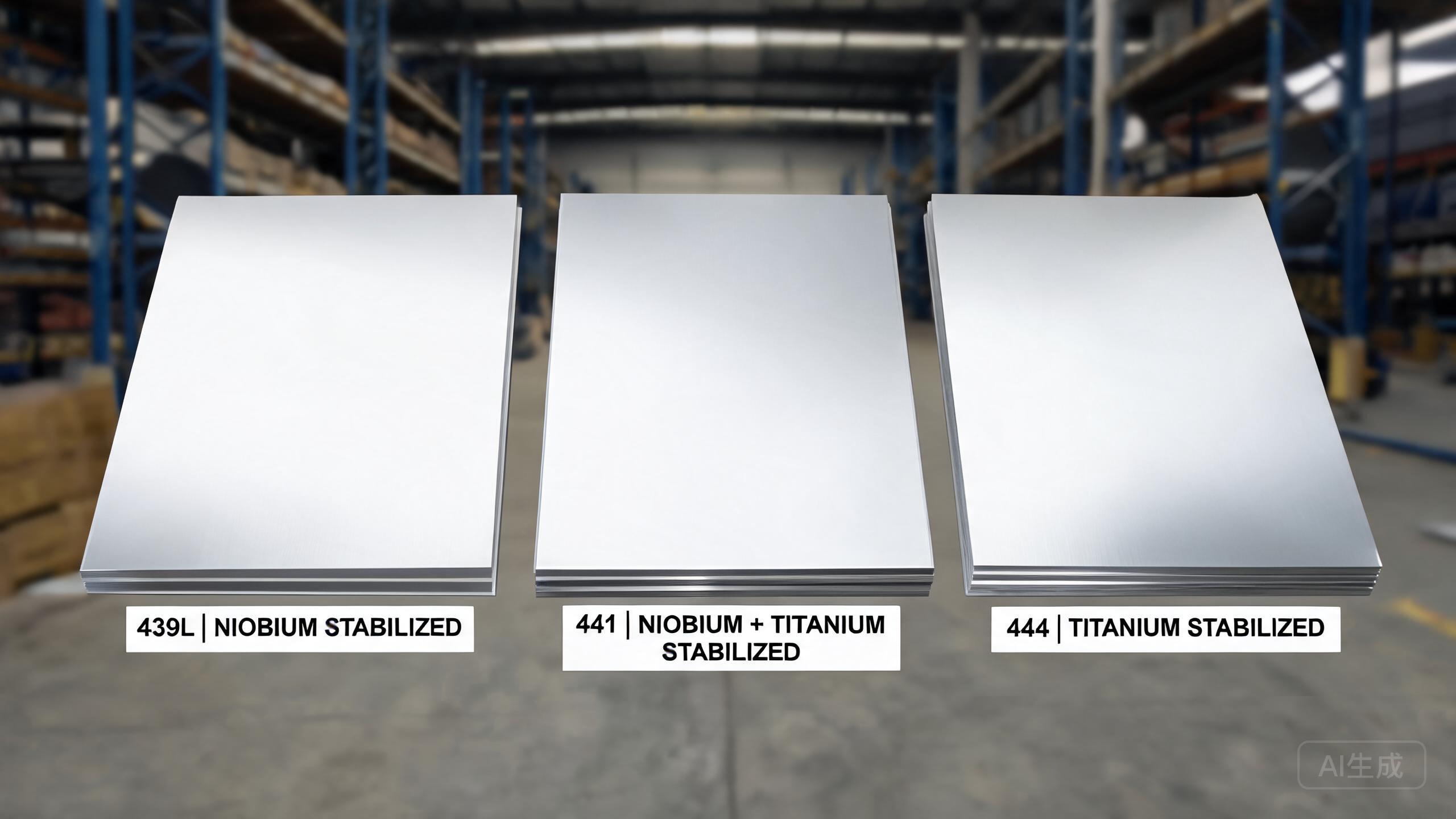
Short answer:
Stabilized ferritic stainless steel has quietly revolutionized automotive exhaust systems over the last 15 years — replacing 304 austenitic grades at 40-50% lower cost, with superior thermal expansion matching mild steel underbodies. 439L (S43035, Ti-stabilized) and 441 (S44100, Nb-stabilized) handle the vast majority of passenger vehicle exhaust underbody applications, preventing intergranular corrosion by tying up carbon as stable carbide phases. 444 (S44400) adds 2% molybdenum for coastal and high-salt environments where plain stabilized ferritics corrode rapidly. All three grades comply with ASTM A240, and China’s auto market now consumes 2.5 million tons of stabilized ferritic annually, led by Baosteel, TISCO, and Tsingtao Iron & Steel.
Quick Comparison
| Property | 439L (S43035) | 441 (S44100) | 444 (S44400) | 430 (S43000, non-stabilized) | 304 (S30400) |
|---|---|---|---|---|---|
| Chromium | 16.0-18.0% | 17.5-19.0% | 17.5-19.5% | 16.0-18.0% | 18.0-20.0% |
| Molybdenum | 0 | 0 | 1.75-2.50% | 0 | ≤0.5% |
| Stabilizer | Ti: ≥8×C | Nb: 10×C | Ti + Nb | None | None |
| PREN | ~17 | ~18 | ~23 | ~17 | ~19 |
| Thermal Expansion | 10.5×10⁻⁶/°C | 10.4×10⁻⁶/°C | 10.5×10⁻⁶/°C | 10.5×10⁻⁶/°C | 17.2×10⁻⁶/°C |
| Max Continuous Temp | 800°C | 850°C | 800°C | 750°C | 870°C |
| Corrosion in Salt Spray (1000h) | <10% rust | <5% rust | <1% rust | >30% rust | <5% rust |
| Price Relative | 0.7x 304 | 0.75x 304 | 0.85x 304 | 0.6x 304 | 1.0x base |
| Typical Uses | Mufflers, tailpipes | Downpipes, catalytic converter shells | Coastal exhaust, truck underbodies | Low-cost (NOT recommended for exhaust) | Premium exhaust (legacy) |
What Buyers Should Evaluate
- Peak exhaust temperature. Components closer to the engine (downpipes, cat converters) see 850-950°C — choose Nb-stabilized 441. Cooler underbody components (mufflers, tailpipes) at 400-600°C use Ti-stabilized 439L.
- Operating environment. Coastal or high-road-salt regions mandate 444 with 2% Mo. Standard 439L/441 corrode through in 2-3 years in salt spray environments.
- Formability. All three stabilized grades have good deep-draw formability — comparable to 304 but lower springback (~5-7% vs 6-8% for 304). Use lower blank-holder pressure to prevent wrinkling.
- Weldability. Ferritic grades require ER430LNb or ER439Nb fillers. Preheat to 150-200°C to prevent cold cracking — this is critical for thick sections (≥3mm). Post-weld annealing at 750°C for 30 minutes restores ductility.
- China-specific note. Baosteel’s “439LX” and TISCO’s “441T” are branded variants optimized for automotive exhaust. Both mills supply to VW, BYD, and Geely. GB/T 1220-2020 covers all three UNS grades.
Common Purchasing Mistakes
Mistake: Using non-stabilized 430 for exhaust “to save money.” A Guangzhou auto parts manufacturer switched from 439L to plain 430 (no stabilizer) in 2024 to cut cost by 15%. Within 6 months, 12% of mufflers showed intergranular corrosion cracking — the carbon in 430 formed chromium carbides during welding, depleting Cr at grain boundaries. Fix: never use non-stabilized ferritics for exhaust systems or any welded application. The 15% savings doesn’t cover warranty claims.
Mistake: Chinese factory trick — stabilized ferritic with insufficient stabilizer content. Some mills in Liaoning supply 439L that has only 4×C titanium instead of the required ≥8×C minimum. With insufficient titanium, chromium carbide still forms during welding, creating the same intergranular corrosion as non-stabilized 430. Solution: PMI (Positive Material Identification) spectroscopy — titanium content must be ≥8× carbon content. For example, if C = 0.02%, Ti must be ≥0.16%. Insist on EN 10204 3.1 mill test certificates that list BOTH Ti and C values, and require the mill’s calculation of Ti/C ratio. Additionally, run a sensitization test per ASTM A262 Practice E (Strauss test) — compliant material shows no grain boundary corrosion.
Mistake: Forgetting preheat on thick-section ferritic welds. Ferritic stainless steels have higher carbon solubility than austenitics and can develop martensite and cold cracks in thick welds (≥3mm). Always preheat to 150-200°C and use controlled low-heat-input welding (<1.0 kJ/mm).
Mistake: Ignoring thermal expansion mismatch. Ferritics have 35% lower thermal expansion than 304. If you’re joining 439L/441 exhaust to a 304 flange, use a transition piece or flexible bellows to accommodate the differential expansion — direct rigid coupling causes joint failure in 50-100 thermal cycles.
Recommended RFQ Wording
Grade: ASTM A240 / UNS [S43035 (439L) / S44100 (441) / S44400 (444)]
Application: [downpipe / muffler / catalytic converter shell / tailpipe]
Peak operating temperature: [exact °C]
Operating environment: [standard / coastal / road-salt]
Form: Cold-rolled sheet / coil
Thickness: [exact mm]
Width: [exact mm]
Surface: 2B mill finish, Ba (bright annealed) preferred for underbody
Quantity: [metric tons]
Certification required:
  - EN 10204 3.1 mill test certificate (Ti/C or Nb/C ratio calculated)
  - PMI spectroscopy on every heat
  - ASTM A262 Practice E sensitization test (no intergranular corrosion)
  - Salt spray test per ASTM B117 (1000h, rust rating ≤5%)
Additional: Material must comply with GB/T 1220-2020 and be formable for deep-draw exhaust components.
FAQ
Why do modern automotive exhaust systems use stabilized ferritic stainless instead of 304?
Stabilized ferritic grades (439L, 441, 444) have three advantages over 304 for exhaust underbody: (1) lower cost — 40-50% cheaper than 304 due to no nickel, (2) lower thermal expansion (10.5×10⁻⁶/°C vs 17.2×10⁻⁶/°C for 304) — reduces thermal fatigue at joints, and (3) good corrosion resistance when properly stabilized against intergranular corrosion. However, they cannot match 304’s high-temperature strength above 800°C.
What is the difference between Ti-stabilized 439L and Nb-stabilized 441?
Both grades are designed to prevent intergranular corrosion by tying up carbon as stable carbide phases. Titanium (439L, S43035) forms TiC at ~900°C, while niobium (441, S44100) forms NbC at ~1050°C. 441’s higher-temperature stabilization makes it better for exhaust components that see peak temperatures above 900°C (downpipes near the engine). 439L is sufficient for cooler underbody components (mufflers, tailpipes).
When should I choose 444 with molybdenum?
Choose 444 (UNS S44400, 2% Mo + Ti) for automotive exhaust systems operating in coastal or road-salt environments, or for commercial vehicles (trucks, buses) that accumulate heavy salt contamination. The 2% molybdenum doubles chloride pitting resistance compared to 439L/441. Without Mo, ferritic grades corrode rapidly in de-icing salt environments — 444 is mandatory for US northern states and European coastal regions.
CTA + Technical References
Send your grade, dimensions, annual volume and application to vip@still-steel.com, or contact us. We supply stabilized ferritic stainless per ASTM A240 and GB/T 1220 for automotive exhaust manufacturers.
References:
- ASTM A240 / A240M: Standard specification for chromium and chromium-nickel stainless steel plate, sheet, and strip
- ASTM A262: Standard practices for detecting susceptibility to intergranular corrosion in austenitic stainless steels
- GB/T 1220-2020: Stainless steel bars
- ASTM B117: Standard practice for salt spray (fog) apparatus
- See also: Stainless spring temper selection
Technical References
- ASTM A240M - Standard Specification for Chromium and Chromium-Nickel Stainless Steel Plate, Sheet and Strip
- EN 10088-2 - Stainless steels. Technical delivery conditions for sheet/plate and strip
- ASM International - Handbook Series, Volume 1: Properties and Selection: Irons, Steels, and High-Performance Alloys