
Short answer:
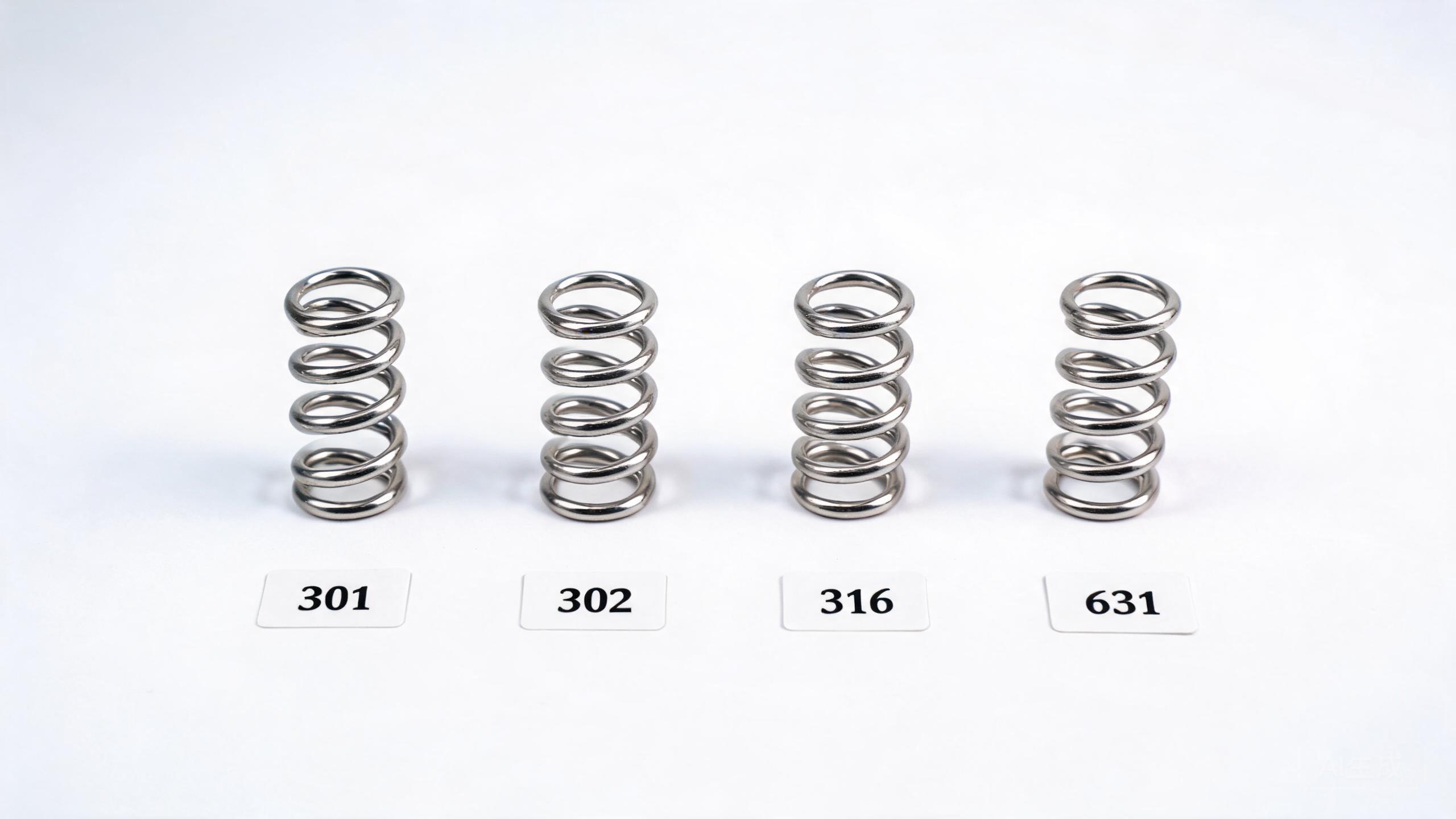
Stainless steel spring selection boils down to three grades and one critical decision: temper vs operating temperature. For ambient-temperature (<200°C) springs, 301 full-hard (HV 750, tensile ~1750 MPa) is the workhorse, used in automotive door locks, appliances, and industrial latches. Choose 302 3/4-hard (HV 500, tensile ~1200 MPa) when you need better formability for complex spring shapes. Above 200°C — exhaust components, hot industrial machinery — you must upgrade to 631 (17-7PH, S17700) which retains strength through precipitation hardening up to 350°C. The minimum bending radius rule: 1t for soft annealed, 2t for full-hard 301, and 2.5t for 631 PH — violate this and you’ll crack the spring on forming.
Quick Comparison
| Grade | UNS | Temper | Hardness (HV) | Tensile (MPa) | Yield (MPa) | Max Use Temp | Min Bending Radius | Fatigue Life (10³ cycles) | Typical Uses |
|---|---|---|---|---|---|---|---|---|---|
| 301 | S30100 | Full Hard | ≥750 | ≥1750 | ≥1450 | 200°C | 2t | 10-50 | Door locks, snap rings, industrial latches |
| 301 | S30100 | 3/4 Hard | ≥580 | ≥1300 | ≥1050 | 200°C | 1.5t | 10-50 | Flat springs, brackets, clips |
| 302 | S30200 | 3/4 Hard | ≥500 | ≥1200 | ≥1000 | 200°C | 1.5t | 10-50 | Formable springs, wire forms |
| 631 | S17700 | H900 | ≥600 | ≥1650 | ≥1550 | 350°C | 2.5t | 50-150 | High-temp springs, aerospace fasteners |
| 631 | S17700 | H1150 | ≥400 | ≥1000 | ≥900 | 425°C | 2t | 50-150 | Extreme-temp industrial springs |
What Buyers Should Evaluate
- Operating temperature range. This drives the grade selection more than anything else. If you’re above 200°C consistently, 301 and 302 are out — they lose temper and go soft.
- Fatigue cycle count. High-cycle applications (>10,000 cycles) benefit from 631 PH’s superior fatigue resistance. Short-cycle (<1,000 cycles) can use lower-cost 302.
- Minimum bending radius. Calculate your tightest bend radius before finalizing grade. If you need <1.5t minimum bend, use 302 half-hard or annealed 301 — forming cracks are not covered by warranty.
- Thickness tolerance. Spring strip requires tighter control than general-purpose sheet. ASTM A666 specifies ±0.010mm tolerance on 0.10-0.50mm strip, vs ±0.015mm for A240.
- China-specific sourcing. Most Chinese mills supply A240 strip labeled “spring temper” that doesn’t meet A666 tolerances or hardness ranges. Verify the mill holds QS-9000 spring quality certification.
Common Purchasing Mistakes
Mistake: Buying “spring temper” 301 without verifying hardness. A Jiangsu appliance manufacturer bought 2 tons of what was labeled “301 full-hard spring strip” and found it was actually 301 annealed (HV 200 vs required HV 750). All 50,000 snap-in door locks failed during assembly — the springs couldn’t hold their shape. Fix: always specify ASTM A666 (not just A240) and require HV hardness testing on every coil.
Mistake: Chinese factory trick — soft 301 sold as full-hard. Multiple mills in Ningbo and Guangdong label 301 3/4-hard as “full-hard” — the visual appearance and thickness are identical, but hardness is 30-40% lower (HV 550 vs HV 750). Solution: PMI (Positive Material Identification) spectroscopy confirms it’s 301 chemistry. Then run HV hardness testing per ASTM E384 on 5% of every shipment. Insist on EN 10204 3.1 mill test certificates with individual hardness readings. For critical springs, run a full ASTM A666 verification including tensile test.
Mistake: Ignoring springback in press brake forming. 301 full-hard has 12-15% springback — meaning your press brake angle must be 12-15% over the final desired angle. Standard 304 has only 6-8% springback. Not compensating results in every spring piece being 5-10° too open.
Mistake: Using 631 in Condition A instead of tempered. 631 arrives in solution-treated Condition A (soft, HRC 32). Springs must be aged to H900 or H1150 after forming to achieve the required hardness. Skipping the aging step delivers a soft, useless spring.
Recommended RFQ Wording
Grade: [UNS S30100 (301) / S30200 (302) / S17700 (631 PH)], per buyer selection
Specification: ASTM A666 for spring strip
Temper: [Full Hard / 3/4 Hard / H900 / H1150]
Form: Cold-rolled spring strip
Thickness: [exact mm] ±0.010mm (A666 tolerance)
Width: [exact mm]
Length: Coiled, [exact ID]
Surface: [BA mill finish / bright annealed / 2B]
Application: [spring / snap ring / clip]
Operating temperature: [max °C]
Quantity: [metric tons or number of coils]
Delivery: [required date, incoterm]
Certification required:
  - EN 10204 3.1 mill test certificate
  - ASTM E384 Vickers hardness test per coil
  - PMI spectroscopy on every heat
  - ASTM A666 compliance test report
FAQ
Can I use 304 stainless steel for springs?
Generally no. 304 (UNS S30400) has relatively low tensile strength (~600 MPa even at full hardness) and poor spring temper retention — it loses strength rapidly above 200°C. Use 301 (S30100) full-hard (HV 750) for ambient-temperature springs, or 631 (S17700, 17-7PH) for springs operating above 200°C.
What is the difference between spring temper specifications ASTM A666 and A240?
ASTM A666 is the dedicated spring strip specification — it mandates tighter thickness tolerance (±0.010mm vs ±0.015mm for A240), controlled hardness ranges per temper, and minimum tensile strength requirements. ASTM A240 is general-purpose sheet/strip that may or may not meet spring temper quality. Always specify A666 for critical spring applications.
How long do stainless steel springs last compared to carbon steel?
In ambient-temperature, non-corrosive service, properly selected 301 full-hard springs typically achieve 10,000-50,000 cycles before fatigue failure vs 50,000-100,000 for chrome-vanadium carbon steel springs. However, stainless steel springs last 5-10x longer in corrosive environments where carbon steel rusts. 631 PH stainless can exceed 100,000 cycles at elevated temperatures.
CTA + Technical References
Send your grade, dimensions, annual volume and application to vip@still-steel.com, or contact us. We supply ASTM A666-certified spring strip in 301, 302, and 631 PH for automotive and industrial customers.
References:
- ASTM A666: Standard specification for annealed or cold-rolled austenitic stainless steel strip for springs
- ASTM A240 / A240M: Standard specification for chromium and chromium-nickel stainless steel plate, sheet, and strip
- ASTM E384: Standard test method for microindentation hardness of materials
- See also: 17-4PH temper guide
Technical References
- ASTM A240M - Standard Specification for Chromium and Chromium-Nickel Stainless Steel Plate, Sheet and Strip
- EN 10088-2 - Stainless steels. Technical delivery conditions for sheet/plate and strip
- ASM International - Handbook Series, Volume 1: Properties and Selection: Irons, Steels, and High-Performance Alloys