
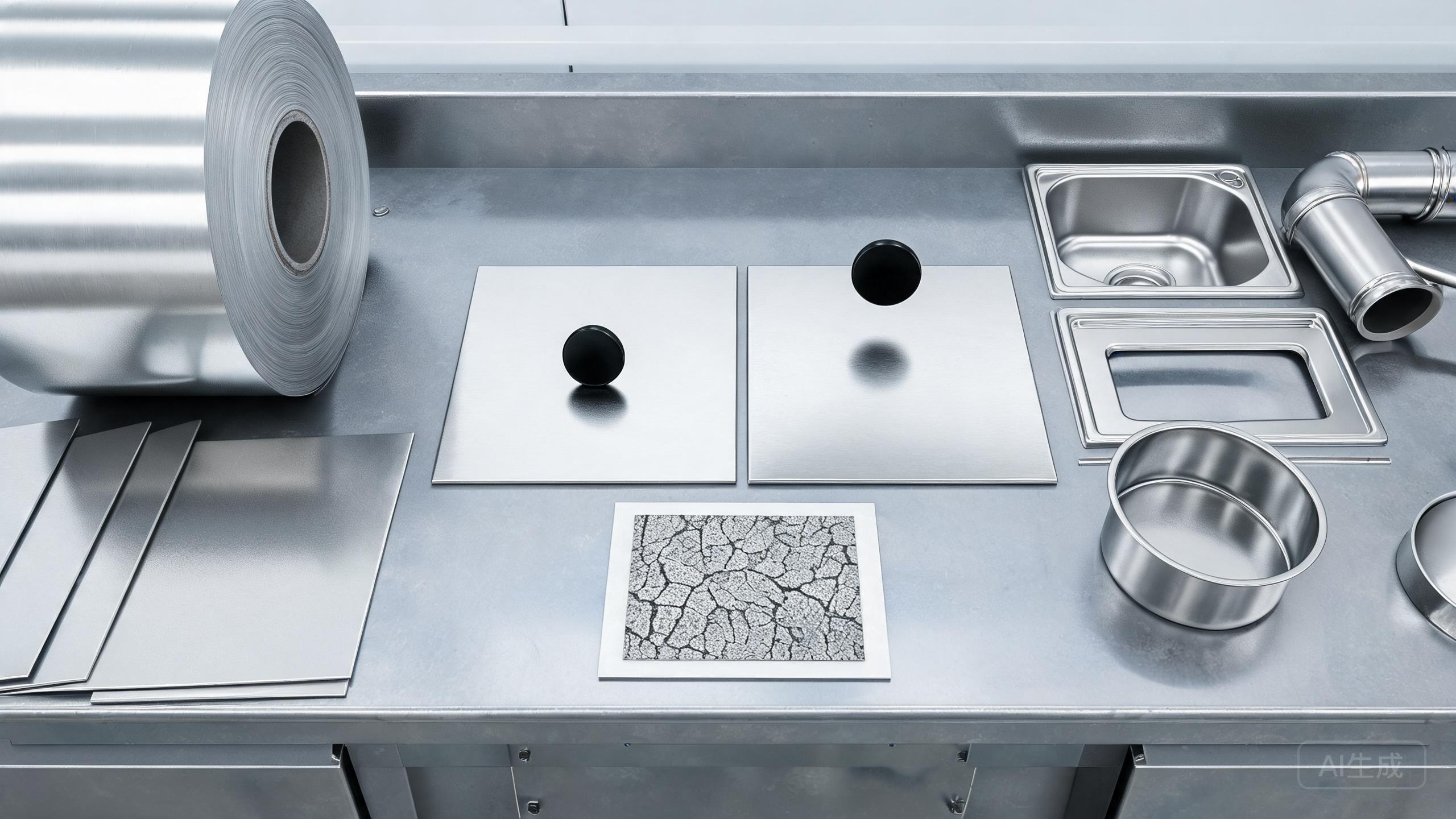
Short answer: Ferritic stainless steels are chromium-rich, nickel-free alloys that are magnetic, moderately formable and cost-effective. Plain 430 is the general-purpose entry; stabilized grades 439, 441 and 444 add Ti/Nb and, in the case of 441/444, higher chromium plus molybdenum to deliver better weldability, elevated-temperature stability and corrosion resistance.
This guide is written for stainless steel buyers, sourcing teams, engineers and product manufacturers. The purpose is not to declare one universal winner, but to turn a broad material question into a specification that a mill or service center can quote, process and inspect consistently.
Quick Comparison
| Option | Key point | Typical use or decision |
|---|---|---|
| 430 (UNS S43000) | Entry-level 17% Cr, non-stabilized | Trim, appliances, indoor decorative panels |
| 430MA | Modified high-purity 430 for better forming | Dishwasher inner panels, kitchen sinks |
| 439 / 441 | Stabilized, improved weldability and oxidation resistance | Exhaust systems, wall cladding, handrail tubes |
| 444 (UNS S44400) | 18–21% Cr + 2% Mo, stabilized | Water heater tanks, solar collectors, coastal trim |
The table is a starting point. Actual performance depends on the governing standard, delivered condition, dimensions, surface finish, fabrication route and service environment. Commercial names should never replace a complete purchase specification.
What Buyers Should Evaluate
- Watch for low interstitial (C+N) grades where deep drawing or ductility after welding is required.
- For outdoor use, review the real environment: coastal salt, industrial fumes or de-icing salts move 430 out of scope quickly.
- Verify the manufacturer’s stabilization practice; “stabilized” is not a specification without an alloy or a standard backing it.
For production orders, share the end use rather than requesting a grade or finish in isolation. A supplier can then review corrosion exposure, forming severity, welding, visual requirements and packing before material is cut. This early review is usually less expensive than correcting a rejected shipment or unstable production trial.
Common Purchasing Mistakes
- Specifying “430” hoping it will last outdoors indefinitely
- Switching from 304 to 430 purely for price without testing formability. Compare the 430 vs 304 stainless steel differences before switching.
- Welding unstabilized 430 heavily and then discovering sensitization
These mistakes are avoidable when drawings, approved samples, inspection methods and certificate requirements are agreed before production. For visual products, retain a signed master sample. For functional dimensions, define where and how measurements will be taken.
Recommended RFQ Wording
State grade (UNS or EN number), product form, finish, thickness/width tolerance, stabilization, minimum chromium and molybdenum if critical, and certificate type. For welded tube or pipe, include the weld-test or flattening-test standard.
Also include order quantity, acceptable quantity variation, destination, required delivery date and whether partial shipments are allowed. If a requirement is critical, make it measurable and place it on the purchase order rather than only in an email conversation.
How Still Steel Supports the Project
Still Steel supplies stainless steel coil, strip and sheet and provides slitting, cut-to-length, brushing, polishing and protective-film services. We can compare available mill material with your drawing, prepare trial quantities and preserve heat-number traceability through service-center processing.
Send the grade, dimensions, annual volume and application to vip@still-steel.com, or discuss the requirement on WhatsApp.
Frequently Asked Questions
Is 430 ferritic stainless magnetic?
Yes. All common ferritic grades are ferromagnetic because of their body-centred cubic (BCC) crystal structure, unlike 304 or 316 austenitics.
When should I choose 441 or 444 over 430?
Upgrade to 441 or 444 when corrosion or high-temperature stability matters beyond what 430 can support, such as outdoor cladding, exhaust hot ends or water heaters.
Does ferritic stainless suffer from weld decay?
Stabilized ferritics (439, 441, 444) with titanium or niobium additions resist intergranular attack after welding much better than unstabilized 430.
Technical References
Reference documents support general selection and fabrication principles. The final material decision must follow the applicable contract, standard, regulation and engineering review for the specific product.