
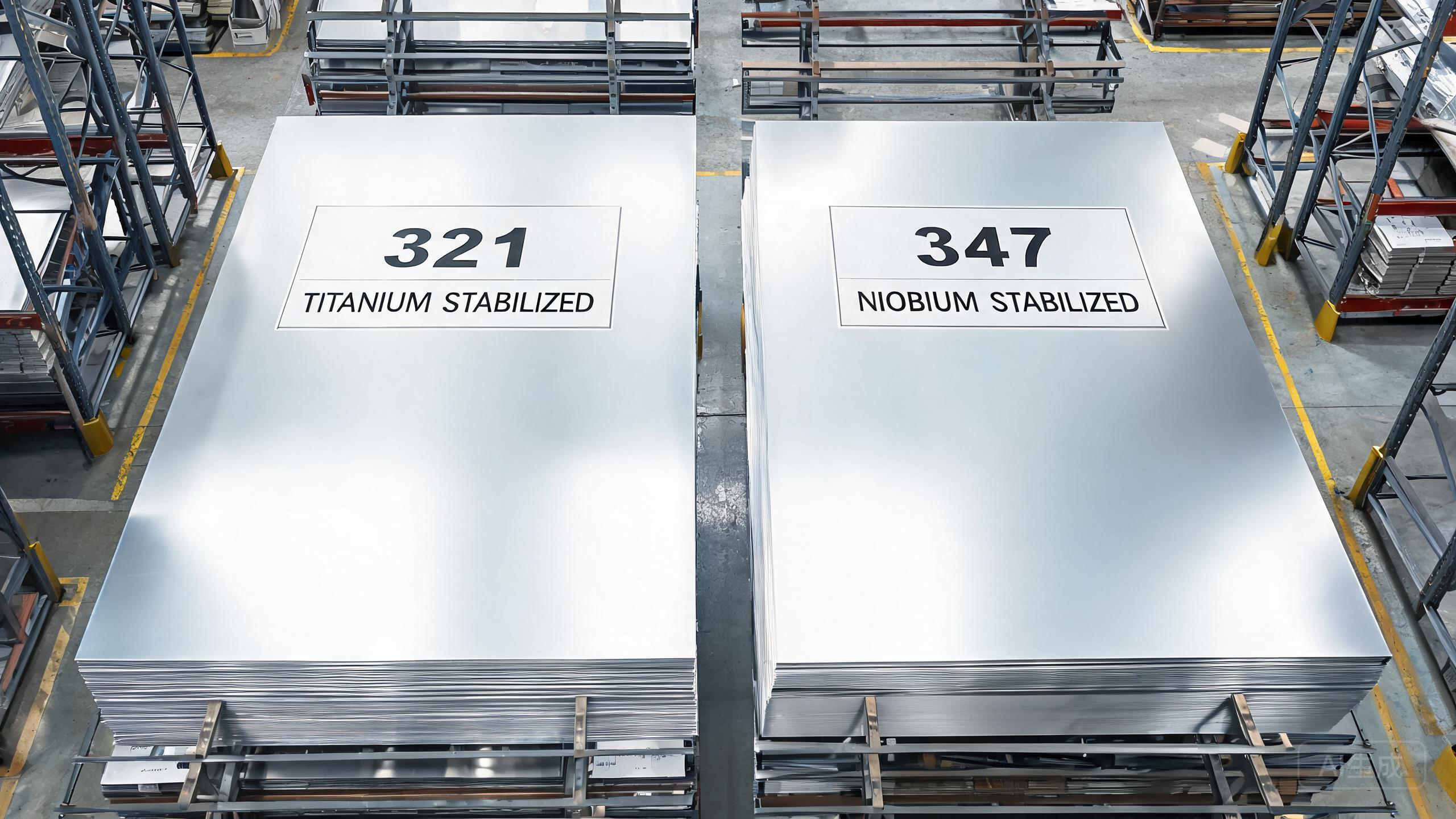
Short answer:
When your stainless steel heat exchanger, furnace part, or pipe operates continuously or intermittently in the 425-870°C range — the danger zone for chromium carbide precipitation — low-carbon 304L isn’t sufficient and you need a stabilized austenitic grade. 321 (UNS S32100, Ti-stabilized) locks carbon away as TiC and handles cyclic/intermittent service up to 870°C. 347 (UNS S34700, Nb+Ta-stabilized) forms NbC that’s stable under continuous heat up to 850°C, making it the choice for boilers, reformers, and process heaters running 24/7. Both grades are ASME BPVC Section II recognized, and both cost 5-10% more than 304L due to the stabilizing additions. China’s refinery and power plant sectors are the largest consumers, with Baosteel and TISCO producing both grades per ASTM A240.
Quick Comparison
| Property | 304L (S30403) | 321 (S32100) | 347 (S34700) | 316L (S31603) |
|---|---|---|---|---|
| Chromium | 18.0-20.0% | 17.0-19.0% | 17.0-19.0% | 16.0-18.0% |
| Nickel | 9.0-13.0% | 9.0-12.0% | 9.0-13.0% | 10.0-14.0% |
| Carbon | ≤0.030% | ≤0.08% | ≤0.08% | ≤0.030% |
| Stabilizer | None | Ti: 5×C min | Nb+Ta: 10×C min | None |
| PREN | ~19 | ~18 | ~18 | ~25 |
| Max Intermittent Temp | 425°C | 870°C | 850°C | 425°C |
| Max Continuous Temp | 425°C | 650°C | 850°C | 425°C |
| Tensile Strength | ≥485 MPa | ≥500 MPa | ≥500 MPa | ≥515 MPa |
| Price Premium vs 304L | Base | +5-10% | +15-20% | +10-15% |
| Typical Uses | Room-temp welded parts | Cyclic high-temp, heat exchangers | Continuous high-temp, boilers, reformers | Chemical piping, marine |
What Buyers Should Evaluate
- Operating temperature mode. 321 wins for cyclic/intermittent heating; 347 wins for continuous service. Define your exact thermal cycle profile before selecting.
- Weld fabrication. Both grades are excellent for welding — no preheat, no post-weld heat treatment needed for thin sections. Filler metal for 321: ER321; for 347: ER347 or ER347L (lower carbon variant preferred).
- Service temperature limits. ASME BPVC Section II provides allowable stress values at elevated temperatures. 347 has higher allowable stresses at 700-850°C vs 321 — critical for pressure vessel design.
- China-specific note. Refinery and chemical plant projects standardize on 347 for continuous process heaters. Power plants use 321 for cyclic boiler components. Verify compliance with GB/T 1220-2020.
- Nb vs Ti commodity cycle. Niobium prices have spiked 40% in 2025 due to supply constraints from Brazil. If your project has long lead time, lock in 347 pricing or consider 321 if service profile allows.
Common Purchasing Mistakes
Mistake: Using 304L for continuous 500°C service “since it’s low-carbon.” A Hebei chemical plant used 304L for a 500°C continuous process line in 2023, thinking low carbon eliminated sensitization risk. After 18 months, NDT inspection found intergranular corrosion cracks in 40% of welds — even with ≤0.03% C, continuous heat causes chromium carbide precipitation over time. Fix: for service above 425°C continuous, stabilized grades are mandatory per ASME BPVC Section II.
Mistake: Chinese factory trick — 321 and 347 with insufficient stabilizer. Some mills in Jiangsu supply 321 with Ti at only 3×C instead of the required 5×C minimum, or 347 with Nb+Ta at only 6×C instead of 10×C. The result: inadequate stabilization, and the material behaves like 304 above 425°C. Solution: PMI (Positive Material Identification) spectroscopy must verify Ti/C ≥5 for 321 and (Nb+Ta)/C ≥10 for 347. Insist on EN 10204 3.1 mill test certificates that list C, Ti, Nb, and Ta explicitly with calculated ratios. Run ASTM A262 Practice E (Strauss test) — sensitized material develops grain boundary corrosion within 12-24 hours of boiling in copper sulfate solution.
Mistake: Confusing 321H and 321. 321H (UNS S32109) has higher carbon (0.04-0.10%) for better elevated-temperature strength — similar to 304H vs 304L. Don’t use 321H in applications requiring 321’s standard carbon range (≤0.08%), as the higher C can reduce stabilization effectiveness.
Mistake: Using wrong filler metal. 321 welded with ER316L filler loses its titanium stabilization benefit — use only ER321 filler. Similarly, 347 must use ER347 (or ER347L for better corrosion resistance). Cross-specifying filler metals is one of the most common field failures in high-temperature stainless welds.
Recommended RFQ Wording
Grade: ASTM A240 / UNS S32100 (321 Ti-stabilized)
  OR: ASTM A240 / UNS S34700 (347 Nb+Ta-stabilized)
Application: [heat exchanger / furnace part / reformer tube / boiler component]
Operating profile: [cyclic / continuous]
Max temperature: [exact °C]
Form: [plate / sheet / pipe / bar]
Thickness: [exact mm]
Quantity: [metric tons]
Certification required:
  - EN 10204 3.1 mill test certificate (C, Ti, Nb, Ta listed with calculated ratios)
  - PMI spectroscopy: (Ti/C ≥5 for 321) or ((Nb+Ta)/C ≥10 for 347)
  - ASTM A262 Practice E sensitization test (no intergranular corrosion)
  - ASME SA-240 compliance (elevated temp allowable stresses verified)
Additional: Weld filler metal ER321 (for 321) or ER347L (for 347) must be specified.
FAQ
Why are stabilized austenitic grades 321 and 347 needed instead of 304L?
304L (UNS S30403, ≤0.03% C) avoids sensitization because low carbon means insufficient carbon to form chromium carbides during welding. However, above 425°C continuous service, even 304L develops intergranular corrosion risk because the remaining carbon can still form Cr₂₃C₆. Stabilized grades 321 and 347 add Ti or Nb+Ta respectively, which form stable carbides (TiC, NbC) at temperatures BEFORE chromium carbide precipitation occurs, locking carbon away permanently.
Which is better for high-temperature heat exchangers — 321 or 347?
It depends on the operating mode. 321 (Ti-stabilized) is better for cyclic high-temperature service (intermittent heating/cooling between 425-870°C) because titanium carbides remain stable through thermal cycling. 347 (Nb+Ta-stabilized) is better for continuous high-temperature service (constant 425-850°C) because niobium carbides have higher thermodynamic stability and resist dissolution better under prolonged heat exposure.
Is 347 more expensive than 321?
Yes, typically 347 costs 10-15% more than 321. The difference comes from niobium’s higher commodity price (Nb ~$15/kg vs Ti ~$8/kg) and tighter compositional control for Nb+Ta (combined minimum 10×C, vs Ti minimum 5×C for 321). The price premium is justified for continuous high-temperature service where 321’s TiC can dissolve and re-precipitate as chromium carbide over long periods.
CTA + Technical References
Send your grade, dimensions, annual volume and application to vip@still-steel.com, or contact us. We supply ASME SA-240 certified 321 and 347 for refinery and power plant high-temperature applications.
References:
- ASME BPVC Section II Part D: Properties (elevated-temperature allowable stresses)
- ASTM A240 / A240M: Standard specification for chromium and chromium-nickel stainless steel plate, sheet, and strip
- ASTM A262: Standard practices for detecting susceptibility to intergranular corrosion in austenitic stainless steels
- GB/T 1220-2020: Stainless steel bars
- See also: 304H vs 304L comparison
Technical References
- ASTM A240M - Standard Specification for Chromium and Chromium-Nickel Stainless Steel Plate, Sheet and Strip
- EN 10088-2 - Stainless steels. Technical delivery conditions for sheet/plate and strip
- ASM International - Handbook Series, Volume 1: Properties and Selection: Irons, Steels, and High-Performance Alloys