
Short answer:
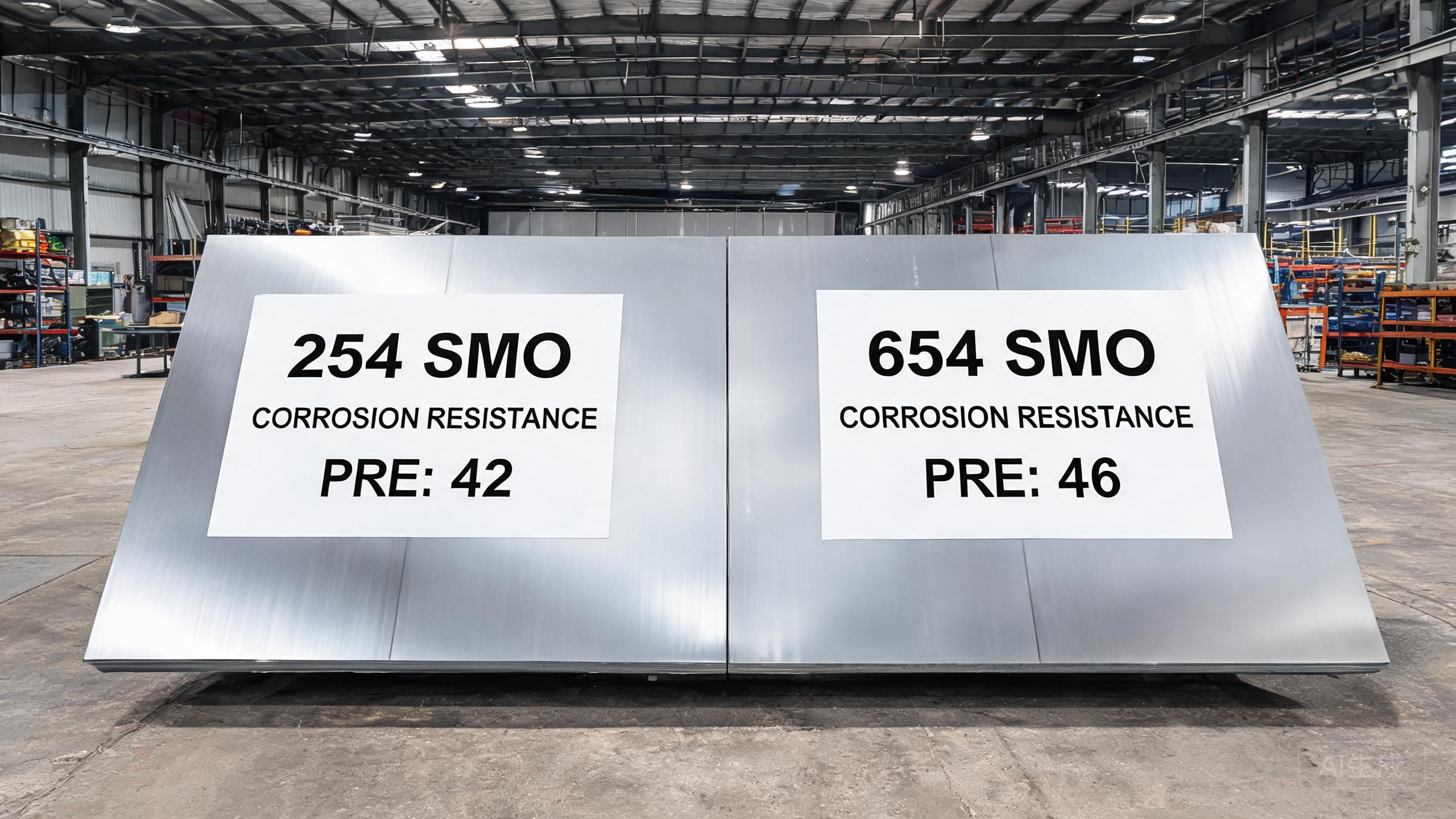
Super austenitic stainless steels exist for the environments where duplex grades (2205, 2507) fail — hot concentrated acids combined with high chlorides. 254 SMO (UNS S31254, PREN ~40) handles most of these, but 654 SMO (UNS S32654, PREN ~45) is the only super austenitic that survives hot concentrated phosphoric acid (≥70% P₂O₅ at 90-110°C) and mixed sulfate-chloride media above 100°C. The 20-30% price premium over 254 SMO buys you 0.8-1.0% extra molybdenum, triple the nitrogen, and 20% higher tensile strength. China’s phosphate fertilizer and fine chemical industries are the largest consumers of 654 SMO, with mills in Baosteel and TISCO now producing it to ASTM A240 specification.
Quick Comparison
| Property | 254 SMO (S31254) | 654 SMO (S32654) | 2205 (S32205) |
|---|---|---|---|
| Chromium | 19.5-20.5% | 19.5-20.5% | 21.0-23.0% |
| Nickel | 17.5-18.5% | 21.0-23.0% | 4.5-6.5% |
| Molybdenum | 6.0-6.5% | 6.8-7.2% | 3.0-3.5% |
| Nitrogen | 0.18-0.22% | 0.40-0.50% | 0.08-0.20% |
| Copper | 0 | 0.3-0.5% | 0 |
| PREN | ~40 | ~45 | ~35 |
| Tensile Strength | ≥650 MPa | ≥770 MPa | ≥620 MPa |
| Yield Strength | ≥300 MPa | ≥430 MPa | ≥450 MPa |
| Corrosion in 70% P₂O₅ @ 100°C | >1.0 mm/year (FAIL) | <0.05 mm/year | >2.0 mm/year (FAIL) |
| Corrosion in Seawater @ 35°C | <0.01 mm/year | <0.005 mm/year | <0.1 mm/year |
| Price Premium vs 2205 | +80-100% | +120-150% | Base |
What Buyers Should Evaluate
- Acid type and concentration. 254 SMO handles hot sulfuric, acetic, and most phosphoric acid below 70% P₂O₅. 654 SMO is mandatory for phosphoric acid above 70% P₂O₅ and temperatures above 90°C.
- Chloride content. Both grades handle high chloride (10,000+ ppm) well, but 654 SMO’s higher nitrogen and PREN give it better pitting resistance above 150°C.
- Weldability. Both grades are fully austenitic with excellent weldability. Use ER385 filler for 254 SMO and ER654 or ER385 for 654 SMO. No preheat or post-weld heat treatment needed for thin sections.
- Stock availability. 254 SMO is stocked more widely. 654 SMO has 6-8 week lead times from Western mills and 4-6 weeks from Baosteel/TISCO. Plan your procurement accordingly.
- China-specific note. Yunnan and Guizhou phosphate fertilizer projects are the primary 654 SMO consumers in China. Verify compliance with GB/T 1220-2020 which recognizes both UNS numbers.
Common Purchasing Mistakes
Mistake: Specifying 254 SMO for concentrated phosphoric acid concentration processes. A Hubei fertilizer plant tried to use 254 SMO for a 72% P₂O₅ evaporator in 2023 to save cost over 654 SMO. The corrosion rate was 1.4 mm/year — the vessel needed replacement after 14 months. Fix: above 70% P₂O₅ and 90°C, 654 SMO is non-negotiable. Run ISO 15156-3 corrosion data for your exact acid concentration and temperature before finalizing.
Mistake: Chinese factory trick — high-molybdenum 254 SMO labeled as 654 SMO. Some mills in Jiangsu push 254 SMO molybdenum to 6.4-6.5% (upper end of its 6.0-6.5% range) and label it 654 SMO. The visual appearance and basic mechanical properties are nearly identical. The critical giveaway is nitrogen content — 254 SMO maxes at 0.22% N; 654 SMO requires 0.40-0.50% N. Solution: PMI (Positive Material Identification) spectroscopy — nitrogen must be ≥0.40% and molybdenum ≥6.8% for genuine 654 SMO. Insist on EN 10204 3.1 mill test certificates that list N and Mo explicitly. For critical applications, run a 72-hour immersion test in 85% H₃PO₄ at 110°C — 254 SMO will show visible corrosion while 654 SMO remains intact.
Mistake: Confusing super austenitic grades with duplex. Super austenitic (254 SMO, 654 SMO) are fully austenitic structures — no ferrite phase. Duplex grades have 50/50 ferrite/austenite. This means super austenitics have better corrosion resistance but lower strength than duplex at the same PREN level. Don’t substitute one for the other without confirming both corrosion and strength requirements.
Mistake: Ignoring crevice corrosion in concentrated acid service. Both 254 SMO and 654 SMO have excellent crevice resistance, but gasket selection matters. Use PTFE or PVDF gaskets — EPDM and rubber gaskets degrade in hot concentrated acids, creating crevices that accelerate corrosion.
Recommended RFQ Wording
Grade: ASTM A240 / UNS S31254 (254 SMO)
  OR: ASTM A240 / UNS S32654 (654 SMO)
Application: [phosphoric acid evaporator / heat exchanger / acid storage tank]
Operating medium: [H₃PO₄ %, P₂O₅ %, temp range °C, chloride ppm]
Form: [plate / pipe / bar / forging]
Thickness: [exact mm + 3mm corrosion allowance]
Surface: Pickled and passivated, Ra ≤0.8μm
Quantity: [metric tons]
Delivery: [required date, shipping incoterm]
Certification required:
  - EN 10204 3.1 mill test certificate (N and Mo listed explicitly)
  - PMI spectroscopy on every heat (verify N ≥0.40%, Mo ≥6.8% for 654 SMO)
  - ISO 15156-3 corrosion data for buyer-specified environment
  - ASTM G31 immersion test report in concentrated H₃PO₄
Additional: Material must comply with ASME B31.3 for process piping applications.
FAQ
What is the main difference between 254 SMO and 654 SMO?
Both are super austenitic stainless steels designed for extreme chloride and acid corrosion environments. 254 SMO (UNS S31254) has PREN ~40, 6.0-6.5% Mo, and tensile ~650 MPa. 654 SMO (UNS S32654) has PREN ~45, 6.8-7.2% Mo, 0.40-0.50% nitrogen (vs 0.18-0.22% for 254 SMO), and tensile ~770 MPa. 654 SMO is specifically formulated to handle hot concentrated phosphoric acid (≥70% P₂O₅ at 90-110°C).
When should I upgrade from 254 SMO to 654 SMO?
Upgrade to 654 SMO when your application involves: (1) phosphoric acid concentration processes (≥70% P₂O₅ at ≥90°C), (2) mixed chloride-organic acid environments with chloride above 5,000 ppm, or (3) temperatures above 100°C in sulfate-chloride media. 254 SMO fails above 90°C in concentrated phosphoric acid — corrosion rate exceeds 1.0 mm/year vs <0.05 mm/year for 654 SMO.
Is 654 SMO’s 20-30% price premium justified?
Absolutely. In a 2023 case study, a Yunnan phosphate fertilizer plant used 254 SMO for a concentrated H₃PO₄ evaporator. The corrosion rate was 1.2 mm/year — liner replacement needed every 18 months at $180,000 each. With 654 SMO, corrosion rate dropped to 0.03 mm/year, projecting 20+ years of service without maintenance. Total cost savings over the system lifetime exceeded $2.5 million.
CTA + Technical References
Send your grade, dimensions, annual volume and application to vip@still-steel.com, or contact us. We supply 254 SMO and 654 SMO super austenitic stainless per ASTM A240 for chemical and fertilizer applications.
References:
- ASTM A240 / A240M: Standard specification for chromium and chromium-nickel stainless steel plate, sheet, and strip
- ISO 15156-3: Petroleum, petrochemical and natural gas industries — Materials for use in H2S-containing environments
- ASME B31.3: Process Piping
- ASTM G31: Standard guide for laboratory immersion corrosion testing of metals
- See also: 317L vs 316L comparison
Technical References
- ASTM A240M - Standard Specification for Chromium and Chromium-Nickel Stainless Steel Plate, Sheet and Strip
- EN 10088-2 - Stainless steels. Technical delivery conditions for sheet/plate and strip
- ASM International - Handbook Series, Volume 1: Properties and Selection: Irons, Steels, and High-Performance Alloys