
Short answer:
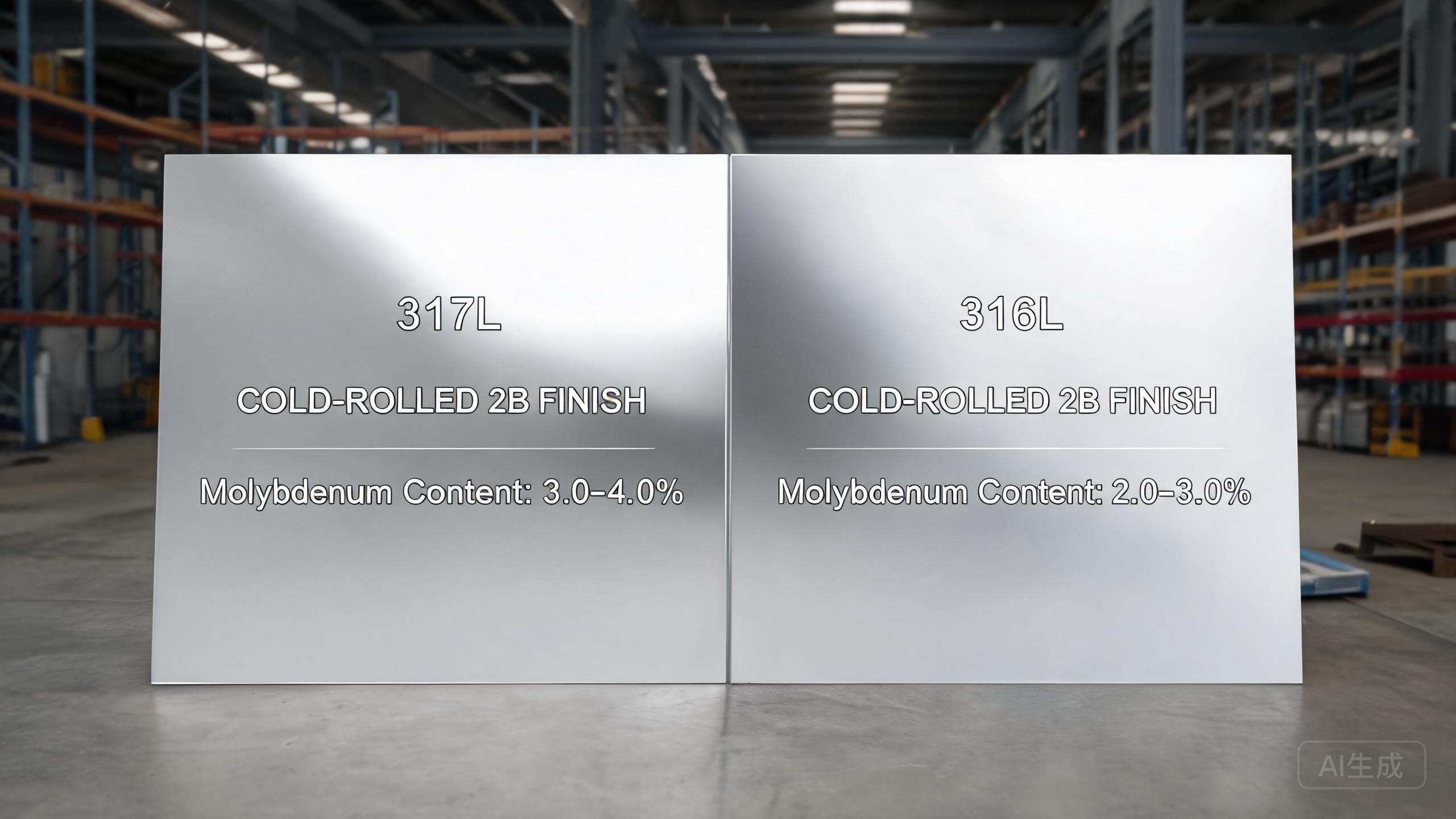
317L (UNS S31703) is 316L’s higher-molybdenum cousin, carrying an extra 1% Mo (3.0-4.0% vs 2.0-3.0%) that makes all the difference in aggressive chemical environments where 316L fails. If you’re processing hot concentrated phosphoric acid, hot acetic acid with chloride impurities, or high-chloride process streams above 1,000 ppm Cl⁻, 317L is non-negotiable. The 15-25% material price premium over 316L is trivial compared to the cost of unplanned shutdowns, liner replacements, or premature equipment failure. The PREN difference is telling — 316L sits at ~25, while 317L hits ~32 — a significant jump in pitting resistance threshold.
Quick Comparison
| Property | 316L (S31603) | 317L (S31703) | 904L (N08904) |
|---|---|---|---|
| Chromium | 16.0-18.0% | 18.0-20.0% | 19.0-23.0% |
| Nickel | 10.0-14.0% | 11.0-15.0% | 23.0-28.0% |
| Molybdenum | 2.0-3.0% | 3.0-4.0% | 4.0-5.0% |
| PREN | ~25 | ~32 | ~35 |
| Yield (0.2%) | ≥205 MPa | ≥205 MPa | ≥210 MPa |
| Tensile | ≥515 MPa | ≥515 MPa | ≥500 MPa |
| Max Phosphoric Acid Corrosion Rate (60°C, 50%) | ~0.5 mm/year | <0.05 mm/year | <0.02 mm/year |
| Price vs 316L | Base (+0%) | +15-25% | +60-80% |
| Typical Uses | General chemical, food, pharmaceutical | Phosphoric acid, hot acetic, high-Cl⁻ streams | Sulfuric acid, hydrochloric, extreme acid service |
What Buyers Should Evaluate
- Corrosion data sheet matching. Never select grade by reputation alone. Request ISO 15156-3 corrosion data for your exact operating environment (acid type, concentration, temperature, chloride content, pressure).
- Weldability. 317L is fully austenitic and has excellent weldability with ER317L filler. No preheat or post-weld heat treatment required for thin sections (≤10mm).
- Formability. 317L has comparable ductility to 316L but slightly higher springback (8-10% vs 6-8% for 316L). Adjust press brake bending parameters accordingly.
- Stock availability. 317L is less commonly stocked than 316L. Lead times from Chinese mills are typically 3-6 weeks vs 1-2 weeks for 316L. Plan accordingly.
- China-specific sourcing note. Only a handful of Chinese mills produce 317L to ASTM A240 specification. Verify mill certification before committing — some mills sell “317L” that actually contains Mo at the 316L upper limit.
Common Purchasing Mistakes
Mistake: Sticking with 316L “because we’ve always used it” when upgrading to higher-concentration feedstocks. A Guangxi fertilizer plant upgraded their phosphoric acid concentration from 40% to 55% in 2023 but kept 316L reactor liners. Corrosion rate spiked from 0.3 mm/year to 1.2 mm/year, and liners failed after 9 months. Fix: whenever operating conditions change — acid concentration, temperature, or chloride level — re-run material selection per ISO 15156-3 data.
Mistake: Chinese factory trick — 317L with low-end molybdenum content. 317L requires 3.0-4.0% Mo. Multiple mills in Fujian have supplied 317L with only 2.6-2.9% Mo (below the 3.0% floor), delivering material that passes visual inspection but has 20-30% lower corrosion resistance. Solution: PMI (Positive Material Identification) spectroscopy on every plate is mandatory. Insist on EN 10204 3.1 mill test certificates that list exact Mo content. For critical chemical equipment, have SGS or TÜV verify 15% of incoming plates.
Mistake: Confusing 317L with 317LN. 317LN adds 0.10-0.22% nitrogen for higher tensile strength (~600 MPa vs 515 MPa for 317L). It’s suitable for high-pressure vessels but costs an additional 5-10% above standard 317L. Specify LN only if your design code explicitly requires the higher strength.
Mistake: Inadequate corrosion allowance. For 317L in chemical service, use minimum 3mm corrosion allowance above the structural minimum thickness. In phosphoric acid with chloride contamination, increase to 4mm.
Recommended RFQ Wording
Grade: ASTM A240 / UNS S31703 (317L), mill certified per ASTM A240-23
Application: [phosphoric acid reactor / acetic acid column / high-Cl⁻ pipeline]
Operating medium: [acid type, concentration, Cl⁻ ppm, temperature range]
Form: [plate / coil / pipe]
Thickness: [exact mm] + 3mm corrosion allowance
Surface: 2B mill finish, pickled and passivated
Quantity: [metric tons]
Delivery: [required date, shipping incoterm]
Certification required:
  - EN 10204 3.1 mill test certificate (exact Mo content listed)
  - PMI spectroscopy report on every heat
  - Corrosion test report per ASTM G31 (immersion) for buyer-specified medium
Additional: Material must comply with ISO 15156-3 for chemical processing equipment.
FAQ
What is the molybdenum content difference between 317L and 316L?
316L (UNS S31603) contains 2.0-3.0% molybdenum. 317L (UNS S31703) contains 3.0-4.0% molybdenum — approximately 1% more on average. It also has slightly higher chromium (18.0-20.0% vs 16.0-18.0% for 316L) and nitrogen (≤0.05% vs ≤0.10%).
When is 317L stainless steel mandatory over 316L?
317L is mandatory for chemical processing involving: (1) hot concentrated phosphoric acid (>50%, >60°C), (2) hot acetic acid (>80%, especially with chloride contamination), (3) sulfurous acid or ammonium sulfate environments, and (4) high-chloride process streams (≥1,000 ppm Cl⁻) where 316L shows pitting within 1-2 years.
Is the 15-25% price premium for 317L justified?
Yes, when the operating environment demands it. In a 2022 case study, a Jiangsu phosphoric acid plant switched from 316L to 317L for a reactor tank. The tank previously needed liner replacement every 18 months (costing $120,000 each time). With 317L, corrosion rate dropped from 0.8 mm/year to <0.05 mm/year — projected service life of 15+ years with no liner needed.
CTA + Technical References
Send your grade, dimensions, annual volume and application to vip@still-steel.com, or contact us. We supply certified 317L and 317LN plate per ASTM A240 to chemical processing plants across Asia.
References:
- ASTM A240 / A240M: Standard specification for chromium and chromium-nickel stainless steel plate, sheet, and strip for pressure vessels
- ISO 15156-3: Petroleum, petrochemical and natural gas industries — Materials for use in H2S-containing environments — Part 3: CRAs and other alloys
- ASTM G31: Standard guide for laboratory immersion corrosion testing of metals
- See also: CCUS carbon capture stainless steel
Technical References
- ASTM A240M - Standard Specification for Chromium and Chromium-Nickel Stainless Steel Plate, Sheet and Strip
- EN 10088-2 - Stainless steels. Technical delivery conditions for sheet/plate and strip
- ASM International - Handbook Series, Volume 1: Properties and Selection: Irons, Steels, and High-Performance Alloys