
Short answer:
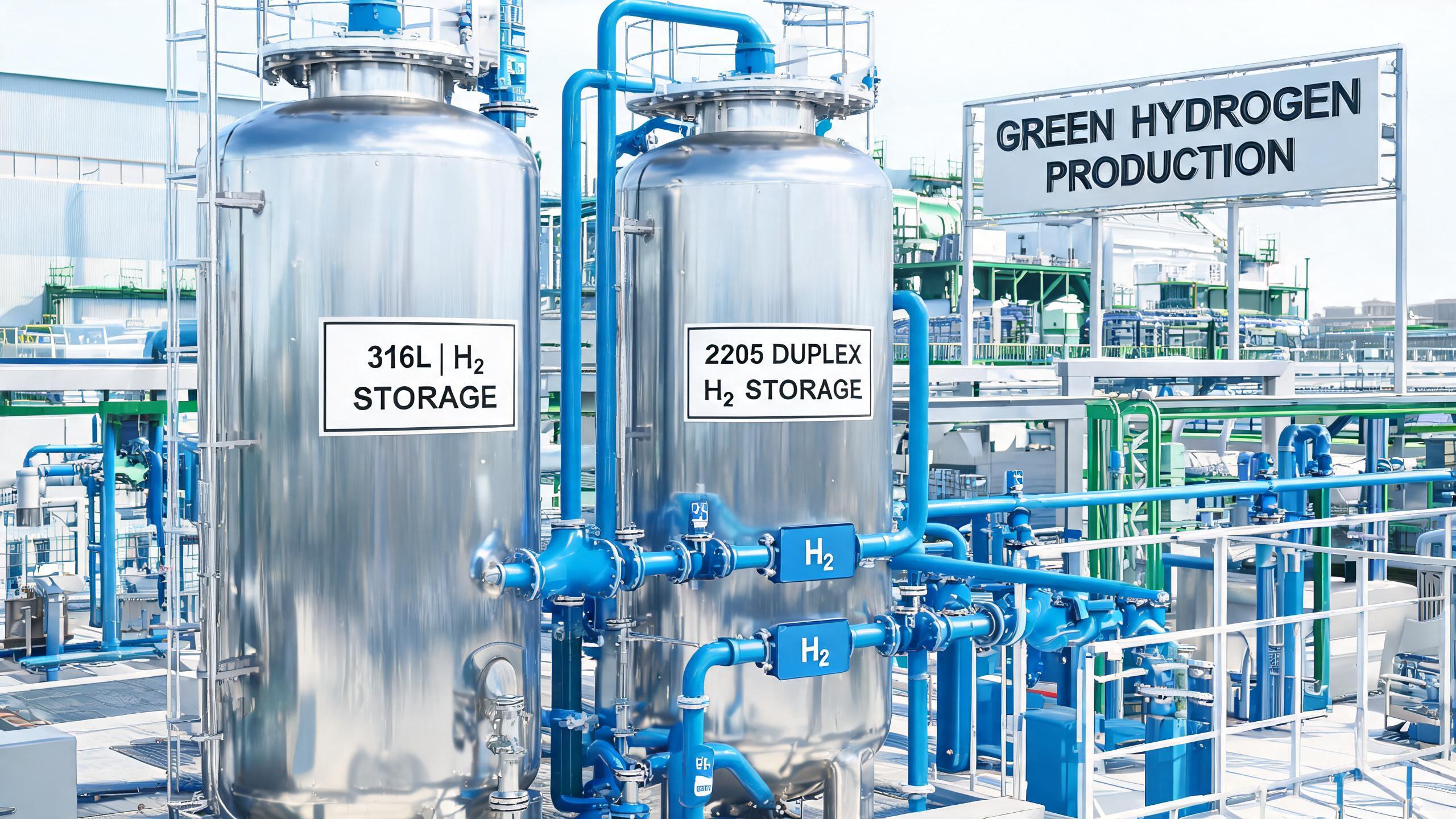
If you’re specifying stainless steel for gaseous hydrogen storage tanks or pipelines, start with these rules: 304 is never safe for H2 at pressure above 10 bar due to hydrogen embrittlement. 316L (UNS S31603) handles ambient-temperature storage up to about 50 bar and is the economical workhorse. Duplex 2205 (UNS S32205) is your go-to for pressures above 50 bar — it combines higher tensile strength with proven hydrogen embrittlement resistance. The hydrogen storage steel market in China alone is projected at 5.76 billion RMB by 2027, driven by national energy transition mandates, and mills are racing to qualify 2205 to ASME BPVC Section VIII Division 1 standards for stationary tanks.
Quick Comparison
| Grade | UNS Number | Tensile (MPa) | Yield (MPa) | HE Susceptibility | Max Safe H2 Pressure | Typical Service |
|---|---|---|---|---|---|---|
| 304 | S30400 | 500-700 | ≥210 | HIGH (not recommended) | ≤10 bar (ambient) | Never for H2 storage |
| 316L | S31603 | ≥515 | ≥205 | LOW | ~50 bar (ambient) | Low-pressure H2 tanks, pipelines |
| 316Ti | S31635 | ≥500 | ≥210 | LOW | ~50 bar (ambient) | Welded assemblies needing carbide stabilization |
| 2205 | S32205 | ≥620 | ≥450 | VERY LOW | ~700 bar (ambient) | High-pressure H2 tanks, refueling stations |
| 2507 | S32750 | ≥800 | ≥550 | VERY LOW | >700 bar (extreme) | Ultra-high-pressure, coastal H2 infrastructure |
What Buyers Should Evaluate
- Operating pressure and temperature. The two biggest variables in H2 storage material selection. If you’re above 50 bar or above 80°C service temperature, upgrade from 316L to 2205.
- ASME BPVC code compliance. Pressure vessels must meet Section VIII Division 1 or 2. Confirm your mill has the appropriate ASME “U” stamp certification for hydrogen service.
- Hydrogen purity. 99.99% pure hydrogen accelerates embrittlement compared to lower-purity H2 with trace moisture or carbon monoxide (which can act as a recombination inhibitor).
- Weld qualification. Hydrogen storage welds require 100% X-ray or ultrasonic testing per ASME IX. Specify filler metal ER316L (for 316L) or ER2209 (for duplex).
- Fatigue life. If your tank will undergo pressure cycling (filling/emptying), specify a fatigue factor of safety ≥4x the highest operating pressure. Duplex grades offer superior fatigue resistance.
- China-specific note. China’s national hydrogen storage standard GB/T 41504-2022 mirrors ISO 19880-1 for pressure vessels. Verify your supplier’s material meets both standards if the project exports internationally.
Common Purchasing Mistakes
Mistake: Using 304 for low-pressure H2 thinking “it’s just a storage tank.” Even at 15 bar, hydrogen at 99.99% purity can cause delayed fracture in 304 over 1-3 years of service. A 2024 incident in Dalian saw a 304 H2 tank rupture at 12 bar after 18 months due to HE. Fix: always specify 316L minimum for any hydrogen storage above atmospheric pressure.
Mistake: Chinese factory trick — heat number fraud and unqualified mill certs. Several incidents in Zhejiang and Jiangsu involved mills providing ASME-style certs for H2 tanks where the actual chemistry failed nickel or molybdenum content. Solution: demand a third-party PMI spectroscopy audit (SGS or TÜV Rheinland) on at least 5% of plates, plus EN 10204 3.1 mill test certificates. For H2 pressure vessels specifically, insist on ASME U-stamp certification which requires unannounced third-party inspections.
Mistake: Ignoring cold-formed material HE sensitivity. Cold-rolled 304 with >20% cold work has 5-10x higher HE susceptibility than annealed 304. For formed H2 components, require a final solution anneal at 1050°C followed by water quench — this fully restores the austenitic microstructure and eliminates residual cold work stress.
Mistake: Underestimating thermal expansion. Hydrogen storage at ambient vs cryogenic temperatures (-253°C for liquid H2) sees 0.3% linear thermal contraction for 316L. In mixed-temperature systems, use a duplex transition piece between cryogenic 316L piping and ambient-temperature duplex 2205 tanks to manage differential expansion.
Recommended RFQ Wording
Grade: ASTM A240 / UNS S31603 (316L) OR UNS S32205 (2205), per buyer selection
Application: [H2 storage tank / pipeline / refueling station component]
Operating pressure: [exact bar / psi]
Operating temperature: [min - max °C]
Form: [plate / pipe / forged component]
Thickness / schedule: [exact spec]
Quantity: [kg or number of pieces]
Required certifications:
  - ASME U-stamp (Section VIII Div 1 or 2)
  - EN 10204 3.1 mill test certificate
  - SGS/TÜV PMI spectroscopy report on ≥5% sample per heat
Additional: Material must comply with ISO 19880-1 gaseous hydrogen pressure vessel requirements.
Weld filler specification (if applicable): ER316L or ER2209 per AWS A5.4.
FAQ
Can 304 stainless steel be used for hydrogen storage tanks?
No. 304 (UNS S30400) is generally NOT recommended for hydrogen storage at pressures above 10 bar. It is susceptible to hydrogen embrittlement (HE) at ambient temperatures under high hydrogen partial pressure. The risk increases with hydrogen purity, pressure, and temperature. Use 316L, 316Ti, or duplex 2205 instead.
Which stainless steel is best for high-pressure hydrogen storage above 50 bar?
Duplex 2205 (UNS S32205) is preferred for high-pressure hydrogen storage above 50 bar. Its higher tensile strength (~650 MPa vs ~515 MPa for 316L) and resistance to hydrogen embrittlement make it suitable for pressures up to 700 bar (10,000 psi). Super duplex 2507 can be specified for extreme applications above 700 bar.
Is stainless steel hydrogen embrittlement risk temperature-dependent?
Yes. Hydrogen embrittlement risk peaks at ambient to moderately elevated temperatures (20-200°C). Below -50°C and above 300°C, most austenitic stainless steels show significantly reduced HE susceptibility. Always cross-reference operating temperature with material selection.
CTA + Technical References
Send your grade, dimensions, annual volume and application to vip@still-steel.com, or contact us. We supply ASME-qualified 316L and 2205 for hydrogen energy projects across China and export markets.
References:
- ASME BPVC Section VIII Divisions 1 and 2: Pressure Vessels
- ISO 19880-1: Gaseous hydrogen — Fueling stations — General requirements
- NACE SP0472: Methods and testing to monitor cracking/amorphous crack growth
- ASTM A240: Standard specification for chromium and chromium-nickel stainless steel plate, sheet, and strip for pressure vessels
- See also: CCUS carbon capture stainless steel
Technical References
- ASTM A240M - Standard Specification for Chromium and Chromium-Nickel Stainless Steel Plate, Sheet and Strip
- EN 10088-2 - Stainless steels. Technical delivery conditions for sheet/plate and strip
- ASM International - Handbook Series, Volume 1: Properties and Selection: Irons, Steels, and High-Performance Alloys