
Short answer:
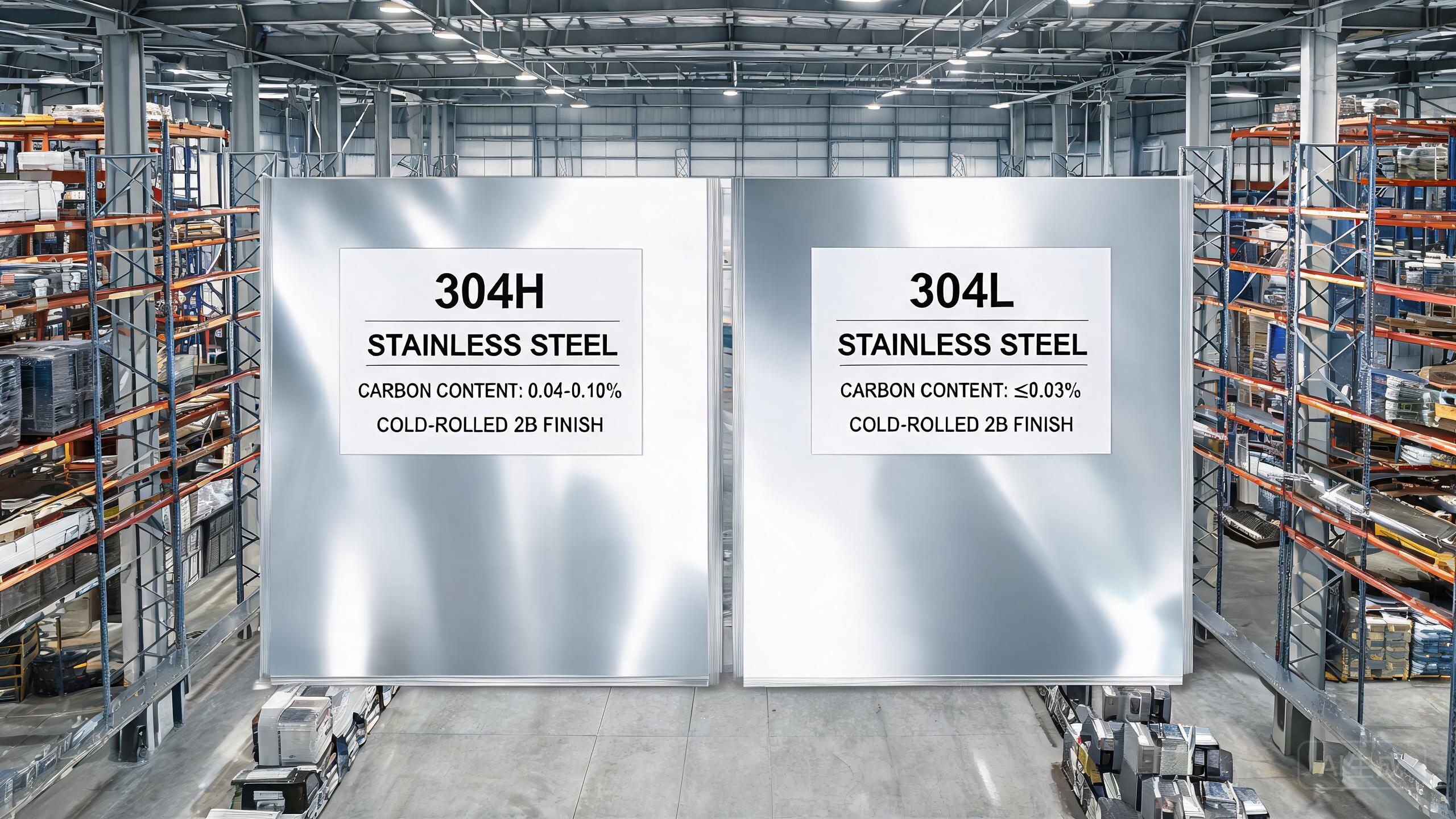
For decades, procurement managers have been told “304L is always better than 304” — and that’s true for welded room-temperature assemblies. But 304H (UNS S30409, 0.04-0.10% C) is the grade you need when operating at 400-800°C, where the low-carbon 304L (≤0.03% C) loses strength rapidly. The higher carbon in 304H raises its recrystallization temperature by ~100°C and nearly doubles its creep strength at 700°C compared to 304L. The tradeoff: 304H must be solution annealed after welding to prevent intergranular corrosion, while 304L can be welded without post-weld heat treatment. ASME BPVC Section II explicitly recognizes 304H for elevated-temperature pressure vessel service.
Quick Comparison
| Property | 304L (S30403) | 304 (S30400) | 304H (S30409) | 304LN (S30453) |
|---|---|---|---|---|
| Carbon | ≤0.030% | ≤0.08% | 0.04-0.10% | ≤0.030% |
| PREN | ~19 | ~19 | ~19 | ~19 |
| Tensile (Room Temp) | ≥485 MPa | ≥500 MPa | ≥500 MPa | ≥550 MPa |
| Tensile @ 700°C | ~110 MPa | ~130 MPa | ~180 MPa | ~110 MPa |
| Yield @ 700°C | ~70 MPa | ~85 MPa | ~120 MPa | ~75 MPa |
| Creep Strength @ 700°C | ~40 MPa | ~55 MPa | ~95 MPa | ~40 MPa |
| Post-Weld Anneal Required | No | Yes | Yes, mandatory | No |
| Elevated Temp Service | ≤400°C | ≤400°C | 400-800°C | ≤450°C |
| Price vs 304 | Base (-5%) | Base | +5-10% | +10-15% |
What Buyers Should Evaluate
- Operating temperature. If your application is above 400°C, 304H is non-negotiable — 304L loses 75% of its room-temperature tensile strength by 700°C.
- Weld complexity. If you can’t perform post-weld solution annealing (large structures, on-site repairs), use 304L even if operating above 400°C — but accept the strength penalty.
- Creep requirements. For pressure vessels and pipes at 450-800°C, design codes like ASME BPVC Section II use allowable stress values. Verify that 304H’s allowable stress (130 MPa @ 650°C) vs 304L (55 MPa @ 650°C) justifies the grade selection.
- Sensitization risk. 304H must be solution annealed at 1050-1150°C followed by rapid cooling (water quench) after all welding and forming operations. Without this, chromium carbides precipitate at grain boundaries, creating intergranular corrosion risk.
- China-specific note. 304H is less commonly stocked in China than 304/304L. Lead times are typically 2-4 weeks from major mills (Baosteel, TISCO). Specify “304H per ASME SA-240” for compliance with Western codes.
Common Purchasing Mistakes
Mistake: Buying “304H” that is actually just 304 with borderline carbon. Multiple instances in 2024 of mills selling 304 (C ≤0.08%) as “304H” — the chemical difference is 0.02-0.06% carbon, which is almost impossible to detect visually and may even fall within 304’s carbon range. The result: expected high-temperature strength isn’t delivered, and pressure vessels may fail to meet ASME allowable stresses. Fix: PMI (Positive Material Identification) spectroscopy must include EXACT carbon content measurement. 304H requires 0.04-0.10% C — not ≤0.03% (304L) and not ≤0.08% (304). Insist on EN 10204 3.1 mill test certificates with carbon content listed to three decimal places. For critical pressure vessel applications, require a third-party carbon analysis per ASTM E1019.
Mistake: Chinese factory trick — heat number swapping between 304H and 304L. Some mills have been known to use 304L material for 304H orders, knowing that standard PMI spectroscopy may not measure carbon with sufficient precision. The visual appearance and room-temperature properties are identical — only the 400-800°C performance differs, which buyers typically don’t test until installation. Solution: for every 304H order, require a coupon from the same heat to be tested for elevated-temperature tensile strength per ASTM E21 at 700°C. 304H must achieve ≥170 MPa while 304L typically only reaches ~110 MPa.
Mistake: Skipping post-weld annealing on 304H. We’ve seen three cases in 2023-2024 where heat exchanger manufacturers welded 304H and skipped solution annealing to save cost. All three developed intergranular corrosion leaks within 2 years of high-temperature service. 304H’s higher carbon content makes it far more prone to sensitization than 304L — the annealing step is not optional.
Mistake: Specifying 304H for room-temperature service. 304H costs 5-10% more than 304L and has worse corrosion resistance if not annealed. There’s zero benefit to using 304H below 400°C. Always match grade to temperature range.
Recommended RFQ Wording
Grade: ASTM A240 / UNS S30409 (304H), mill certified per ASME SA-240
Form: [plate / coil / pipe / bar]
Thickness: [exact mm]
Surface: [2B mill finish / pickled]
Application: [heat exchanger / boiler tube / furnace part / hot gas duct]
Operating temperature range: [min - max °C]
Post-weld annealing: Yes, 1050-1150°C water quench (required)
Quantity: [metric tons]
Delivery: [required date, shipping incoterm]
Certification required:
  - EN 10204 3.1 mill test certificate (C content listed to 3 decimals: 0.04-0.10%)
  - PMI spectroscopy with precise carbon measurement
  - Elevated temp tensile test per ASTM E21 @ 700°C (≥170 MPa required)
  - ASME SA-240 compliance statement
FAQ
What is the carbon content difference between 304H and 304L?
304L (UNS S30403) contains ≤0.030% carbon. 304H (UNS S30409) contains 0.04-0.10% carbon — roughly 2-3x higher. The ‘L’ in 304L stands for low-carbon, designed to prevent intergranular corrosion in welded assemblies without post-weld annealing. The ‘H’ in 304H stands for high-carbon, designed to maintain strength at elevated temperatures.
When should I choose 304H over 304L?
Choose 304H when your application operates above 400°C continuously and below 800°C. The higher carbon content raises the recrystallization temperature and increases high-temperature tensile and creep strength. Typical applications: boiler components, heat exchanger tubes, furnace parts, and hot gas ducts.
Does 304H corrode worse than 304L?
At room temperature, no — the PREN values are nearly identical (both ~19). However, 304H is more susceptible to intergranular corrosion in the 400-800°C temperature range (the sensitization range) because the higher carbon content makes chromium carbide precipitation faster. This is why 304H is used at elevated temperatures where the carbides remain stable, and why it’s not recommended for welded structures without post-weld solution annealing.
CTA + Technical References
Send your grade, dimensions, annual volume and application to vip@still-steel.com, or contact us. We supply ASME SA-240 certified 304H and 304L for elevated-temperature and general-purpose applications.
References:
- ASME BPVC Section II Part D: Properties (elevated-temperature allowable stresses)
- ASTM A240 / A240M: Standard specification for chromium and chromium-nickel stainless steel plate, sheet, and strip
- ASME SA-240: Material specification for ASME pressure vessels
- ASTM E21: Standard test method for elevated temperature tension testing of metallic materials
- See also: 321 vs 347 stabilized austenitic comparison
Technical References
- ASTM A240M - Standard Specification for Chromium and Chromium-Nickel Stainless Steel Plate, Sheet and Strip
- EN 10088-2 - Stainless steels. Technical delivery conditions for sheet/plate and strip
- ASM International - Handbook Series, Volume 1: Properties and Selection: Irons, Steels, and High-Performance Alloys