
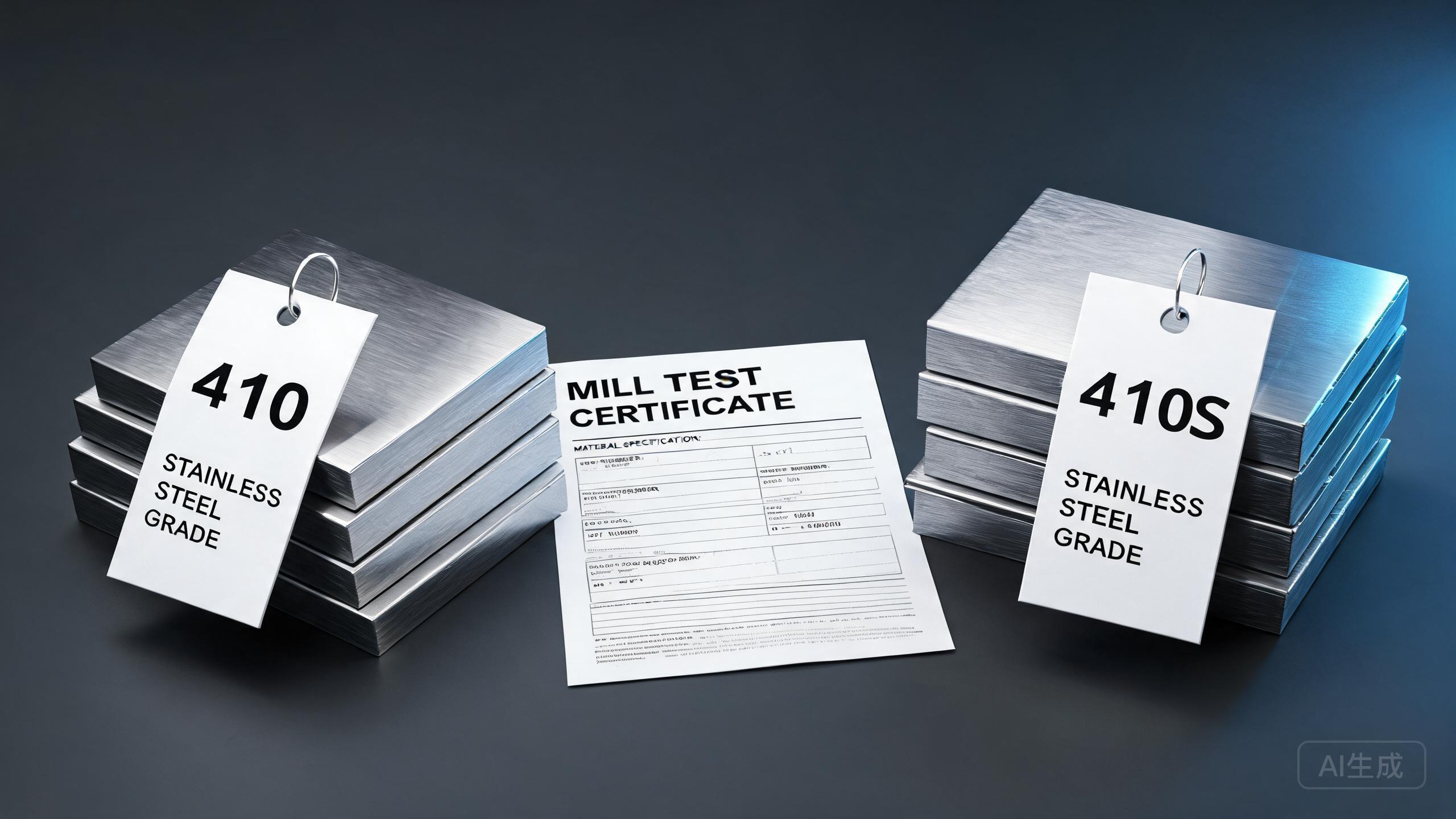
Short answer: The letter S marks a carbon ceiling, not a minor tweak. 410 stainless steel (UNS S41000) is a martensitic grade whose carbon of 0.08-0.15% lets it harden by heat treatment to high strength and HRC 25-50. 410S (UNS S41008) caps carbon at 0.08% so it never forms martensite; it stays soft, welds without preheat and resists crack-prone joints. If you need hardness and wear, buy 410. If you need weldability and forming for large or welded fabrications, buy 410S.
This guide explains the differences a buyer actually pays for: chemistry, heat treatment, weldability, corrosion and total project cost.
Quick Comparison
| Item | 410 (UNS S41000) | 410S (UNS S41008) |
|---|---|---|
| Family | Martensitic | Ferritic |
| Carbon (C) | 0.08-0.15% | 0.08% max (usually 0.03-0.06%) |
| Chromium (Cr) | 11.5-13.5% | 11.5-14.5% |
| Hardenable | Yes (HRC 25-50) | No (~75 HRB max) |
| Weldability | Poor: preheat + PWHT required | Excellent: no preheat needed |
| Tensile (annealed approx.) | ~480 MPa (hardened up to ~850 MPa) | ~444 MPa |
| Elongation | ~20% (annealed) | ≥33% |
| Typical uses | Pump shafts, valve seats, turbine blades, cutlery, high-strength fasteners | Heat exchanger tubing, refinery baffles, annealing baskets, exhaust parts |
The deciding factor is carbon. Above the martensite-forming threshold, 410 hardens and sacrifices weldability. Below that threshold, 410S stays ductile and weldable.
What Buyers Should Evaluate
-
Hardness need. 410 is one of the few stainless grades that hardens to HRC 40-50. If your part must stay sharp or resist wear, 410 is the candidate; 410S will disappoint.
-
Welding volume. Large welded structures in 410 need preheat at 250-350°C and post-weld annealing, which raises fabrication cost. 410S welding is correspondingly simpler.
-
Corrosion. Both have similar general corrosion resistance thanks to comparable chromium. Do not rely on either for chloride-rich or seawater service; consider 316L or a duplex grade there.
-
Heat treatment route. 410 anneals at 815-900°C; 410S anneals at 760-815°C. 410S post-weld treatment is only stress relief, not a mechanical-property restore.
-
Certificate. Confirm the UNS number (S41000 vs S41008) and EN designation (1.4006 vs 1.4000) on the mill certificate. The small name change hides a different microstructure.
Common Purchasing Mistakes
-
Calling 410S a “low-carbon 410”. It is not a softer 410; its microstructure is fully ferritic, which is why it behaves differently in welding and heat treatment.
-
Buying 410 for a welded assembly that can never be annealed. Without post-weld heat treatment, hard HAZ martensite can crack. 410S exists to solve this exact problem.
-
Expecting hardness from 410S. If the drawing calls for a hardened blade or a high-strength part, 410S cannot deliver it; specify 410.
-
Skipping preheat rules on 410. Small weldments still face hydrogen cold cracking; preheat and PWHT are part of the material decision, not an optional extra.
-
Assuming identical price behavior. 410S mill price is often 3-8% higher, but total project cost is usually lower because it deletes preheat and PWHT (which can add 15-25% to fabrication cost).
Recommended RFQ Wording
State the intended final use so the supplier can check the weldability, heat-treatment and certificate requirements before quoting:
-
“Grade 410 (UNS S41000) / 410S (UNS S41008), per ASTM A240, in the annealed condition.”
-
“Part will be welded; confirm whether preheat and post-weld heat treatment are required.”
-
“Confirmation that the offered heat meets the UNS designation on the EN 10204 3.1 certificate.”
-
“Supply the mill test certificate and state thickness range and surface finish (2B, No.1, BA).”
-
Include quantity, destination, delivery date and whether partial shipments are allowed.
How Still Steel Supports the Project
Still Steel supplies stainless coil, strip and sheet and provides slitting, cut-to-length, brushing, polishing and protective-film services. We stock both 410 and 410S, can compare available mill heats against your drawing, prepare trial quantities and preserve heat-number traceability through processing.
Send the grade, dimensions, annual volume and application to vip@still-steel.com, or discuss the requirement on WhatsApp.
Frequently Asked Questions
Is 410S ferritic or martensitic stainless steel?
410S (UNS S41008) is ferritic. Its carbon is limited to 0.08% max, so it cannot form martensite under any heat treatment and remains fully ferritic through all thermal cycles, which is why it stays soft and welds well.
Can 410 be hardened by heat treatment?
Yes. After austenitizing around 980-1010°C and oil or air quenching, 410 reaches HRC 40-50, then tempering tailors the hardness-toughness balance. 410S cannot be hardened and stays around 75 HRB max.
Is 410 or 410S easier to weld?
410S is easier. It needs no preheat and no mandatory post-weld heat treatment because no martensite forms in the heat-affected zone. 410 needs preheat at 250-350°C plus post-weld annealing to avoid hydrogen cold cracking.
What is stronger, 410 or 410S?
Hardened 410 is stronger, reaching up to about 850 MPa tensile with high hardness. Annealed 410 is roughly 480 MPa, while 410S is about 444 MPa and cannot be hardened.
Technical References
Reference documents support general selection principles. The final material decision must follow the applicable contract, standard and engineering review for the specific product.