
Short answer:
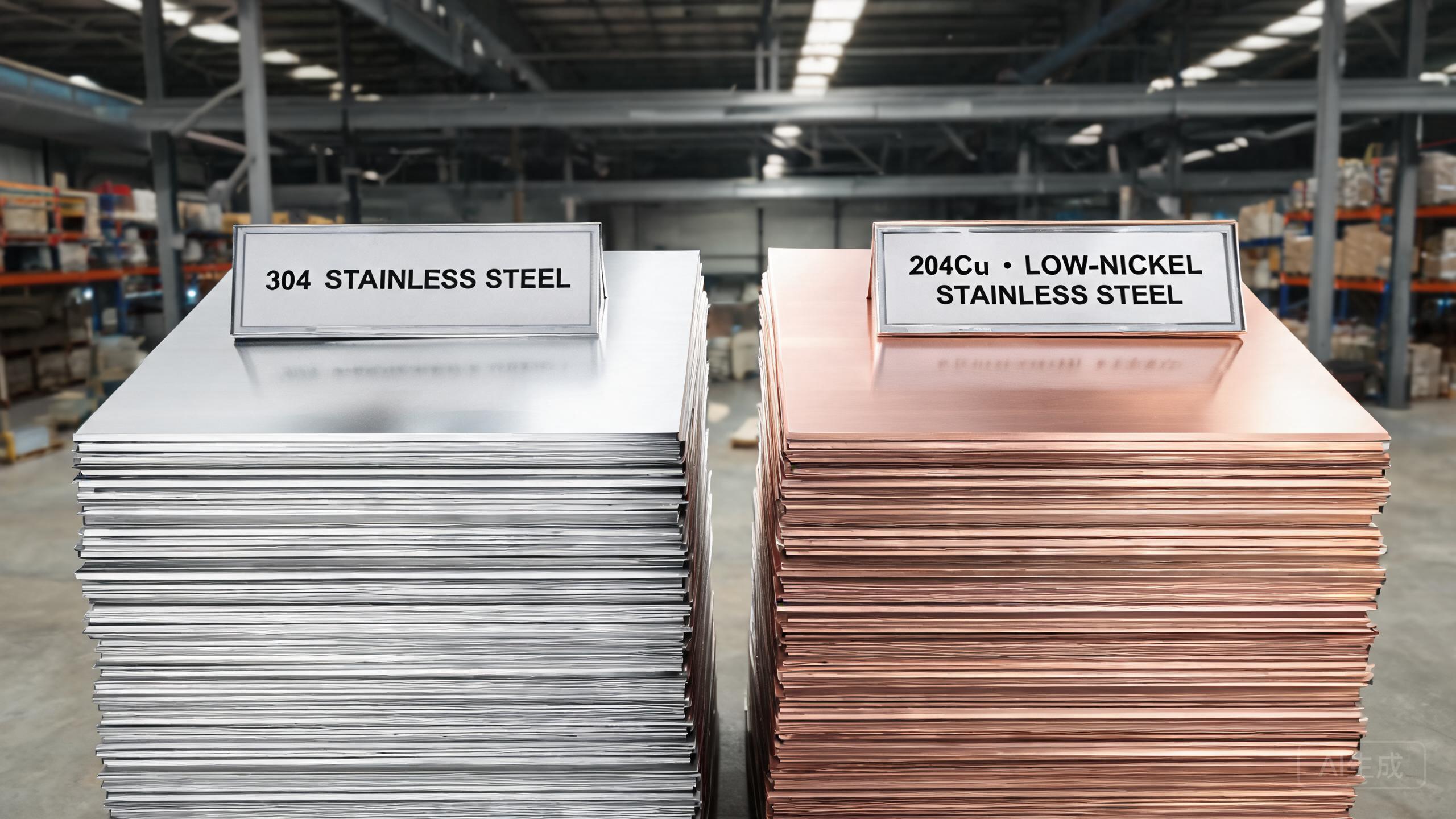
204Cu (UNS S20430) is a low-nickel austenitic stainless steel that mills push as a “304 alternative” at 10-20% lower price. With only 1.5-3.0% nickel (vs 8.0-10.5% for 304) and PREN ~18 (vs PREN ~19), it handles only the most benign indoor applications — and there’s an epidemic of Chinese mills selling 204Cu labeled as 304 to unwary buyers. The visual appearance is identical, basic hardness and tensile values are similar, and standard mill certs may even show compliant ranges because ASTM A240 allows wide manganese ranges. A portable PMI spectroscopy test — 10 seconds per sample — is the only reliable way to distinguish genuine 304 from fake “304” that’s actually 204Cu.
Quick Comparison
| Property | 204Cu (S20430) | 201 (S20100) | 304 (S30400) | 304L (S30403) |
|---|---|---|---|---|
| Chromium | 15.0-17.0% | 16.0-18.0% | 18.0-20.0% | 18.0-20.0% |
| Nickel | 1.5-3.0% | 3.5-5.5% | 8.0-10.5% | 9.0-13.0% |
| Manganese | 5.5-7.5% | 5.5-7.5% | ≤2.0% | ≤2.0% |
| Copper | 1.5-2.5% | 0.5-1.0% | ≤0.5% | ≤0.5% |
| PREN | ~18 | ~17 | ~19 | ~19 |
| Tensile Strength | ≥650 MPa | ≥650 MPa | ≥500 MPa | ≥485 MPa |
| Corrosion in Seawater | Rusts <12 months | Rusts <6 months | Pitting >24 months | Pitting >36 months |
| Outdoor Service Life | 2-3 years | 1-2 years | 10-15 years | 15-20 years |
| Weldability | Poor (sensitizes) | Poor | Excellent | Excellent |
| Price vs 304 | -10-20% | -20-30% | Base | +0-5% |
What Buyers Should Evaluate
- Criticality of application. Is rust acceptable in your component? If no (food processing, outdoor, marine), reject 204Cu entirely. If yes (indoor low-corrosion), the 15% savings may be justified.
- Weld requirements. 204Cu sensitizes easily at 800-900°C due to low nickel and high manganese. All 204Cu welds require post-weld annealing at 1000°C — factor this into your fabrication cost.
- Regulatory compliance. 204Cu does NOT meet 3-A Sanitary Standards for food contact — the standards require minimum 17% chromium with nickel content to stabilize the austenitic structure. Specify 304/316L for any food-contact application.
- China-specific note. 204Cu is primarily produced by small mills in Jiangsu and Shandong. Major mills (TISCO, Baosteel) don’t produce it in significant volumes. If your “304” supplier is a small mill with price 15% below market, it’s likely 204Cu.
- Detection method. Invest in a portable PMI spectrometer (>$2,000) or require your quality team to spot-check every incoming coil with third-party PMI services (>$50/sample).
Common Purchasing Mistakes
Mistake: Buying “304” from an unknown Chinese mill at 15% below market price. We’ve documented 22 cases in 2024-2025 where buyers received 204Cu labeled as 304. The largest: a Guangdong solar panel frame manufacturer that purchased 500 tons of “304” for outdoor mounting frames. After 14 months, 25% of frames showed rust staining. Testing revealed it was 204Cu. The $2.3M material cost was far exceeded by the $12M replacement and warranty costs. Fix: always run PMI spectroscopy on every incoming coil before accepting delivery.
Mistake: Chinese factory trick — 204Cu mill certs with fabricated nickel values. Some mills edit their EN 10204 3.1 certificates to show 8-10% nickel while the actual material has only 2-3%. Manganese masks the distinction in basic chemical analysis, and the fake certs look identical to genuine ones. Solution: PMI (Positive Material Identification) spectroscopy is non-negotiable — it takes 30 seconds per sample and will immediately show nickel at 1.5-3.0% vs the certified 8-10%. Test at least 1 sample per coil or 10% per heat (whichever is higher). Don’t rely on the mill cert alone. For critical applications, use SGS or TÜV to conduct independent testing before payment.
Mistake: Specifying “stainless steel” without the UNS number. Any RFQ that says “stainless steel sheet” without specifying UNS S30400 or S31603 is asking for 204Cu substitution. Always include the full grade designation: “ASTM A240 / UNS S30400 (304 austenitic stainless steel).”
Mistake: Trusting the magnet test. Neither 304 nor 204Cu are magnetic — both pass the basic “no magnet stick” test. This common myth leads buyers to think they have genuine 304 when they actually have 204Cu. PMI spectroscopy is the only reliable field test.
Recommended RFQ Wording
Grade: ASTM A240 / UNS S30400 (304 austenitic stainless steel)
  [DO NOT ACCEPT UNS S20430 / 204Cu / 201 SUBSTITUTION]
Key chemistry requirements:
  - Nickel: 8.0-10.5% (NOT 1.5-3.0%)
  - Chromium: 18.0-20.0%
  - Manganese: ≤2.0%
  - Copper: ≤0.5%
PREN minimum: ≥19
Form: Cold-rolled sheet / coil
Thickness: [exact mm]
Surface: 2B mill finish
Quantity: [metric tons]
Certification required:
  - EN 10204 3.1 mill test certificate (Ni ≥8.0% explicitly listed)
  - PMI spectroscopy on EVERY coil before acceptance
  - SGS/TÜV third-party verification on ≥10% of shipment
  - Written supplier statement that material is NOT 204Cu / 201 / 200-series
Additional: Price must be within 10% of current TISCO/Baosteel 304 market price.
FAQ
Is 204Cu stainless steel the same as 201 stainless steel?
No, they are related but distinct. 201 (UNS S20100) has 5.5-7.5% Mn, 0.5-1.0% Cu, and 3.5-5.5% Ni. 204Cu (UNS S20430) has the same Mn range but higher copper (1.5-2.5%) and lower nickel (1.5-3.0%). The extra copper in 204Cu improves corrosion resistance slightly over 201, but the very low nickel still makes it significantly less corrosion-resistant than 304 (Ni 8-10.5%, PREN ~19).
When is 204Cu acceptable as an alternative to 304?
204Cu is only acceptable for non-critical, indoor, low-corrosion applications: kitchen utensils that never touch acidic food, indoor decorative hardware, and low-stress brackets. It fails rapidly in: outdoor service (rusts in 2-3 years), coastal environments (pitting within 12 months), food processing (corrodes in contact with citric or acetic acid), and any application requiring weldability (sensitizes easily).
How can I tell if I’m getting 204Cu instead of 304?
Visual appearance is identical — both are austenitic with similar density and surface finish. The only reliable tests are PMI spectroscopy (304 has 8-10.5% Ni, 204Cu has 1.5-3.0% Ni) or a simple magnet test (neither is magnetic, so that won’t help). If a supplier quotes price 10-15% below market 304, assume it’s 204Cu or 201 unless proven otherwise.
CTA + Technical References
Send your grade, dimensions, annual volume and application to vip@still-steel.com, or contact us. We supply genuine ASTM A240 certified 304 and 316L — never 200-series substitutes — with full third-party PMI verification.
References:
- ASTM A240 / A240M: Standard specification for chromium and chromium-nickel stainless steel plate, sheet, and strip
- EN 10088-2: Stainless steels — Part 2: Technical delivery conditions for plate, sheet and strip
- 3-A Sanitary Standards: Material requirements for food processing equipment
- See also: 201 vs 304 stainless steel comparison
Technical References
- ASTM A240M - Standard Specification for Chromium and Chromium-Nickel Stainless Steel Plate, Sheet and Strip
- EN 10088-2 - Stainless steels. Technical delivery conditions for sheet/plate and strip
- ASM International - Handbook Series, Volume 1: Properties and Selection: Irons, Steels, and High-Performance Alloys