
Short answer:
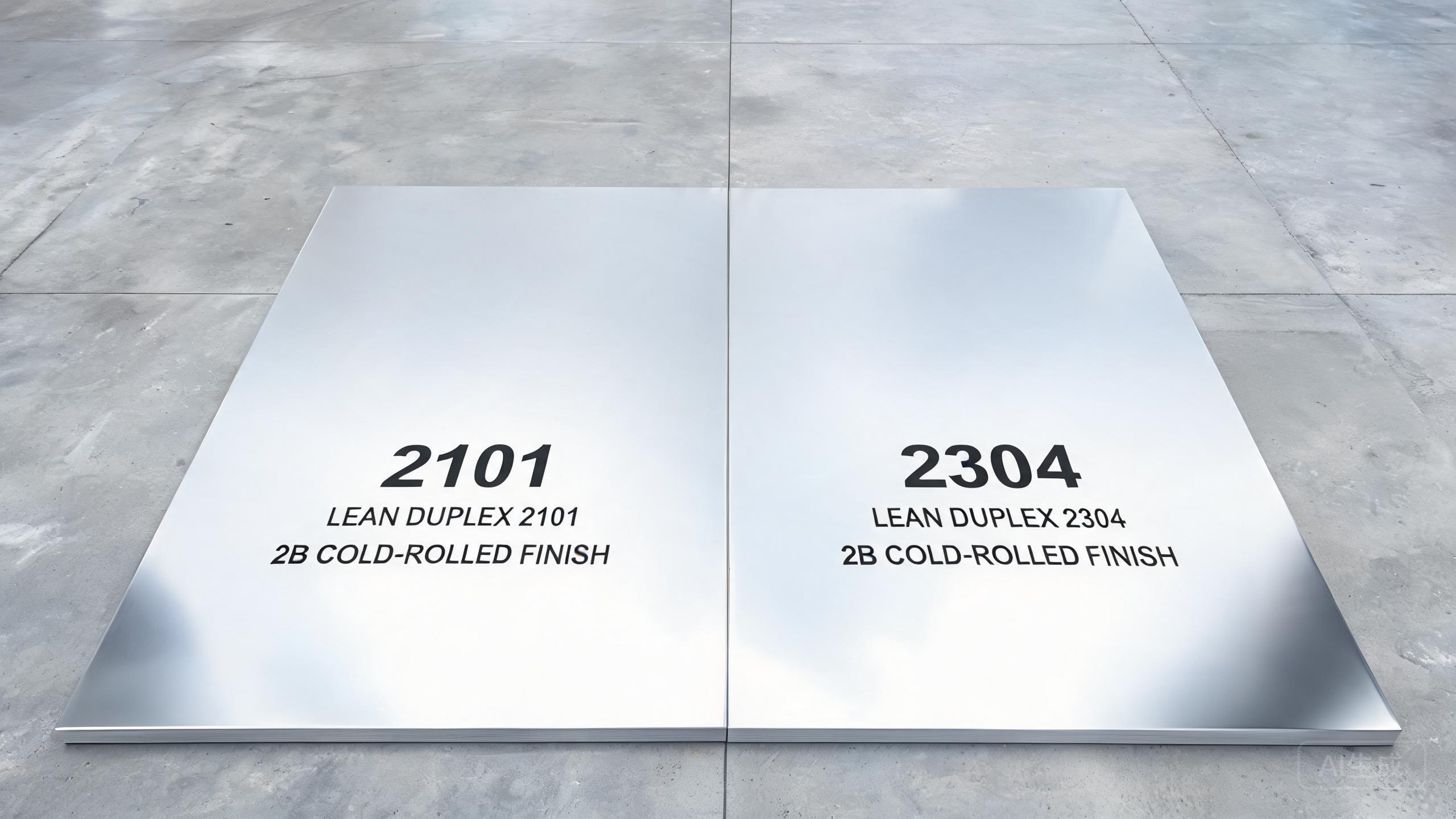
If your project needs stainless steel for structural members, railings, or infrastructure components in mild chloride environments and every kilogram counts toward your budget, lean duplex 2101 or 2304 should be on your shortlist. Both grades deliver roughly double the yield strength of standard austenitic grades like 304 or 316, allowing you to use thinner sections while maintaining equivalent load-bearing capacity. Choose 2101 (UNS S32101) when price is your dominant concern — it’s typically 15-25% cheaper than 2304. Upgrade to 2304 (UNS S32304) when your application faces coastal salt spray, road de-icing salts, or mild process water with chlorides, as its slightly higher chromium and molybdenum provide better pitting resistance. Neither grade replaces standard duplex 2205 — that’s a different performance tier entirely.
Quick Comparison
| Property | Lean Duplex 2101 (S32101) | Lean Duplex 2304 (S32304) | 304 (S30400) |
|---|---|---|---|
| Chromium | 21.0-22.0% | 22.0-23.0% | 18.0-20.0% |
| Nickel | 1.35-1.70% | 4.0-5.5% | 8.0-10.5% |
| Molybdenum | 0.3-0.6% | 0.10-0.60% | ≤0.5% |
| Nitrogen | 0.20-0.25% | 0.05-0.20% | ≤0.10% |
| PREN | ~24 | ~26 | ~19 |
| Yield Strength (0.2%) | ≥450 MPa | ≥400 MPa | ≥210 MPa |
| Tensile Strength | 650-820 MPa | 600-800 MPa | 500-700 MPa |
| Hardenable | No | No | No |
| Weldability | Good (preheat optional) | Good (preheat optional) | Excellent |
| Typical Uses | Structural beams, railings, road barriers | Coastal infrastructure, bridges, facade panels | Food equipment, general fabrication |
What Buyers Should Evaluate
- Chloride exposure level. Measure the maximum chloride concentration in your service environment. If you’re above ~200 ppm Cl⁻ continuously, lean duplex may not suffice — standard duplex 2205 starts at a much higher PREN of 35.
- Required section thickness. Run a yield strength calculation: 2101 delivers ~450 MPa minimum yield, allowing you to size members at roughly 50% the thickness of 304 for equivalent deflection limits.
- Weld filler metal compatibility. Use ER2209 or ER2101 filler wire. Match nitrogen content to preserve phase balance — avoid low-nitrogen fillers.
- Price delta vs 304. Lean duplex 2101 often trades at a 10-20% premium over 304, but the reduced section size can drive total project cost savings of 30-40%.
- Stock availability. Check whether your supplier stocks 2mm-20mm plate or coil in the exact thicknesses your structural engineer specified — lean duplex stock breadth lags behind 304 in some regions.
- Surface finish requirement. 2B mill finish is standard; specify electro-polishing if your facade demands low-gloss aesthetics that resist fingerprinting.
Common Purchasing Mistakes
Mistake: Treating lean duplex as a drop-in replacement for standard duplex 2205. This is one of the most costly specification errors in structural stainless engineering. A bridge contractor in Shanghai specified 2101 for a coastal bridge railing in 2023, assuming equivalent corrosion resistance to 2205. Within 18 months, 15% of the railing posts showed visible pitting. Fix: always run a PREN comparison and a site-specific chloride concentration test before finalizing grade selection.
Mistake: Chinese factory trick — downgraded molybdenum content. Some mills in Jiangsu province sell “2304” material that actually runs Mo at 0.0% (the minimum is 0.10% per ASTM A240) and Cr below the 22.0% floor. The visual appearance is identical to compliant material. Solution: demand PMI (Positive Material Identification) spectroscopy on every heat certificate and insist on EN 10204 3.1 mill test reports that list every alloying element — not just the mandatory ranges. We recommend portable PMI testing on 10% of incoming coils as a spot check.
Mistake: Skipping post-weld solution annealing. While lean duplex welds don’t normally require preheat, heavy weldments (over 20mm thick) can develop ferrite phase imbalance. A 1050°C solution anneal followed by water quench restores the 50/50 ferrite/austenite ratio.
Recommended RFQ Wording
Copy-paste this into your next request for quotation:
Grade: ASTM A240 / UNS S32101 (lean duplex 2101) or UNS S32304 (lean duplex 2304), per buyer specification
Form: [plate / coil / strip]
Thickness: [exact mm, e.g. 6.0mm ±0.05mm]
Width: [exact mm]
Length / ID: [exact mm]
Surface: 2B mill finish [specify electro-polish if required]
Quantity: [total kg or number of pieces]
Delivery: [required date, shipping incoterm]
Documentation required:
  - EN 10204 3.1 mill test certificate listing all alloying elements
  - PMI spectroscopy report for 10% sample per heat
  - Visual inspection report per ASTM A240
Additional: Material must comply with EN 1993-1-4 structural stainless steel code.
FAQ
What is the main difference between 2101 and 2304 lean duplex stainless steels?
The primary difference is molybdenum content. 2101 (UNS S32101) contains 0.3-0.6% Mo, while 2304 (UNS S32304) contains 0.10-0.60% Mo with slightly higher chromium (22.0-23.0% vs 21.0-22.0%). 2304 generally delivers better pitting resistance in chloride-bearing environments.
Can lean duplex 2101 or 2304 replace standard duplex 2205?
No. Lean duplex grades are not direct replacements for 2205 (UNS S32205). They contain significantly less molybdenum (≤0.6% vs 3.0-3.5%) and nitrogen, resulting in PREN values of ~24 (2101) and ~26 (2304) versus PREN ~35 for 2205. Lean duplex is suitable for atmospheric, mild chloride, and fresh water service only.
Why choose lean duplex 2101 over 304 or 316 for structural applications?
Lean duplex grades offer 2-3x higher yield strength than 304/316 austenitic grades (~450 MPa vs ~210 MPa), enabling thinner sections with significant weight savings. They also resist stress corrosion cracking (SCC) better than 304 in chloride environments, making them preferred for coastal infrastructure and bridges.
CTA + Technical References
Send your grade, dimensions, annual volume and application to vip@still-steel.com, or contact us. Our metallurgists can help you optimize section thickness to cut project cost while meeting EN 1993-1-4 structural codes.
References:
- ASTM A240 / A240M: Standard specification for chromium and chromium-nickel stainless steel plate, sheet, and strip for pressure vessels and for general applications
- EN 10088-2: Stainless steels — Part 2: Technical delivery conditions for plate, sheet and strip
- EN 1993-1-4: Eurocode 3 — Design of steel structures — General rules — Supplementary rules for stainless steels
- See also: Best stainless steel for marine applications
Technical References
- ASTM A240M - Standard Specification for Chromium and Chromium-Nickel Stainless Steel Plate, Sheet and Strip
- EN 10088-2 - Stainless steels. Technical delivery conditions for sheet/plate and strip
- ASM International - Handbook Series, Volume 1: Properties and Selection: Irons, Steels, and High-Performance Alloys