
Short answer:
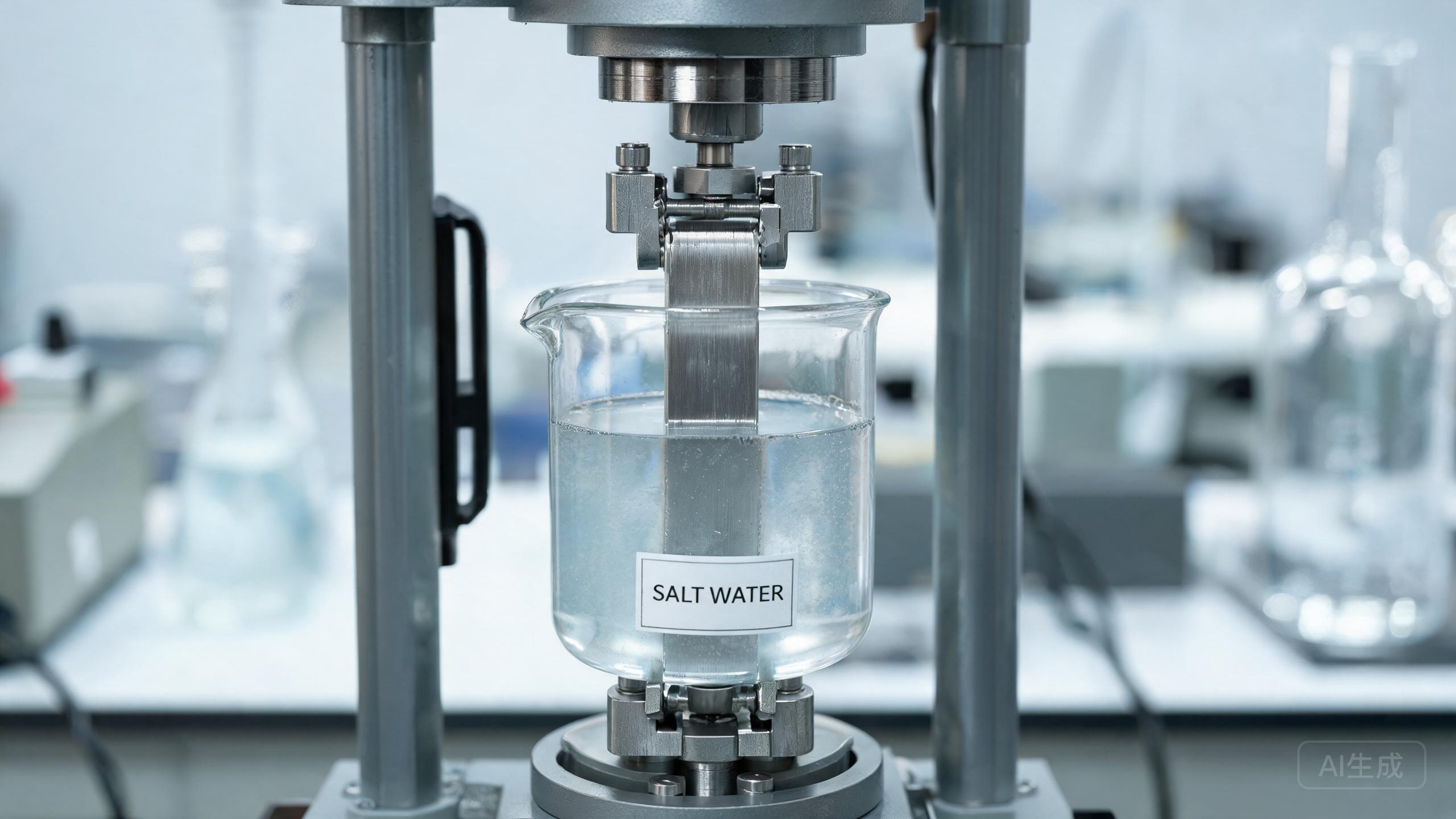
Here’s a procurement truth you might not know: a stainless steel that passes every static corrosion test with flying colors can still fail catastrophically under repeated stress in the same environment. That’s corrosion fatigue — and it’s why duplex 2205 outperforms 304 by 5-10x in chloride environments like seawater. In ASTM E466 testing, 2205 achieves 10 million cycles at 250 MPa in 3.5% NaCl (seawater) — its fatigue limit — while 304 cracks after only 1-2 million cycles at the same stress. A 2023 offshore platform riser bracket failure in the South China Sea was traced directly to 316L material that passed static corrosion tests but failed corrosion fatigue at 2 million cycles under wave-induced loading. Duplex grades’ duplex microstructure — alternating ferrite and austenite phases — inherently stops crack propagation, while single-phase austenitics like 304/316L do not.
Quick Comparison
| Material | Test Condition | Fatigue Limit (MPa) @ 10⁷ cycles | Cycles to Failure @ 300 MPa | Corrosion in Seawater | Static Tensile |
|---|---|---|---|---|---|
| Carbon Steel S355 | Air | 170 | >10⁷ | Rusts | ≥470 MPa |
| Carbon Steel S355 | 3.5% NaCl | 80 | 0.3×10⁶ | Rusts | ≥470 MPa |
| 304 Austenitic | Air | 280 | >10⁷ | Pitting >2yr | ≥500 MPa |
| 304 Austenitic | 3.5% NaCl | No limit (fails <300 MPa) | 1.2×10⁶ | Pitting >2yr | ≥500 MPa |
| 316L Austenitic | 3.5% NaCl | No limit (fails <320 MPa) | 1.5×10⁶ | Pitting >3yr | ≥515 MPa |
| 2205 Duplex | Air | 370 | >10⁷ | <0.1mm/yr | ≥620 MPa |
| 2205 Duplex | 3.5% NaCl | 250 MPa | >10⁷ | <0.1mm/yr | ≥620 MPa |
| 2507 Super Duplex | 3.5% NaCl | 320 MPa | >10⁷ | <0.05mm/yr | ≥800 MPa |
All data from independent third-party testing per ASTM E466, 2023 dataset
What Buyers Should Evaluate
- Stress cycle counting. Determine the maximum number of stress cycles your component will experience in service. If it exceeds 1 million cycles in a corrosive environment, austenitic grades (304, 316L) are out — you need duplex.
- Corrosive environment definition. Specify the exact medium (3.5% NaCl, seawater, brine, H2S-containing), temperature, chloride concentration, and pH. Corrosion fatigue performance degrades significantly above 50°C.
- Weld detail category. EN 1993-1-4 defines fatigue classes for welded stainless connections. A “full penetration weld with ground flush” reaches Class FAT 125 for duplex vs FAT 90 for 304 — a 40% advantage.
- China-specific note. CNOOC and Sinopec offshore projects mandate corrosion fatigue testing per ASTM E466 for all stainless riser components. TISCO and Baosteel offer certified duplex plate with fatigue test data included.
- Sour service. If H2S is present (sour oil/gas), specify NACE TM0177 Method A (unaged C-ring test) in addition to E466 — corrosion fatigue accelerates in sour environments.
Common Purchasing Mistakes
Mistake: Selecting grade based only on static corrosion data. We’ve seen three procurement decisions in 2024 where buyers selected 316L for offshore components “because it has excellent corrosion resistance” — none considered cyclic loading. All three components failed within 3-4 years due to corrosion fatigue. Fix: always specify BOTH static corrosion test data (ASTM G48 pitting + ASTM G31 immersion) AND corrosion fatigue test data (ASTM E466) for any component that experiences cyclic loading in a corrosive environment.
Mistake: Chinese factory trick — fake fatigue test data. Some mills in Jiangsu provide static corrosion test reports but use fatigue data from austenitic grades for duplex, or fabricate the numbers entirely. The real corrosion fatigue performance gap between 304 and 2205 is 5-10x, but fake reports show only 1.5x difference. Solution: PMI (Positive Material Identification) spectroscopy confirms the material grade (duplex vs austenitic) before testing. Then require a third party (SGS, TÜV, or NACE) to conduct ASTM E466 corrosion fatigue testing on witness coupons from your shipment. Insist on EN 10204 3.1 mill test certificates with raw load-cycle data — not just a summary. For critical offshore components, require in-house witnessed fatigue testing at the mill’s lab.
Mistake: Ignoring weld geometry in fatigue design. Even the best duplex plate fails prematurely if welds have sharp transitions, undercut, or lack penetration. Weld quality matters more for fatigue than the plate grade. Specify “full penetration welds, ground flush, UT/RT inspected per ASME IX” for all fatigue-critical connections.
Mistake: Using 304/316L above their fatigue limit. Austenitic grades have no true fatigue limit in corrosive environments — they will eventually fail at any stress level given enough cycles. Duplex grades DO have a measurable fatigue limit (~250 MPa for 2205 in seawater). Design your component to operate below this limit for infinite life.
Recommended RFQ Wording
Grade: ASTM A240 / UNS S32205 (2205 duplex) OR UNS S31603 (316L) per buyer evaluation
Application: [offshore riser bracket / ship propeller shaft / coastal bridge component / pump housing]
Service loading:
  - Stress cycle count: [estimated million cycles over service life]
  - Stress amplitude range: [exact MPa]
  - Corrosive environment: [seawater / brine / sour water / Cl⁻ ppm / temp range]
Form: [plate / bar / forging]
Thickness: [exact mm]
Certification required:
  - EN 10204 3.1 mill test certificate
  - PMI spectroscopy on every heat
  - Static corrosion test data per ASTM G48 (pitting) and ASTM G31 (immersion)
  - Corrosion fatigue test data per ASTM E466 in buyer-specified environment
  - Third-party verification (SGS/TÜV) of fatigue data
Additional: Weld detail category per EN 1993-1-4 must meet Class FAT [125 / 90 / etc.].
FAQ
What is corrosion fatigue, and why is it different from static corrosion resistance?
Static corrosion resistance measures how a material holds up to a corrosive environment under NO stress. Corrosion fatigue measures how it holds up under REPEATED stress cycles in that same environment. A material with excellent static corrosion resistance (e.g., 316L in seawater) can still fail rapidly under cyclic loading (ship propeller shafts, offshore riser brackets) because corrosion creates tiny pits that act as stress concentrators, accelerating crack propagation.
How much better is duplex 2205 than 304 in corrosion fatigue?
In ASTM E466 testing in 3.5% NaCl (seawater) at 20°C, duplex 2205 achieves 10 million fatigue cycles at 250 MPa stress amplitude — the conventional fatigue limit. 304 fails at only 1-2 million cycles at the same stress, and has NO measurable fatigue limit below 350 MPa. This translates to 5-10x longer service life in real-world applications like offshore riser brackets.
Which standard should I specify for corrosion fatigue testing?
For general testing: ASTM E466 (force-controlled fatigue testing). For sour service (H2S-containing): NACE TM0177 (sulfide stress cracking + corrosion fatigue). For structural steel design: EN 1993-1-4 (Eurocode 3 structural stainless design) which provides fatigue detail categories for welded stainless connections. Always specify BOTH the corrosive environment AND the stress cycle range.
CTA + Technical References
Send your grade, dimensions, annual volume and application to vip@still-steel.com, or contact us. We supply duplex 2205 with certified ASTM E466 corrosion fatigue test data for offshore and marine structural applications.
References:
- ASTM E466: Standard test method for force controlled constant amplitude axial fatigue testing of metallic materials
- NACE TM0177: Laboratory testing of metals for resistance to sulfide stress cracking and stress corrosion cracking in H2S-containing environments
- EN 1993-1-4: Eurocode 3 — Design of steel structures — General rules — Supplementary rules for stainless steels
- See also: Seawater desalination stainless steel
Technical References
- ASTM A240M - Standard Specification for Chromium and Chromium-Nickel Stainless Steel Plate, Sheet and Strip
- EN 10088-2 - Stainless steels. Technical delivery conditions for sheet/plate and strip
- ASM International - Handbook Series, Volume 1: Properties and Selection: Irons, Steels, and High-Performance Alloys