
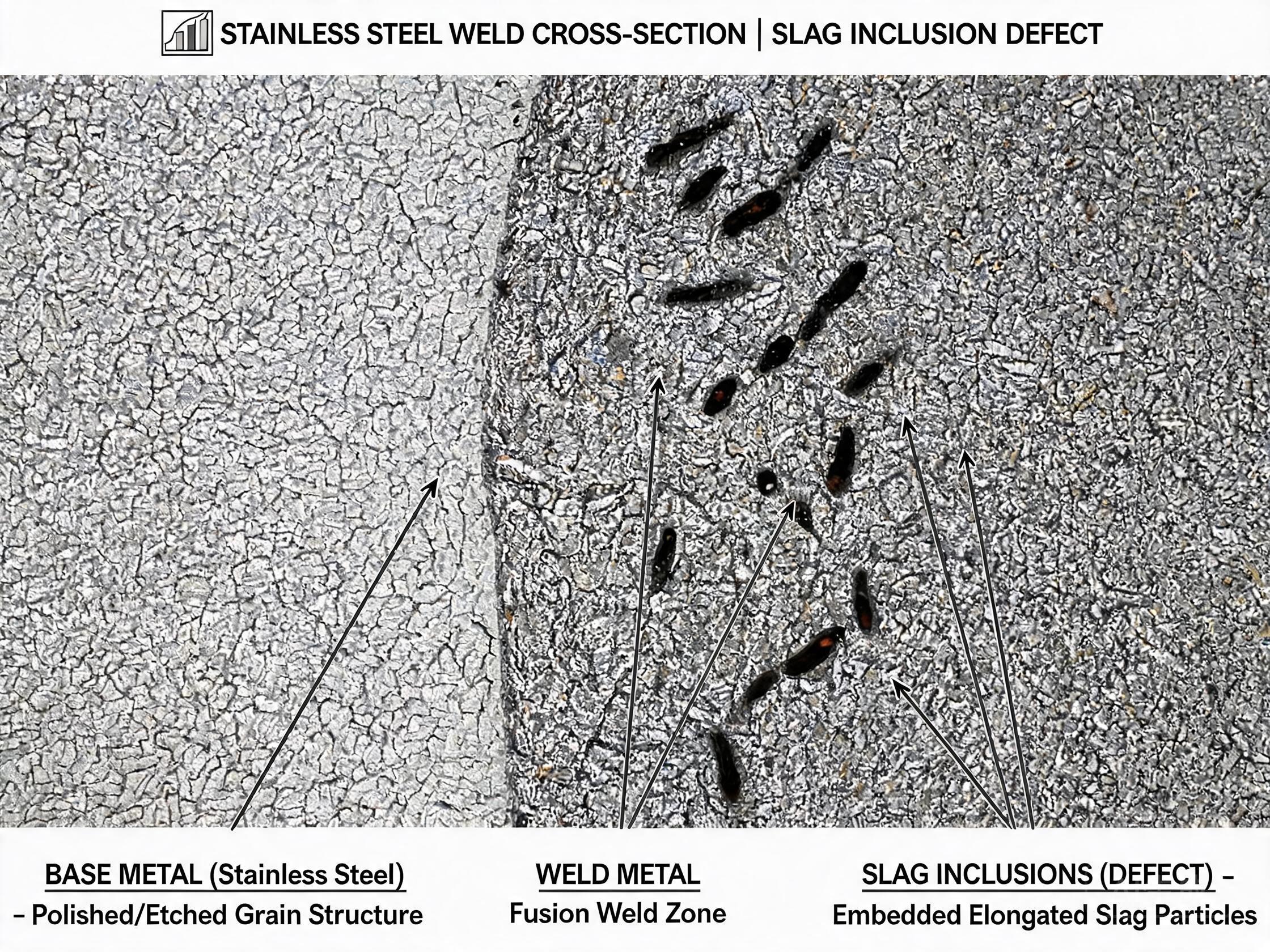
Short answer: Weld slag inclusions look like dark irregular lines or patches inside the weld. They happen when the slag from flux-coated wires or tungsten contamination gets trapped between weld passes. The fix is straightforward: keep current in range, clean every pass with a stainless brush or grinder, and specify interpass inspection. Skip this and you will find rejectable inclusions on radiography — after the part is finished.
Slag inclusions are not harmless. They reduce effective weld cross-section by the inclusion area, acting as built-in stress raisers. In pressure vessels, slag can crack and cause leakage. In food equipment, trapped slag can harbor contaminants. Unlike porosity, slag is almost always a process control failure, not a material problem.
Quick Comparison
| Welding process | Slag source | Typical cause | Fix |
|---|---|---|---|
| SMAW (stick) | Flux coating on electrode | Current too high, slag not chipped | Current 20% below max, chip + brush between passes |
| FCAW | Flux core wire | Same as SMAW | Same, plus check wire feed rate |
| GMAW-MIG (solid) | Tungsten pickup, scale | Contaminated gas lens | Replace tungsten, clean joint edges |
| GTAW-TIG | Tungsten melt-off, back purge gas | Tungsten touched weld, O2 >10 ppm | Grind tungsten tip, fix purge |
| G6 (18% Cr FCAW) | High Cr slag viscosity | Hard to remove Cr-rich slag | More passes, grinder cleaning |
18% Cr FCAW wires (G6 type) produce very viscous slag because of high chromium content. These inclusions are particularly hard to remove — plan for more passes and a grinder pass between each one.
What Buyers Should Evaluate
- Does the fabricator require interpass cleaning between every weld pass, or just “the big ones”?
- Are they using stainless steel brushes and grinders, or carbon steel brushes that contaminate stainless?
- Do they check current against the wire diameter specified in the WPS? A 3.2mm ER308L electrode runs 90-110A; cranking it to 160A guarantees slag.
- Is there a QC checkpoint between passes, or does the welder just weld straight through?
- For critical welds, is radiography (RT) or ultrasonic testing (UT) specified, or only visual inspection (VT)?
VT misses 100% of subsurface slag. Any application that matters (pressure containment, structural load) needs RT or UT.
Common Purchasing Mistakes
- A China factory trick: the fabricator charges you for radiography but only does it on one weld coupon, then applies the same “no slag” certificate to every weld in the batch. Specify RT sample percentage (minimum 10% for general, 100% for critical), and require individual weld IDs on the RT film so you can cross-reference to the part.
- Forgetting that G6 flux-cored wires have different slag behavior. 18% Cr FCAW slag is far more viscous than 16% Cr. If you specify G6 without requiring grinder interpass cleaning, you will get trapped slag. Ask for test welds with the exact wire before production starts.
- Allowing carbon steel tools in the stainless welding area. A carbon steel brush leaves microscopic iron particles that corrode in service, and if they are brushed into the weld joint, they become embedded inclusions that fail PMI (positive material identification). Require dedicated stainless tools: brushes, grinders, chisels — no carbon steel within 5 meters of the weld area.
- Setting current too high to “speed up” welding. Many fabricators run current 25% above WPS values to increase deposition rate. This overheats the flux, makes it burn too early, and creates slag that becomes trapped. Enforce current logging on the WPS — welder signs off on amperage after every pass.
Recommended RFQ Wording
“Please supply cold rolled 304L or 316L stainless steel sheet per EN 10088-2 with EN 10204-3.1 test reports. Fabrication must follow AWS D1.6 qualified WPS. Interpass cleaning: every weld pass shall be cleaned with stainless steel wire brush and/or pneumatic chisel before next pass. Carbon steel tools are prohibited in the welding area. Welding current shall be logged on the WPS, within ±10% of the qualified value. Slag inspection: visual (VT) for all welds, radiography (RT) at minimum 10% sample rate for structural welds, 100% for pressure containment welds. AWS D1.6 clause 7 acceptance criteria apply.”
Frequently Asked Questions
What causes weld slag inclusions in stainless steel?
Slag inclusions form when the protective slag from SMAW or flux-cored wires is not fully removed between passes, or when welding current is too high — causing the arc to blow molten slag into the joint root where it solidifies before the weld metal covers it. For TIG and MIG (solid wire), inclusions come from tungsten contamination or base metal scale.
How do I detect slag inclusions in stainless welds?
Visual inspection (VT) catches surface slag, but subsurface inclusions need radiography (RT) or ultrasonic testing (UT). RT is most reliable for inclusions because they appear as darker irregular shapes on the film. Magnetic particle (MT) and penetrant (PT) only find surface-breaking inclusions — they miss subsurface slag entirely.
What should be specified for interpass cleaning?
Require a stainless steel wire brush (not carbon steel — it leaves iron particles that cause rust), a pneumatic chisel or grinder with a thin disc for root cleaning, and visual verification that no slag remains before the next pass. For critical applications, add a white-light photo or a dye-penetrant spot-check between passes.
How Still Steel Supports the Project
Still Steel supplies cold rolled stainless steel sheet and strip with pre-cut edges, beveling and pre-weld cleaning services so your fabricator can start welding immediately. We stock matching filler wires (ER308L, ER316L, ER2209) and provide material traceability via EN 10204-3.1 test reports. Send your weld joint design, grade and thickness to vip@still-steel.com, or discuss on WhatsApp.
Technical References
- AWS D1.6/D1.6M Clause 7: Imperfection Tolerance for Stainless Steel Welds
- ASME V Article 2: Radiographic Examination (RT methods for welds)
- ASME IX QW-195: Visual Inspection and Acceptance Criteria
- EN 1011-3: Arc welding of stainless steels — interpass cleaning guidance