
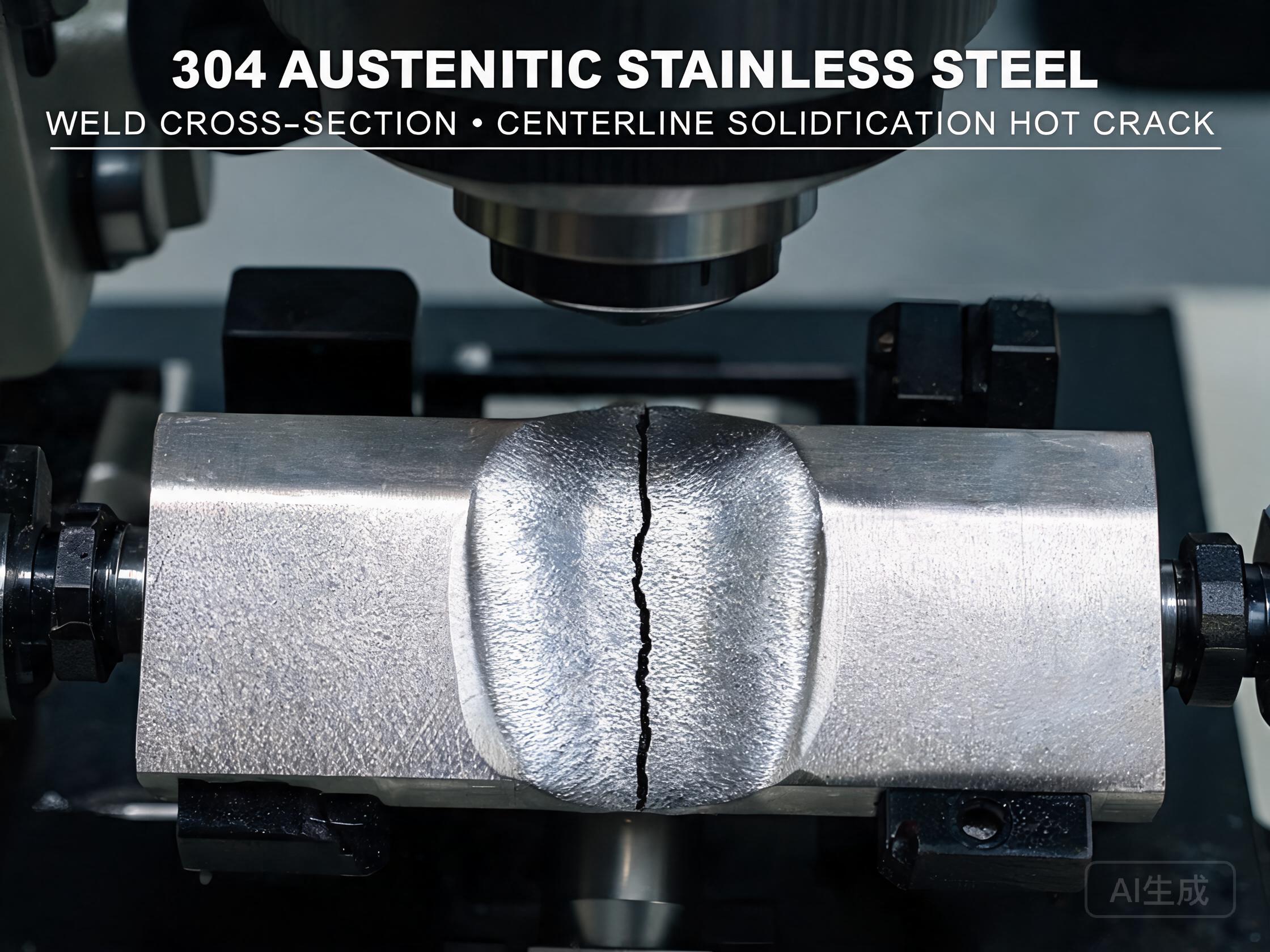
Short answer: Hot cracking in 304 and 316 welds is almost always caused by sulfur or phosphorus impurities segregating to grain boundaries during solidification. The fix is simple: use filler wire that deposits 5-10% delta ferrite (ER308L for 304, ER316L for 316), keep base metal S and P below 0.015% each, and follow a qualified WPS. Skip these checks and you will see cracks along the weld centerline within minutes of welding.
Hot cracking occurs above 1200°C, when the weld metal is still mushy and weak. The crack looks like a fine, branching line running along the weld seam. It is not the same as cold cracking — that happens after cooling, in martensitic steels. Austenitic steels do not harden significantly, but they do contract, and that contraction stress pulls across the already-brittle grain boundaries.
Quick Comparison
| Material | Hot cracking risk | Typical fix |
|---|---|---|
| 304 base + ER308L filler | Low (ferrite 5-10%) | Standard practice, WPS qualifies ferrite |
| 304 base + ER304 filler | High (no ferrite) | Change filler to ER308L |
| 316 base + ER316L filler | Low (ferrite 5-10%) | Standard practice, confirm PREN match |
| 316 base + S/P > 0.020% | High | Source lower-impurity base metal |
| Bead-on-plate high heat input | Medium | Reduce heat input, control travel speed |
Ferrite content is measured with a ferrite meter (magnetic method) or calculated from composition using the WRC-1992 diagram. A weld with 5-10% ferrite is the sweet spot for cracking resistance and corrosion performance.
What Buyers Should Evaluate
- Does your fabricator have a qualified WPS that specifies ferrite content for every joint?
- Are they using ER308L (for 304) or ER316L (for 316), not the cheaper ER304 or ER316?
- Do they check sulfur and phosphorus in incoming base metal and filler wire?
- Has a weld sample been tested for hot cracking (macro etch or bend test)?
A fabricator that says “we’ve always used ER304 for 304” is a red flag. ER304 filler deposits fully austenitic weld metal — no ferrite — and that is the number one cause of hot cracking in 304 welds.
Common Purchasing Mistakes
- A China factory trick: quoting you ER304 filler price but using ER308L in the spec, then substituting back to ER304 on the shop floor to save ¥2 per kg of wire. Ask for the actual filler wire brand and heat number on the material test report, and spot-check weld ferrite content at incoming inspection.
- Skipping the WPS entirely. Without a qualified procedure, the welder sets heat input, filler diameter and purge gas by feel. High heat input widens the HAZ and increases hot cracking risk. Specify AWS D1.6 or ASME IX compliance in your purchase order.
- Accepting base metal with sulfur or phosphorus above 0.020%. Many low-quality cold rolled coils from non-mill-certified suppliers run 0.025-0.030% S. Require EN 10204-3.1 certificates with full chemical composition, including S and P columns.
- Ignoring the filler to base metal match for PREN (pitting resistance equivalent number). 316 base metal with PREN ≥25 needs filler wire with matching PREN, or the weld corrodes first in chloride environments.
Recommended RFQ Wording
“Please supply cold rolled 304/304L or 316/316L stainless steel sheet per EN 10088-2 with sulfur ≤0.015% and phosphorus ≤0.015%. Provide EN 10204-3.1 test reports. Fabrication must follow a Welding Procedure Specification (WPS) per AWS D1.6 or ASME IX. Filler wire must be ER308L (for 304 base) or ER316L (for 316 base), with documented ferrite content 5-10% and PREN matching base metal. We reserve the right to verify ferrite content on produced welds.”
Frequently Asked Questions
Why does hot cracking happen in austenitic stainless steel welds?
Hot cracking occurs in the weld metal or heat-affected zone (HAZ) when low-melting impurities (sulfur, phosphorus) segregate to grain boundaries during solidification. The austenitic microstructure has no phase change upon cooling, so these brittle films remain. Tensile stress from contraction pulls the weld apart along the weak grain boundaries.
How does ferrite prevent hot cracking in 304 and 316 welds?
A small amount of delta ferrite (5-10% by volume) in the as-welded microstructure breaks up the continuous austenite grain boundaries. Sulfur and phosphorus have limited solubility in ferrite, so they cannot form a continuous brittle film. ER308L and ER316L filler wires are designed to deposit weld metal with this ferrite content.
What should I specify to my fabricator to avoid hot cracking?
Specify the welding procedure (TIG/MIG/SMAW), require filler wire with documented ferrite content (WRC-1992 diagram), ask for a Welding Procedure Specification (WPS) per AWS D1.6 or ASME IX, and verify sulfur and phosphorus levels in base and filler metals (typically ≤0.015% each).
How Still Steel Supports the Project
Still Steel supplies cold rolled stainless steel sheet and strip with pre-cut edges, beveling and pre-weld cleaning services so your fabricator can start welding immediately. We stock matching filler wires (ER308L, ER316L, ER2209) and provide material traceability via EN 10204-3.1 test reports. Send your weld joint design, grade and thickness to vip@still-steel.com, or discuss on WhatsApp.
Technical References
- AWS D1.6/D1.6M: Structural Welding Code — Stainless Steel
- ASME IX: Qualification Standard for Welding, Brazing, and Fusing Procedures
- EN 1011-3: Welding — Recommendations for welding of metallic materials — Part 3: Arc welding of stainless steels
- WRC-1992 Ferrite Diagram: Nickel and chromium equivalent calculation for austenitic weld metal