
Short answer:
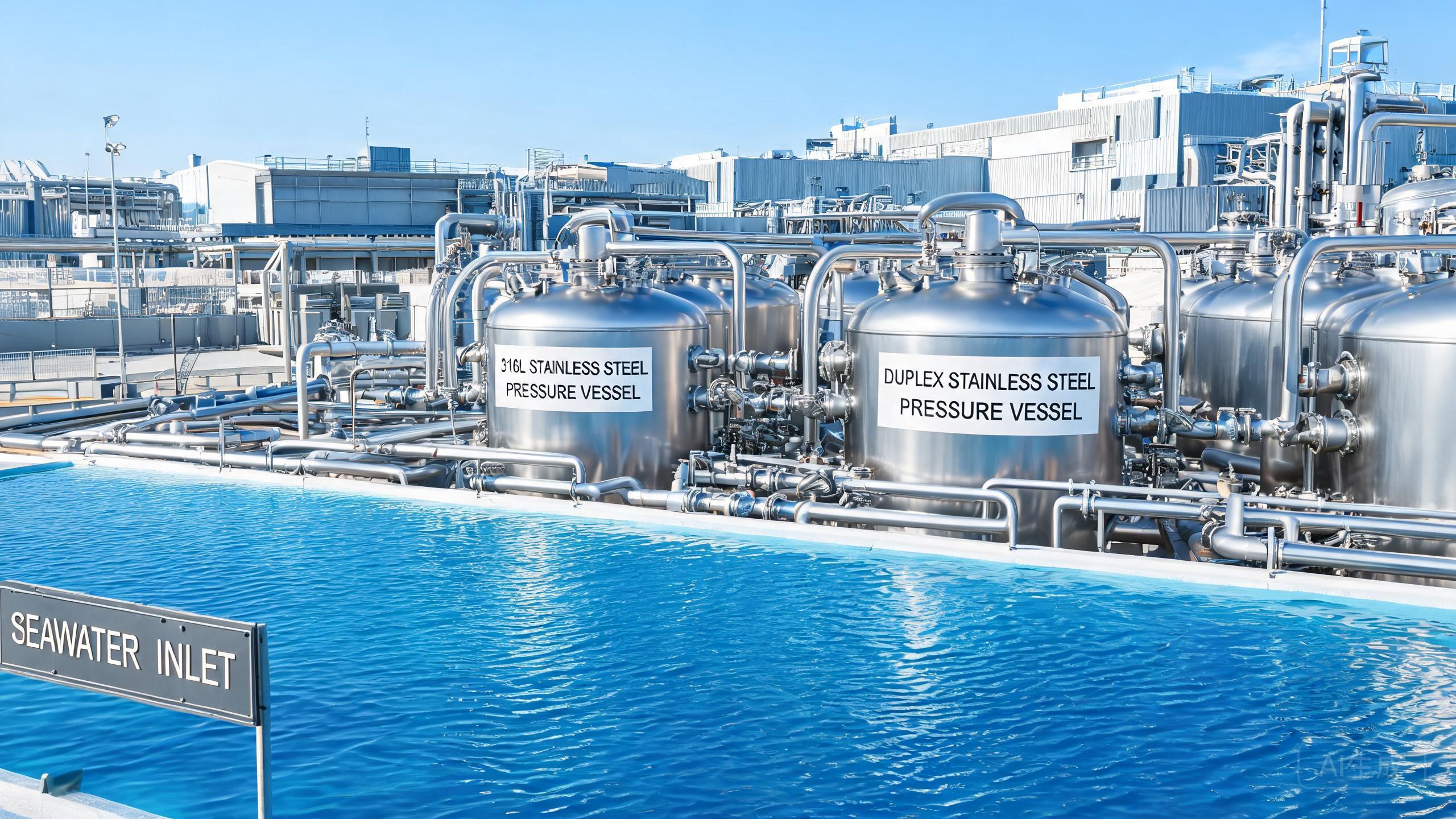
Reverse-osmosis seawater desalination plants represent one of the highest-demand applications for high-corrosion stainless steel. With chloride concentrations ranging from 25,000 ppm (natural seawater) to 80,000 ppm (RO retentate brine), standard austenitic grades like 316L fail rapidly. Duplex 2205 (UNS S32205, PREN ~35) handles pressure vessels and low-pressure piping. Super duplex 2507 (UNS S32750, PREN ~40) serves heat exchangers and high-pressure components. 254 SMO (UNS S31254, PREN ~40) handles the most aggressive brine zones where 2507’s strength or fabrication constraints make it impractical. The global desalination stainless market grew 18% in 2025, with China and the Middle East driving most volume.
Quick Comparison
| Grade | UNS | Type | Cr | Mo | PREN | Tensile (MPa) | CPT (°C) | Best For |
|---|---|---|---|---|---|---|---|---|
| 316L | S31603 | Austenitic | 16-18% | 2-3% | ~25 | ≥515 | ~10 | NOT for seawater (crevice corrosion risk) |
| 2205 | S32205 | Duplex | 21-23% | 3.0-3.5% | ~35 | ≥620 | ~40 | RO pressure vessels, seawater piping |
| 2507 | S32750 | Super Duplex | 24-26% | 3-5% | ~40 | ≥800 | ~55 | MED heat exchangers, high-pressure components |
| 254 SMO | S31254 | Super Austenitic | 19.5-20.5% | 6.0-6.5% | ~40 | ≥650 | ~60 | Brine handling, extreme chloride zones |
CPT = Critical Pitting Temperature per ASTM G48
What Buyers Should Evaluate
- Pressure vessel code compliance. RO pressure vessels must meet ASME BPVC Section VIII Div 1 or European PED 2014/68/EU. Confirm your mill’s U-stamp certification specifically for desalination service.
- Crevice corrosion testing. Desalination systems have inherent crevices (gaskets, flange joints, tube-to-tubesheet connections). Specify ASTM G48 Method D crevice corrosion testing — 2205 must resist 80,000 ppm Cl⁻ at 25°C.
- Weld inspection requirement. 100% radiographic or ultrasonic testing per ASME IX for all pressure boundary welds. Use ER2209 filler for 2205, ER2553 for 2507, ER385 for 254 SMO.
- Biofouling resistance. Smooth surfaces (No.8 finish, Ra <0.2μm) reduce biofouling accumulation. Specify pickled and passivated surface per ASTM A380.
- China-specific note. Tianjin and Zhejiang mills produce most of China’s desalination stainless. Verify compliance with GB/T 3097-2017 (marine stainless steel) which aligns closely with ASTM A240 and EN 10088-3.
Common Purchasing Mistakes
Mistake: Specifying “duplex” without distinguishing between standard duplex 2205 and super duplex 2507. A Saudi Arabian desalination plant in 2023 ordered 200 tons of “duplex stainless” for MED heat exchangers and received 2205 instead of 2507. At 70°C with 60,000 ppm chloride, 2205’s CPT is exceeded — pitting appeared within 4 months. Fix: always spell out UNS numbers and specific PREN requirements, not just “duplex.”
Mistake: Chinese factory trick — PREN fudging on super duplex. Some mills in Guangdong label material as “2507” or “254 SMO” but deliver chemistry with PREN 35-38 (2205 range). The visual appearance and basic mechanical properties are nearly identical. Solution: mandatory PMI (Positive Material Identification) spectroscopy on every plate. Insist on EN 10204 3.1 mill test certificates that include a calculated PREN value. Run ASTM G48 pitting corrosion testing on 10% of incoming material — this is the ultimate proof that PREN claims are genuine.
Mistake: Ignoring galvanic corrosion with seawater pumps. Many desalination plants use bronze or cupronickel pumps connected to stainless manifolds. Without insulating gaskets, the more noble stainless steel accelerates corrosion of the copper alloy. Install PTFE or EPDM gaskets at every stainless-copper junction, and keep galvanic separation distances ≥50mm in seawater service.
Mistake: Under-specifying wall thickness for pressure vessels. RO pressure vessels operate at 60-70 bar. Use minimum 8mm wall thickness for 2205 vessels with 3mm corrosion allowance. Super duplex 2507 can go down to 6mm due to its higher tensile strength.
Recommended RFQ Wording
Grade: ASTM A240 / UNS [S32205 2205 / S32750 2507 / S31254 254 SMO]
Application: [RO pressure vessel / MED heat exchanger / brine discharge manifold]
Operating conditions:
  - Chloride: [exact ppm]
  - Temperature: [exact °C]
  - Pressure: [exact bar]
Form: [plate / pipe / bar / forging]
Thickness: [exact mm + corrosion allowance]
Surface: Pickled and passivated, No.4 or 2B finish, Ra ≤0.4μm
Quantity: [metric tons]
Delivery: [required date, shipping incoterm]
Certification required:
  - EN 10204 3.1 mill test certificate with calculated PREN
  - PMI spectroscopy on every heat
  - ASTM G48 Method A (pitting) and Method D (crevice) corrosion test reports
  - ASME U-stamp certification if pressure vessel application
FAQ
Why is duplex 2205 preferred over 316L for desalination pressure vessels?
316L (UNS S31603) fails in seawater service due to pitting and crevice corrosion. Natural seawater contains 20,000-25,000 ppm chloride, while RO retentate brine reaches 40,000-80,000 ppm Cl⁻. Duplex 2205 (S32205) with PREN ~35 resists pitting in these concentrations, while 316L (PREN ~25) develops crevice corrosion within 6-12 months in stagnant zones.
What is the role of super duplex 2507 in desalination plants?
Super duplex 2507 (UNS S32750, PREN ~40) handles the most aggressive desalination zones: multi-effect distillation (MED) heat exchangers operating at 60-80°C with concentrated brine, and high-pressure pumps handling 60,000+ ppm chloride retentate. It is also used for the brine discharge manifold where backdiffusion of marine organisms can create crevice conditions.
How to prevent galvanic corrosion between stainless steel and copper alloys in desalination?
Stainless steel and copper alloys (brass, cupronickel) have different corrosion potentials in seawater, creating galvanic attack when connected directly. Use insulating gaskets (EPDM or PTFE) between stainless and copper components. In RO systems, specify all-stainless 2205 manifolds rather than copper/stainless hybrid designs. If mixed metals are unavoidable, the less noble metal (copper) should have at least 10x the surface area of the more noble metal (stainless).
CTA + Technical References
Send your grade, dimensions, annual volume and application to vip@still-steel.com, or contact us. We supply 2205, 2507, and 254 SMO per ASTM A240 for desalination projects across Asia and the Middle East.
References:
- ASTM A240 / A240M: Standard specification for chromium and chromium-nickel stainless steel plate, sheet, and strip
- EN 10088-3: Stainless steels — Part 3: Technical delivery conditions for semi-finished products
- ASTM G48: Standard test method for pitting and crevice corrosion resistance of stainless steels
- ASME BPVC Section VIII: Pressure Vessels
- See also: Best stainless steel for marine applications
Technical References
- ASTM A240M - Standard Specification for Chromium and Chromium-Nickel Stainless Steel Plate, Sheet and Strip
- EN 10088-2 - Stainless steels. Technical delivery conditions for sheet/plate and strip
- ASM International - Handbook Series, Volume 1: Properties and Selection: Irons, Steels, and High-Performance Alloys