
Short answer:
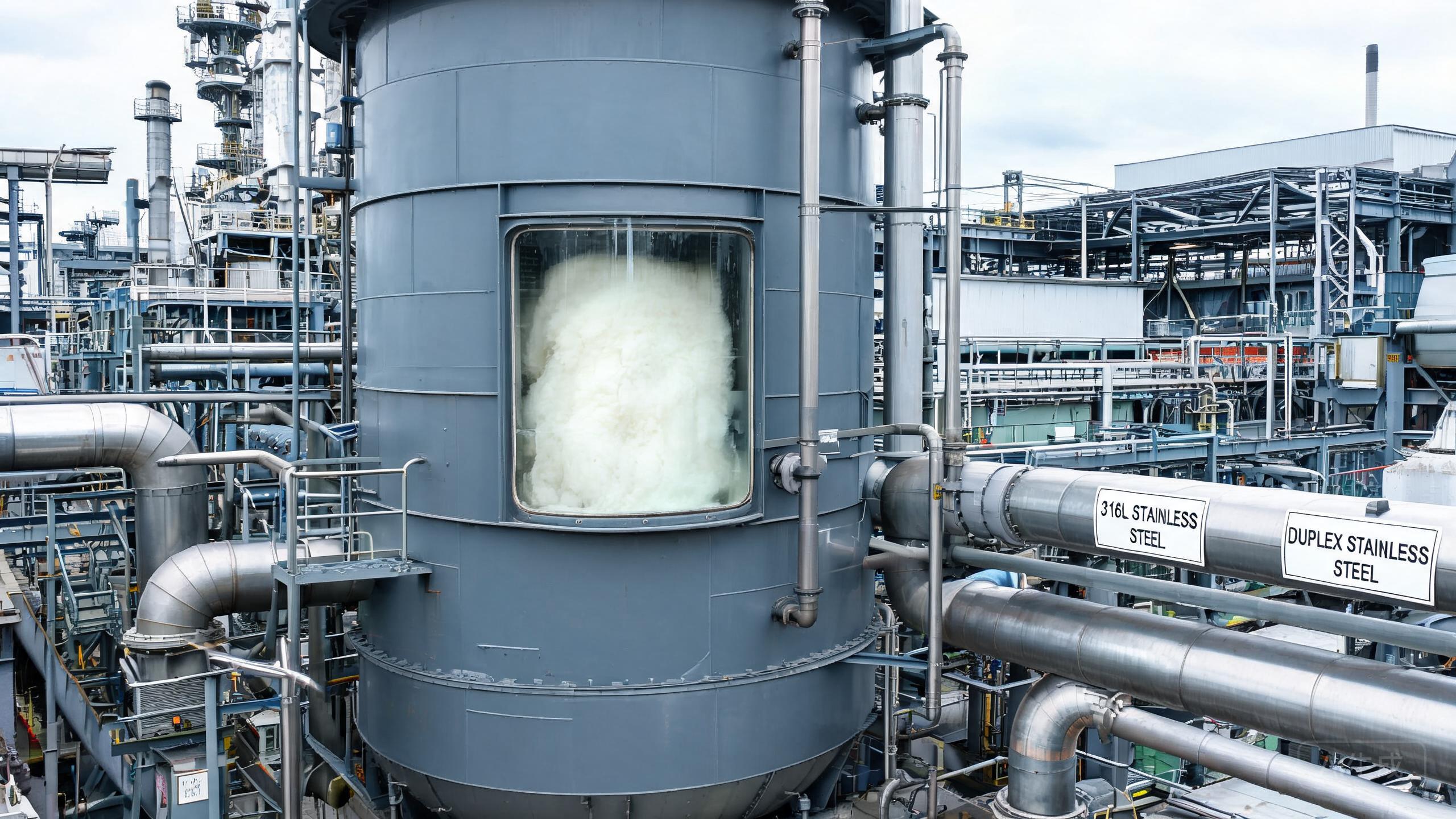
Pulp and paper bleaching is one of stainless steel’s most demanding industrial environments — hot caustic soda, chlorine dioxide, peroxides, and chlorides all combine in modern Elemental Chlorine-Free (ECF) processes to attack anything less than duplex or super austenitic grades. 316L fails within 2-4 years in these environments, and the correct grade hierarchy is: 2205 (S32205) for chlorine dioxide (D-stage) towers; 904L (N08904) for ozone and oxygen (Z-stage/O-stage) stages; 254 SMO (S31254) for hot caustic soda (white liquor) above 95°C with high chlorides. China’s pulp industry expanded 18% in 2025 driven by domestic demand and export growth, with mills in Guangdong and Fujian being the primary stainless consumers.
Quick Comparison
| Bleaching Stage | Primary Corrosive | Temp Range | Recommended Grade | UNS | PREN | Corrosion Rate | Price vs 316L |
|---|---|---|---|---|---|---|---|
| D-stage (ClO₂) | Chlorine dioxide | 60-80°C | 2205 Duplex | S32205 | ~35 | <0.1 mm/year | +40-50% |
| O-stage / Z-stage | Ozone, oxygen, H₂O₂ | 70-90°C | 904L | N08904 | ~35 | <0.05 mm/year | +60-70% |
| E-stage / EOP | H₂O₂ + NaOH | 70-95°C | 904L or 2205 | - | - | <0.1 mm/year | +40-70% |
| Hot caustic (white liquor) | NaOH + Na₂SO₄ + Cl⁻ | 80-110°C | 254 SMO | S31254 | ~40 | <0.03 mm/year | +100-120% |
| 316L (reference) | All of above | Any | FAILS | S31603 | ~25 | 0.5-2.0 mm/year | Base |
What Buyers Should Evaluate
- Chloride content in process streams. Above 3,000 ppm Cl⁻ in any bleaching stage, upgrade from 2205 to 904L or 254 SMO depending on temperature. Chloride levels vary significantly by mill location (water source quality).
- Operating temperature. Each 10°C increase roughly doubles corrosion rate. If your hot caustic operates at 100°C consistently, 254 SMO is mandatory even with chloride levels as low as 1,500 ppm.
- Welding requirements. 2205 uses ER2209 filler (interpass ≤250°C, no preheat). 904L and 254 SMO use ER385 filler (excellent weldability, no preheat needed). Duplex and super austenitic welds require 100% RT inspection per ASME IX.
- Stock availability. 2205 is more commonly stocked. 904L and 254 SMO have 4-6 week lead times from Chinese mills (Baosteel, Tsingtao Iron & Steel) and 6-10 weeks from Western mills.
- China-specific note. China’s pulp mills in Guangdong and Fujian have been upgrading from 316L to duplex since 2018. Verify compliance with GB/T 24511-2020 which mirrors ASTM A240.
Common Purchasing Mistakes
Mistake: Using 316L “because we used it for the old CFP bleaching line.” A Guangxi pulp mill tried to use remaining 316L inventory for their new ECF bleaching line in 2023. Within 18 months, pitting corrosion caused 7 leaks across the ClO₂ tower and hot caustic piping. Downtime cost $1.2M for emergency repair. Fix: ECF bleaching is fundamentally different from older CFP processes — it’s more corrosive. Always upgrade to duplex 2205 minimum.
Mistake: Chinese factory trick — 2205 with borderline molybdenum content. Some mills in Jiangsu supply duplex labeled “2205” but with Mo running at 2.7-2.9% instead of the required 3.0-3.5% minimum per ASTM A240. This drops PREN from ~35 to ~32, reducing pitting resistance by 20-30% in ClO₂ environments. These towers develop visible pitting within 12-18 months. Solution: PMI (Positive Material Identification) spectroscopy on every plate — Mo must be ≥3.0% for genuine 2205. Insist on EN 10204 3.1 mill test certificates listing PREN calculation: %Cr + 3.3×%Mo + 16×%N. Run ASTM G48 Method A pitting corrosion testing on a sample — 2205 must resist 6% FeCl₃ at 35°C for 24 hours without pitting.
Mistake: Skipping post-weld solution annealing on 904L/254 SMO. Super austenitics like 904L and 254 SMO can develop chromium and molybdenum carbide precipitation in the weld HAZ if heat input is excessive (>2.5 kJ/mm). This causes intergranular corrosion in service. Solution annealing at 1080-1120°C followed by water quench is recommended for critical welds in caustic or ClO₂ environments.
Mistake: Using the wrong filler metal for 904L. 904L has higher nickel (23-28%) and molybdenum (4-5%) than 316L. Welding with ER316L filler produces a weld with reduced Ni and Mo, creating a galvanic couple between weld and base metal. Always use ER385 or ER904L matching fillers.
Recommended RFQ Wording
Grade: ASTM A240 / UNS [S32205 (2205 duplex) / N08904 (904L) / S31254 (254 SMO)]
Application: [ClO₂ bleach tower / ozone stage / hot caustic piping / bleach pump]
Operating medium: [ClO₂ / H₂O₂ / hot NaOH / white liquor]
Medium parameters:
  - Temperature range: [min - max °C]
  - Chloride content: [exact ppm]
  - pH: [exact value]
Form: [plate / pipe / bar]
Thickness: [exact mm + 3mm corrosion allowance]
Surface: Pickled and passivated
Quantity: [metric tons]
Certification required:
  - EN 10204 3.1 mill test certificate (PREN calculated)
  - PMI spectroscopy on every heat (verify Mo ≥3.0% for 2205)
  - ASTM G48 Method A pitting corrosion test (no pitting, 35°C, 24h)
  - ASTM G31 immersion test in buyer-specified medium
Additional: Weld filler metal ER2209 (for 2205) or ER385 (for 904L/254 SMO) specified.
FAQ
Why does 316L fail in modern pulp bleaching operations?
Modern Elemental Chlorine-Free (ECF) pulp bleaching uses chlorine dioxide (ClO₂), hot sodium hydroxide (white liquor), and high-purity oxygen — all at elevated temperatures (80-110°C) with chloride levels 2,000-5,000 ppm. 316L (UNS S31603, PREN ~25) develops crevice and pitting corrosion within 2-4 years in these environments. The corrosion rate exceeds 0.5 mm/year in hot white liquor (Na₂SO₄ + NaOH) with chloride contamination.
Which stainless steel handles chlorine dioxide bleaching towers?
Duplex 2205 (UNS S32205, PREN ~35) is the standard material for chlorine dioxide (D-stage) bleaching towers and piping. It handles ClO₂ at 60-80°C with corrosion rates <0.1 mm/year. Super duplex 2507 (S32750) is used for critical components where 2205 shows localized attack, or for higher-pressure operations in TCF (Totally Chlorine-Free) processes.
Why is 254 SMO needed for hot caustic soda towers?
Hot white liquor (Na₂SO₄ + NaOH, 80-110°C) with 3,000+ ppm chloride is one of the most corrosive environments in pulp processing. 904L (N08904) handles it up to ~95°C, but above that temperature or with higher chloride levels, 254 SMO (S31254, PREN ~40) is needed. The 6% molybdenum in 254 SMO provides critical pitting resistance where 904L’s 4% Mo begins to fail.
CTA + Technical References
Send your grade, dimensions, annual volume and application to vip@still-steel.com, or contact us. We supply 2205, 904L, and 254 SMO per ASTM A240 for pulp and paper bleaching applications.
References:
- ASTM A240 / A240M: Standard specification for chromium and chromium-nickel stainless steel plate, sheet, and strip
- ASTM G48: Standard test method for pitting corrosion resistance of stainless steels
- ASTM G31: Standard guide for laboratory immersion corrosion testing of metals
- GB/T 24511-2020: Stainless steel plates for pressure equipment
- See also: CCUS carbon capture stainless steel
Technical References
- ASTM A240M - Standard Specification for Chromium and Chromium-Nickel Stainless Steel Plate, Sheet and Strip
- EN 10088-2 - Stainless steels. Technical delivery conditions for sheet/plate and strip
- ASM International - Handbook Series, Volume 1: Properties and Selection: Irons, Steels, and High-Performance Alloys