
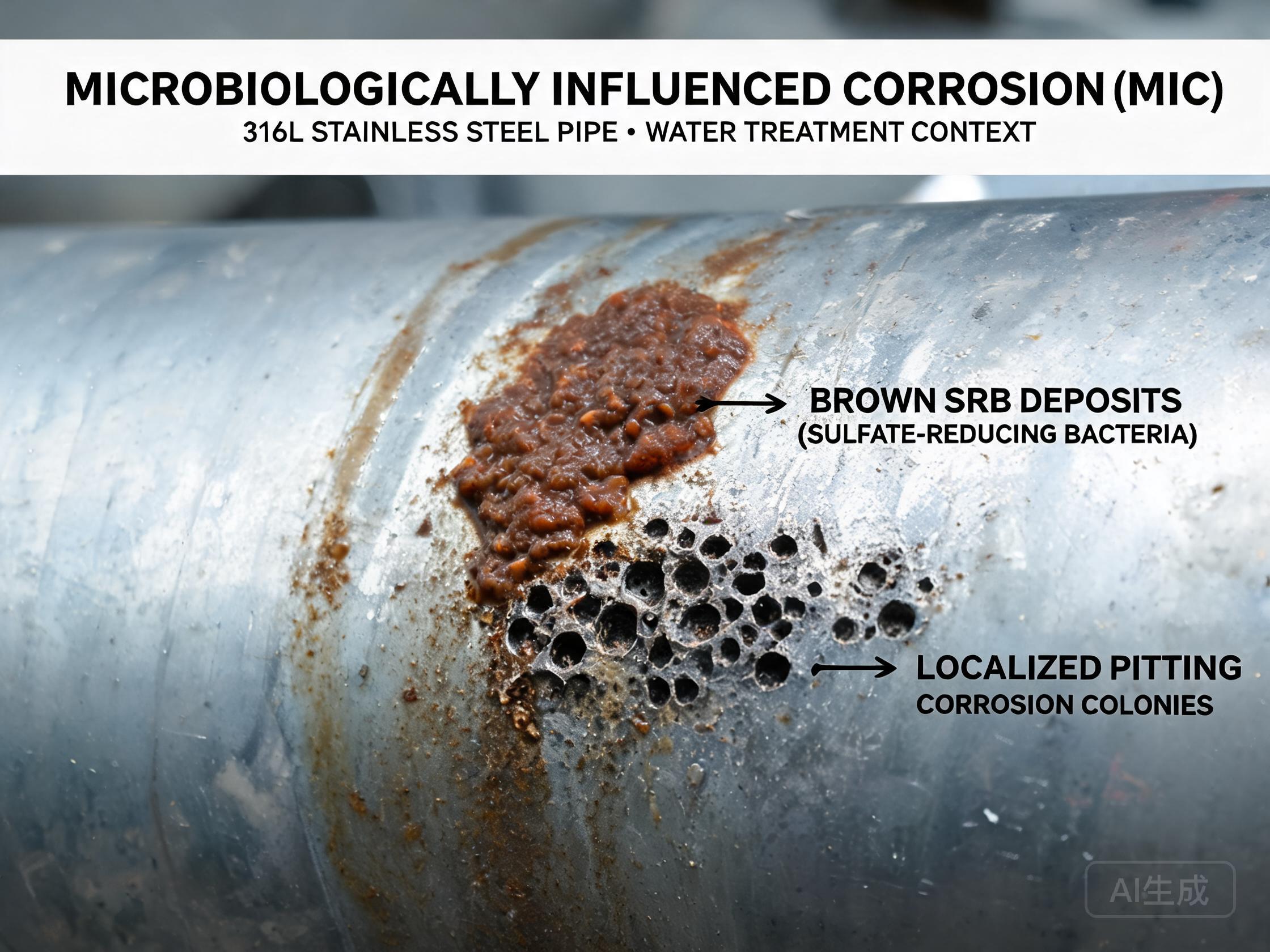
Short answer: Microbiologically influenced corrosion (MIC) is the corrosion you cannot see — until it perforates the wall. Sulfate-reducing bacteria (SRB) grow in anaerobic biofilms on cold rolled stainless steel, excrete H2S, and create a localized acid pit that eats through 304 like termites through wood. The fix: 316L with regular pasteurization, or 2205 if sulfate levels exceed 500 ppm.
MIC looks like pitting, but the pits are filled with black FeS sludge and smell like rotten eggs. In food and beverage systems, this happens in CIP tanks, beer fermenters, and waste treatment lines. In industrial water systems, it hits closed loops and sediment traps. Cold rolled 304 is the worst victim because the residual cold working stress helps bacteria initiate pits.
Quick Comparison
| Grade | SRB MIC resistance | H2S resistance | Pasteurization interval |
|---|---|---|---|
| 304 / 304L | Poor | Poor | 7 days |
| 316 / 316L | Good | Moderate | 14 – 21 days |
| 317L | Very good | Good | 28 days |
| 2205 duplex | Excellent | Good | No scheduled pasteurization needed |
| 2507 super duplex | Excellent | Excellent | Not needed |
Pasteurization: 80 °C for 30 minutes kills 99.99% of SRB. But it does not remove established biofilms — you need mechanical cleaning (brush, foam ball) followed by pasteurization for that.
What Buyers Should Evaluate
- Test your water for sulfate (SO4²⁻). If sulfate > 100 ppm and the system can go anaerobic, assume MIC is a risk.
- For food contact applications, confirm biocides are FDA/EU approved. Chlorine dioxide is approved in most regions; check with your regulator.
- Specify smooth 2B surface finish. Rougher cold rolled surfaces trap biofilms 2-3× more than smooth finishes.
- For anaerobic systems (biogas, beer fermentation, sludge tanks), start at 316L minimum. If sulfate > 500 ppm, go to 2205.
Common Purchasing Mistakes
- Using 304 for a beer fermenter. The fermentation process creates an anaerobic environment with 200-500 ppm sulfate. SRB grow on the cold rolled 304 wall and produce H2S, which both pits the stainless and ruins the beer flavor. A 304 fermenter develops MIC within 12 months; 316L lasts 5-10 years.
- Skipping Mo verification on “316L”. A cheap Chinese mill may sell you 1.8% Mo material as “316L” — the Mo content is below the effective threshold for MIC resistance. Always PMI check 10% of coils.
- Assuming pasteurization alone fixes everything. Heat kills planktonic bacteria but does not remove the polysaccharide biofilm matrix. Without mechanical cleaning, biofilms reform in 1-2 weeks and MIC starts again.
- Using BA (bright annealed) finish instead of 2B for exterior surfaces. BA finish can have surface imperfections that trap moisture and bacteria. 2B is more uniform and easier to clean.
Recommended RFQ Wording
“Cold rolled stainless steel sheet, grade 316L (EN 10088-2, ASTM A240). Mo minimum 2.0%, PREN minimum 25. Interior surface finish 2B (cold rolled, pickled, passivated). Wall thickness 1.5mm. Application: beer fermentation tank, anaerobic environment, sulfate 300-500 ppm, operating temp 10-15 °C. Pasteurization: 80 °C for 30 min every 14 days. Flow velocity >1.5 m/s to prevent biofilm attachment. EN 10204-3.1 certificate required.”
How Still Steel Supports the Project
Still Steel supplies cold rolled stainless steel in 304/304L/316/316L/317L/2205/2507/904L with full EN 10204-3.1 material test reports. We verify PREN, Mo, Cr and Ni content by PMI before dispatch and match the grade to your corrosion environment (chloride level, temperature, pH). Send your corrosion data and grade requirement to vip@still-steel.com, or discuss on WhatsApp.
Frequently Asked Questions
What is microbiologically influenced corrosion?
MIC is corrosion caused or accelerated by microorganisms. Sulfate-reducing bacteria (SRB) are the main culprits. They grow in anaerobic biofilms, consume sulfate and produce H2S, which reacts with stainless steel to form corrosive FeS. The bacteria also create localized acidic conditions under the biofilm that break down the Cr2O3 passive layer.
Does 304 stainless steel get MIC?
Yes, and badly. 304 has no Mo, so the passive film breaks down under biofilms even at low SRB levels. Cold rolled 304 in an anaerobic system with sulfate >100 ppm can develop MIC pitting within 6-12 months. 316L with 2% Mo is 5-10× more resistant.
How do I control MIC in stainless steel tanks?
Four methods: (1) pasteurization at 80 °C for 30 minutes every 7-14 days, (2) biofouling inhibitors (chlorine dioxide, biocides — check food contact regulations), (3) upgrade to 316L (minimum) or 2205 for high-sulfate systems, (4) maintain high flow velocity (>1 m/s) to prevent biofilm attachment.
Technical References
- NACE TM0212 Laboratory Testing of Metals for Resistance to Microbially Influenced Corrosion
- ASTM G191 Standard Guide for Microbiologically Influenced Corrosion Testing
- ISO 15589 Petroleum, petrochemical and natural gas industries — Cathodic protection of steel pipelines
- EN 10088-2 Chemical composition data sheets
Reference documents support general selection and fabrication principles. The final material decision must follow the applicable contract, standard, regulation and engineering review for the specific product.