
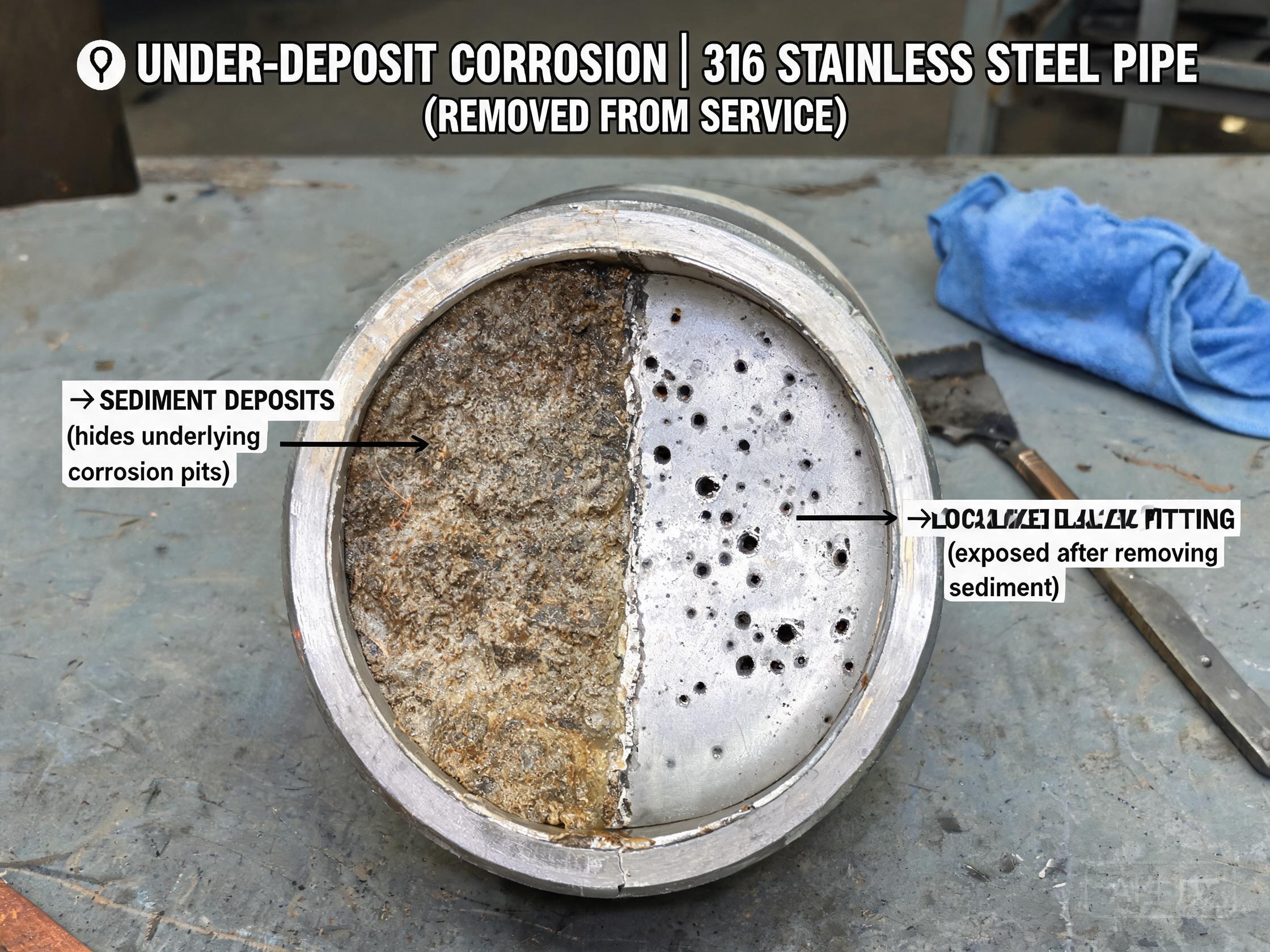
Short answer: Under-deposit corrosion is crevice corrosion from dirt. Sediment, scale, or biofilm settles on the bottom of cold rolled stainless steel tanks and pipes, creating a hidden crevice. Under the deposit, oxygen drops to near zero, chlorides concentrate 20-100×, and the stainless passive film breaks down. 304 tanks with 200 ppm Cl⁻ can perforate in 2 years if sediment is not removed. 316 buys you 3-4× the cleaning interval.
Most buyers think their 304 tank is clean. They are wrong. Even “clean” process water carries 0.5-5 ppm of suspended solids. Over 12 months, a 10 m³ tank accumulates 0.5-5 kg of sediment. The thickest deposit settles in the lowest point, under the pump suction, or around welds. That is where the first pinhole appears.
Quick Comparison
| Grade | PREN | Recommended cleaning interval (200 ppm Cl⁻) | Approx. corrosion rate under deposit |
|---|---|---|---|
| 304 / 304L | 18 – 19 | 3 – 6 months | 0.5 – 1.0 mm/year |
| 316 / 316L | 24 – 28 | 12 – 18 months | 0.1 – 0.3 mm/year |
| 317L | 30 – 34 | 18 – 24 months | 0.05 – 0.1 mm/year |
| 2205 duplex | 35 – 40 | 24+ months | < 0.05 mm/year |
| 2507 super duplex | 40 – 45 | No scheduled cleaning needed | Negligible |
These rates assume no cleaning and moderate sediment load (100 g/m² surface area). With filtration, rates drop by 80-90%.
What Buyers Should Evaluate
- Install Y-strainers with 50-100 mesh filters on every inlet. This is cheaper than upgrading from 304 to 316.
- For 304 tanks, schedule manual inspection and sediment removal every 3 months. Use a 0.8mm wall thickness minimum — corrosion allowance matters.
- If cleaning intervals must exceed 12 months (remote sites, large tanks), start at 316L or 2205.
- Specify a smooth surface finish (2B or BA) for tank interiors. Rough cold rolled surfaces trap sediment and biofilm 2-3× more than smooth 2B.
Common Purchasing Mistakes
- Using 304 for a buried tank or underground pipe that cannot be drained and cleaned. The sediment buildup is constant and undisturbed. Under-deposit corrosion eats through a 3mm wall in 3-4 years. Specify 316L minimum for buried stainless steel.
- Ordering cold rolled sheet with mill finish (No. 1, rough) instead of 2B for tank interiors. Rough surfaces trap sediment and biofilm 3× more than smooth 2B. The extra cost of 2B is recovered in the first year of cleaning.
- Skipping filtration and expecting the grade to carry the whole load. A 2205 tank with no filtration will still develop under-deposit corrosion — just slower. Filtration is 10× more effective than grade upgrade at preventing this failure mode.
- Specifying 316 from a cheap mill without Mo verification. If Mo is only 1.8% (common in “budget 316” from some Chinese mills), PREN drops to 22 and the corrosion rate under deposit doubles. Always PMI check 10% of incoming coils.
Recommended RFQ Wording
“Cold rolled stainless steel sheet, grade 316L (EN 10088-2, ASTM A240). Mo minimum 2.0%, PREN minimum 25. Interior surface finish 2B. Wall thickness minimum 3.0mm (includes 0.5mm corrosion allowance for under-deposit). Tank bottom slope 1:100 for sediment drainage. Inlet Y-strainer 50 mesh required. Sediment cleaning interval: 12 months. Application: process water storage tank, 200 ppm Cl⁻ max, remote site, manual cleaning access limited.”
How Still Steel Supports the Project
Still Steel supplies cold rolled stainless steel in 304/304L/316/316L/317L/2205/2507/904L with full EN 10204-3.1 material test reports. We verify PREN, Mo, Cr and Ni content by PMI before dispatch and match the grade to your corrosion environment (chloride level, temperature, pH). Send your corrosion data and grade requirement to vip@still-steel.com, or discuss on WhatsApp.
Frequently Asked Questions
What is under-deposit corrosion?
Under-deposit corrosion is crevice corrosion that happens under sediment, scale or biofilm that settles on the stainless steel surface. The deposit creates a stagnant microenvironment where oxygen is depleted, chlorides concentrate, and the passive film breaks down. It behaves exactly like crevice corrosion — but the “gasket” is dirt you cannot see until you drain the tank.
How often should I clean 304 vs 316 stainless steel pipes?
For water systems with sediment: 304 should be cleaned every 3-6 months; 316 can go 12-18 months. For systems with <50 ppm chlorides: 304 can stretch to 12 months if filtered. Always install Y-strainers or self-cleaning filters to reduce sediment load.
Can I prevent under-deposit corrosion without frequent cleaning?
Three steps: (1) install filtration to keep incoming water free of particulates, (2) select a grade with higher PREN (316 > 304, 2205 > 316), (3) use a smooth surface finish (2B or BA, no rough cold rolled mill finish) so deposits do not adhere as easily.
Technical References
- NACE SP0178 Design Considerations for Pitting and Crevice Corrosion
- ASTM G48 Standard Test Methods for Pitting and Crevice Corrosion
- EN ISO 17628 Corrosion resistance testing
- EN 10088-2 Chemical composition and surface finish data sheets
Reference documents support general selection and fabrication principles. The final material decision must follow the applicable contract, standard, regulation and engineering review for the specific product.