
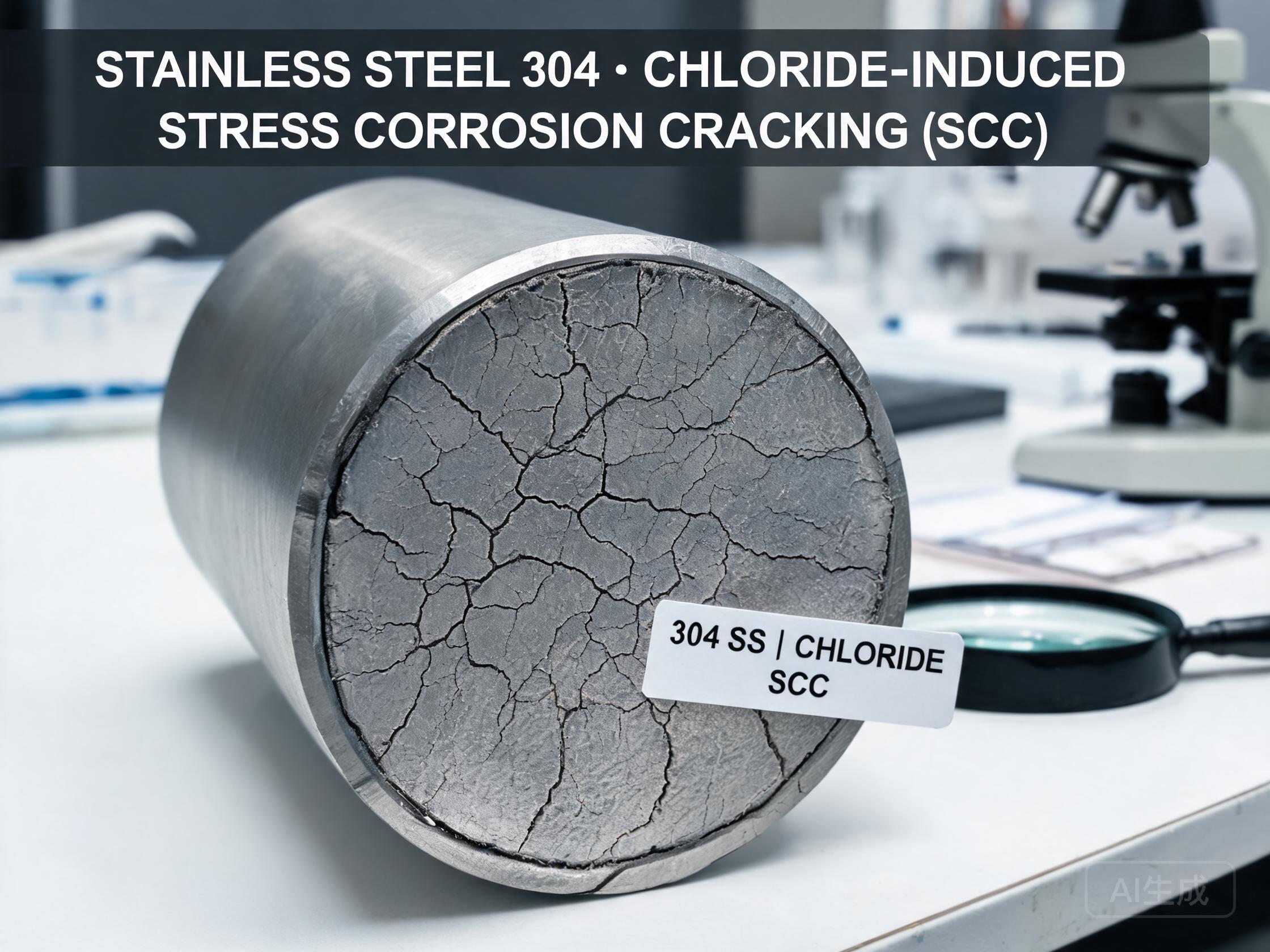
Short answer: Stress corrosion cracking (SCC) is the silent killer of cold rolled stainless steel. It needs three things: tensile stress above the threshold, a corrosive environment, and a susceptible grade. Cold rolling locks residual stress into the sheet, so cold formed 304 cracks at chloride levels where hot rolled 304 might survive. The fix is stress relief annealing or grade upgrade — pick one before you order.
SCC does not look like rust. It appears as fine, hairline cracks that propagate through the wall thickness with almost no plastic deformation. One day the tank is fine; the next day it leaks. In cold rolled 304, residual stress from cold rolling can be 60-80% of yield strength in the as-delivered condition. Add 100 ppm Cl⁻ and 60 °C, and SCC initiates in weeks.
Quick Comparison
| Grade | SCC threshold (100 ppm Cl⁻, 80 °C) | H2S resistance | Cold rolling stress sensitivity |
|---|---|---|---|
| 304 / 304L | ~20% of yield | Poor | High — 60-80% residual stress |
| 316 / 316L | ~40% of yield | Poor | High — similar to 304 |
| 2205 duplex | ~80% of yield | Good | Medium — higher yield helps |
| 2507 super duplex | > yield | Excellent | Low |
| 316L stress-relieved | ~50% of yield | Poor | Low — residual stress <10% yield |
Duplex grades have roughly twice the yield strength of austenitic 304/316, so the SCC threshold is proportionally higher. Cold rolling increases residual stress in all grades, but the effect is most dangerous in austenitic grades with low yield strength.
What Buyers Should Evaluate
- Know your residual stress level. Ask the supplier for a stress relief annealing certificate if the part is cold formed or cold rolled.
- Calculate operating stress vs yield strength. Keep operating stress below 20% of yield for 304/316 in chloride environments.
- If H2S is present (oil and gas, biogas), skip austenitic grades entirely and specify duplex 2205 or 2507.
- For cold rolled sheet that will be deep drawn or bent, require stress relief anneal at 1050-1150 °C followed by water quenching.
Common Purchasing Mistakes
- Ordering cold rolled 304 without stress relief annealing and using it in a chloride environment. The residual stress from cold rolling is already 30-40% of yield before you add any operating load.
- Confusing 304 and 316 SCC resistance. Mo improves pitting and crevice corrosion but does almost nothing for chloride SCC. 316 cracks at roughly the same chloride level as 304 — you need duplex for real SCC resistance.
- Skipping the H2S question. If your process produces even 10 ppm H2S (anaerobic digestion, oil storage), 304 and 316 will crack. Always test the environment before specifying grade.
- Buying “annealed” 304 from a Chinese mill without verifying the temperature. A cheap mill may do a 700 °C anneal (below the Cr23C6 solution temperature) and call it “stress relieved.” Demand the annealing temperature on the EN 10204 3.1 certificate.
Recommended RFQ Wording
“Cold rolled stainless steel sheet, grade 2205 duplex (EN 10088-2, ASTM A240). Solution annealed at 1050 °C minimum, water quenched. Residual stress verified <10% of yield strength by X-ray diffraction or hole-drilling method. Mo 2.5-3.5%, Cr 21-23%, Ni 4.5-6.5%, N 0.08-0.20%. Thickness 2.0mm. Surface 2B. EN 10204-3.1 certificate required with annealing temperature recorded. Application: pressure vessel, 500 ppm Cl⁻, operating temp 60 °C, H2S present.”
How Still Steel Supports the Project
Still Steel supplies cold rolled stainless steel in 304/304L/316/316L/317L/2205/2507/904L with full EN 10204-3.1 material test reports. We verify PREN, Mo, Cr and Ni content by PMI before dispatch and match the grade to your corrosion environment (chloride level, temperature, pH). Send your corrosion data and grade requirement to vip@still-steel.com, or discuss on WhatsApp.
Frequently Asked Questions
What causes stress corrosion cracking in stainless steel?
SCC requires three conditions simultaneously: (1) tensile stress above the threshold, (2) a corrosive environment (chlorides, H2S, hydroxides), and (3) a susceptible grade. Remove any one and SCC does not occur.
Does 304 stainless steel get stress corrosion cracking?
Yes. 304 austenitic stainless steel is very susceptible to SCC in chloride environments. The threshold stress for 304 in 100 ppm Cl⁻ at 80 °C is only about 20% of yield strength. Cold rolling increases residual stress, making cold rolled 304 even more vulnerable.
How do you prevent stress corrosion cracking?
Three methods: (1) stress relief annealing at 1050-1150 °C followed by rapid cooling to reduce residual stress, (2) upgrade to a more resistant grade (duplex 2205 or super austenitic 254 SMO), (3) design to keep operating stress below the SCC threshold for your environment.
Technical References
- ASTM G123 Standard Test Method for Stress-Corrosion of Stainless Steels
- NACE TM0177 Laboratory testing of metals for resistance to sulfide stress cracking
- EN ISO 7539 Corrosion of metals and alloys — Stress corrosion testing
- EN 10088-2 Chemical composition and heat treatment data sheets
Reference documents support general selection and fabrication principles. The final material decision must follow the applicable contract, standard, regulation and engineering review for the specific product.