
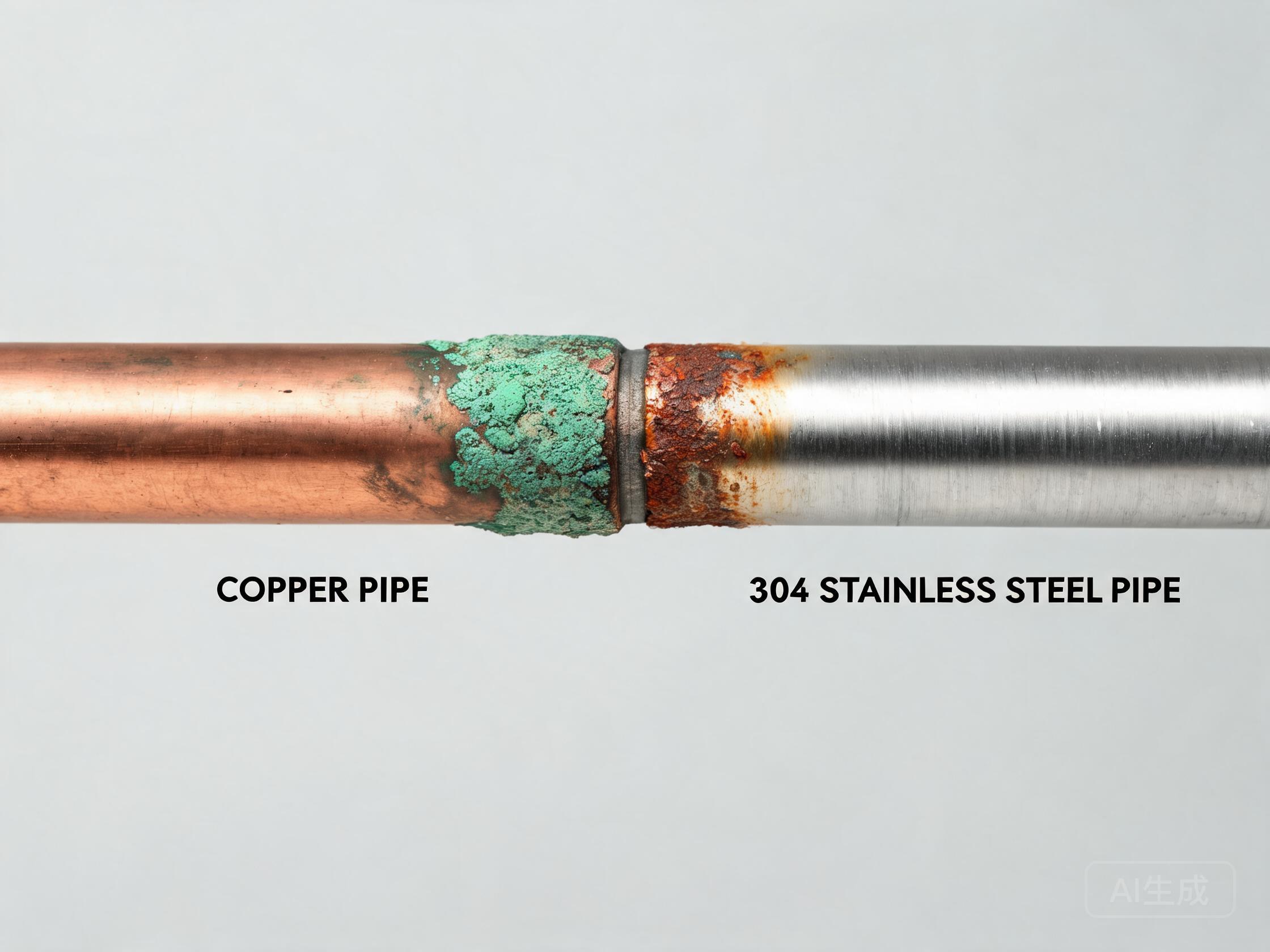
Short answer: Galvanic corrosion between copper and cold rolled stainless steel is a battery. Put two metals with different electrode potentials in conductive water, connect them with a pipe or a flange, and current flows. The more active metal — stainless steel — becomes the anode and corrodes faster than it would alone. The bigger the copper surface relative to stainless, the faster the stainless fails.
In real systems this shows up as a pinhole leak in the 304 pipe within 2-5 years of connecting to a copper heat exchanger, while the copper flange looks untouched. The cold rolled 304 loses 0.1-0.3mm per year at the joint — 10-30× the normal atmospheric corrosion rate.
Quick Comparison
| Metal | Electrode Potential (passive) vs SHE | Galvanic role in pair |
|---|---|---|
| Copper | +0.34 V | Cathode (protected) |
| 304 stainless steel (passive) | +0.50 V | Anode (corrodes) |
| 316 stainless steel (passive) | +0.55 V | Anode (corrodes, but slower) |
| 2205 duplex (passive) | +0.60 V | Anode (corrodes, slower still) |
| Carbon steel | -0.60 V | Anode (very fast corrosion if paired) |
Austenitic stainless steel is more active than copper only when passive. If the stainless steel surface breaks down (pitting, crevice), its potential drops to -0.20 V and the galvanic current reverses — copper then corrodes. But in most potable and process water, stainless remains passive and copper is the cathode.
What Buyers Should Evaluate
- Calculate the exposed surface area ratio of copper to stainless steel at the joint. For copper (cathode) to stainless (anode), keep the ratio ≤ 1:5.
- Use insulating gaskets or sleeves between copper and stainless to break the galvanic circuit when the area ratio is unfavorable.
- For closed water systems, consult a corrosion engineer about inhibitors. Orthophosphate at 1-3 ppm is the standard for potable water systems in EU and US.
- Consider upgrading the stainless grade to 316L if the chloride level exceeds 200 ppm — 316L is more resistant to galvanic attack than 304.
Common Purchasing Mistakes
- Pairing a large copper heat exchanger (0.5 m² exposed surface) with a small 304 pipe (0.01 m² exposed surface). The area ratio is 50:1, so the pipe corrodes 50× faster than normal. Pinholes appear in 18 months.
- Using a steel bolt through both copper and 304 flanges. Steel is more active than both metals, so the bolt becomes the sacrificial anode — but the galvanic circuit also increases current between copper and 304.
- Buying cheap insulating gaskets made from foam or low-density plastic. These absorb water, become conductive, and do not break the galvanic path. Use solid PTFE or high-density polyethylene gaskets.
- Assuming 304 and 316 have the same galvanic behavior. 316L is slightly more noble than 304, so the galvanic current is about 30% lower when paired with copper. It is not a silver bullet, but it helps.
Recommended RFQ Wording
“Cold rolled stainless steel pipe, grade 316L (EN 10088-2, ASTM A312). Chemical: Mo 2.0% minimum, PREN 25 minimum. Wall thickness 3.0mm. Connection design: PTFE insulating gasket between 316L flange and copper heat exchanger flange, exposed surface area ratio (copper:stainless) ≤ 1:5. Closed-loop system with orthophosphate inhibitor 2 ppm. Application: chilled water system, 200 ppm Cl⁻ max, 25 °C.”
How Still Steel Supports the Project
Still Steel supplies cold rolled stainless steel in 304/304L/316/316L/317L/2205/2507/904L with full EN 10204-3.1 material test reports. We verify PREN, Mo, Cr and Ni content by PMI before dispatch and match the grade to your corrosion environment (chloride level, temperature, pH). Send your corrosion data and grade requirement to vip@still-steel.com, or discuss on WhatsApp.
Frequently Asked Questions
Why does copper and stainless steel cause galvanic corrosion?
All metals have different electrode potentials. In a conductive electrolyte (water), copper is more noble (+0.34V vs SHE) than stainless steel (+0.50V for 304). When connected, stainless steel becomes the anode and corrodes. The potential difference drives the corrosion current.
What area ratio is safe for copper-to-stainless joints?
The safe area ratio depends on which metal is the anode. For copper (noble) connected to stainless (active), the stainless surface area must be at least 5-10× larger than the copper surface area. A small copper pipe flange connected to a large 304 tank surface is relatively safe. A large copper heat exchanger connected to a small 304 pipe is dangerous.
Can I use inhibitors to prevent galvanic corrosion?
Yes. In closed water systems, chromates (where permitted) or phosphonates can passivate the stainless steel surface and reduce the galvanic current. For potable water, orthophosphate at 1-3 ppm is approved in most regions. Always check local drinking water regulations.
Technical References
- ASTM G71 Standard Guide for Galvanic Corrosion Testing
- ISO 17081 Corrosion of metals and alloys — Determination of galvanic corrosion
- NACE SP0198 Galvanic corrosion of metals in water and wastewater
- EN 10088-2 Chemical composition data sheets
Reference documents support general selection and fabrication principles. The final material decision must follow the applicable contract, standard, regulation and engineering review for the specific product.