
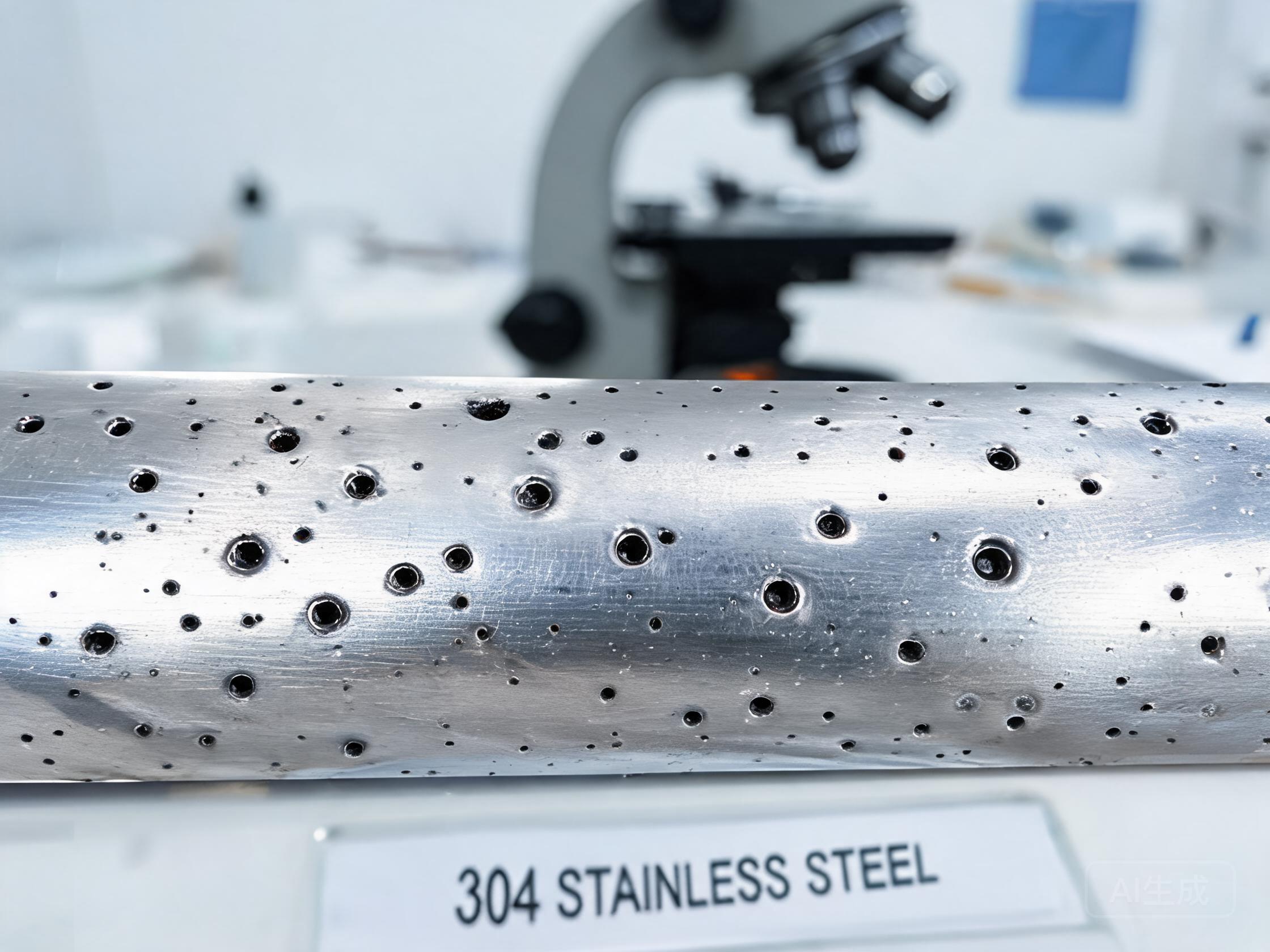
Short answer: Pitting corrosion is the #1 failure mode for cold rolled stainless steel in chloride environments. It starts as a tiny hole and eats through the wall thickness before you see it. The fix is simple: calculate PREN from your material cert, match the critical pitting temperature from ASTM G48 to your operating temperature, and stop buying 304 for anything more aggressive than tap water.
Pitting happens when a local spot on the passive Cr2O3 film breaks down and does not repassivate. Chlorides are the trigger — they punch holes in the oxide layer faster than chromium can rebuild it. Once a pit forms, it autocatalyzes: the pit interior becomes acidic and concentrates Cl⁻, dissolving more metal. A 0.8mm cold rolled sheet can be perforated in months if the grade is wrong.
Quick Comparison
| Grade | Typical PREN | ASTM G48 Critical Pitting Temp (CPT) | Chloride limit (approx.) |
|---|---|---|---|
| 304 / 304L | 18 – 19 | 4 °C | < 200 ppm Cl⁻ |
| 316 / 316L | 24 – 28 | 25 – 30 °C | < 1000 ppm Cl⁻ |
| 317L | 30 – 34 | 35 – 45 °C | < 5000 ppm Cl⁻ |
| 2205 duplex | 35 – 40 | 55 – 65 °C | Seawater service |
| 2507 super duplex | 40 – 45 | 75 – 85 °C | Brine / concentrated Cl⁻ |
| 904L super austenitic | 40 – 45 | 45 – 55 °C | Concentrated H2SO4 + Cl⁻ |
PREN = Cr + 3.3×Mo + 16×N (all in wt%). Mo and N are the pitting fighters. If you see a Chinese mill cert for “316” with Mo < 2.0%, the PREN is inflated on paper but the real plate will pit at 15 °C.
What Buyers Should Evaluate
- Get the chloride level (ppm) and operating temperature from your process engineer before picking a grade.
- Calculate PREN from the actual mill report — do not rely on the grade designation alone.
- Specify ASTM G48 as a factory test when the application is critical (marine, chemical, food CIP with sanitizers).
- Confirm the cold rolled surface: 2B or BA with no pickling residue. A dirty surface initiates pits 3× faster.
Common Purchasing Mistakes
- Ordering “316” without a Mo minimum. Some Chinese mills label 1.8% Mo material as 316, and the PREN drops from 25 to 22. Pitting starts at 15 °C instead of 25 °C.
- Skipping PMI verification. A cheap supplier can substitute 304 for 316 on the same EN 10204 3.1 certificate if you do not test with a portable spectrometer. Always run PMI on 10% of incoming coils.
- Ignoring nitrogen content. 316 with 0.08% N has PREN 26; the same Cr/Mo with 0.18% N hits PREN 28. N is free pitting resistance — demand it on the spec.
- Using 304 for food CIP processes with hypochlorite sanitizer. 200 ppm free Cl⁻ will pit 304 in weeks. Upgrade to 316L or 317L.
Recommended RFQ Wording
“Cold rolled stainless steel sheet / strip, grade 316L (EN 10088-2, ASTM A240). Chemical minimums: Cr 16.0%, Ni 10.0%, Mo 2.0%, N 0.08%. PREN minimum 25 per heat. Surface 2B. Thickness 0.8mm ±0.02mm. Width 1219mm. EN 10204-3.1 certificate required. PMI spot check on 10% of coils prior to dispatch. Application: food process tank, CIP with 500 ppm Cl⁻ sanitizer, max temp 50 °C.”
How Still Steel Supports the Project
Still Steel supplies cold rolled stainless steel in 304/304L/316/316L/317L/2205/2507/904L with full EN 10204-3.1 material test reports. We verify PREN, Mo, Cr and Ni content by PMI before dispatch and match the grade to your corrosion environment (chloride level, temperature, pH). Send your corrosion data and grade requirement to vip@still-steel.com, or discuss on WhatsApp.
Frequently Asked Questions
What is PREN and how do I calculate it?
PREN stands for Pitting Resistance Equivalent Number. The formula is: PREN = Cr + 3.3×Mo + 16×N. Higher PREN means better pitting resistance. Calculate it from the material test report using weight percentages of Cr, Mo and N.
Can 304 stainless steel get pitting corrosion?
Yes. 304 stainless steel has no Mo addition, so its PREN is around 18-19. It can pit in water with chlorides above 200 ppm or in acidic environments. 304L has the same pitting resistance as 304.
How do I test a grade’s pitting resistance?
ASTM G48 method A is the standard test for critical pitting temperature (CPT). The sample is exposed to 6% FeCl3 solution at increasing temperatures. The CPT is the lowest temperature where pitting is observed after 24 hours.
Technical References
- ASTM G48 Standard Test Methods for Pitting and Crevice Corrosion
- ASTM G123 Standard Test Method for Stress-Corrosion of Stainless Steels
- EN ISO 17628 Corrosion of metals and alloys — Determination of pitting corrosion resistance
- EN 10088-2 Chemical composition data sheets
Reference documents support general selection and fabrication principles. The final material decision must follow the applicable contract, standard, regulation and engineering review for the specific product.