
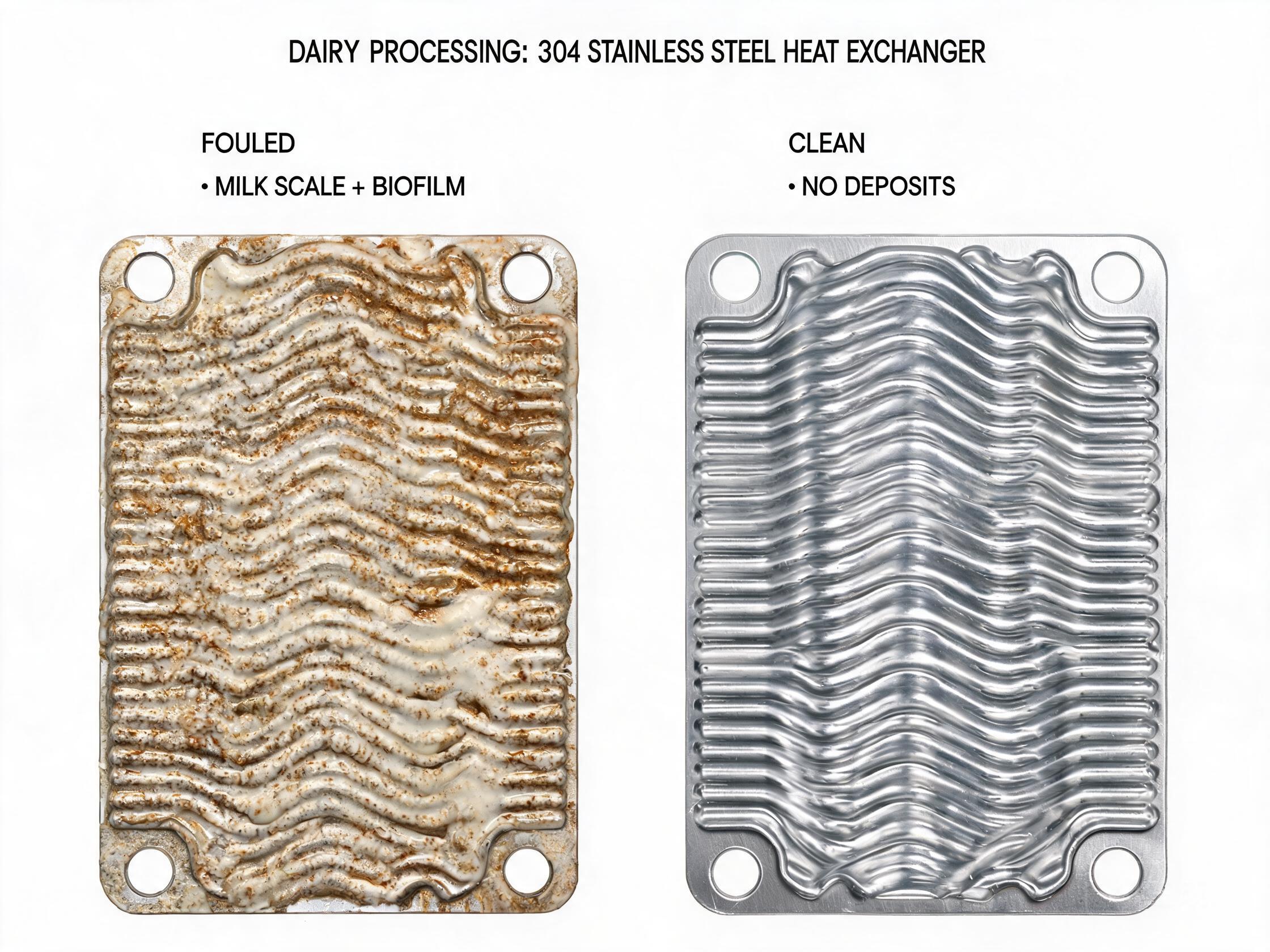
Short answer: Your cold rolled stainless steel plate heat exchanger is fouling because of three things — not one. The surface is too rough. The plate gap is too tight. And the grade is wrong for your temperature and product. Upgrade 304 to 316L if you run UHT. Polish to Ra ≤0.4 μm. Widen the plate gap to 2.5 mm minimum. You will cut your CIP frequency from every 8 hours to every 12 and your heat transfer efficiency stays above 92%.
Milk pasteurization, juice concentration, jam cooking and brewery wort cooling all run through cold rolled stainless steel heat exchangers. When fouling builds up, the heat transfer coefficient drops. Your plant slows down. You need a CIP cycle. Each CIP takes 45 minutes of lost production. The wrong stainless steel sheet — rough finish, wrong grade, wrong thickness — makes fouling 200% worse than the textbook fouling factor predicts.
Quick Comparison
| Product | Grade | Surface roughness | Plate gap | Expected fouling factor |
|---|---|---|---|---|
| HTST milk (72°C) | 304 | Ra ≤0.4 μm | 2.5 mm | 0.0001 m²·K/W |
| UHT milk (138°C) | 316L | Ra ≤0.2 μm | 3.0 mm | 0.00015 m²·K/W |
| Fruit juice | 316L | Ra ≤0.4 μm | 2.5 mm | 0.0002 m²·K/W |
| Beer wort | 304 | Ra ≤0.8 μm | 3.0 mm | 0.00008 m²·K/W |
| High-sugar jam | 316 | Ra ≤0.2 μm | 3.5 mm | 0.00025 m²·K/W |
The fouling factor tells you how much thermal resistance the deposit adds. When your measured fouling factor doubles the design value, it is time to CIP. Start with 304 for beer and HTST milk only. Anything hotter, saltier or higher in sugar and you need 316.
What Buyers Should Evaluate
- Match grade to product chemistry and temperature. The critical threshold is phosphates and organic acids above 75°C. 304 pits and fouling accelerates. 316L’s molybdenum prevents this.
- Surface roughness is the biggest fouling variable. Ra ≤0.4 μm minimum. No. 2B mill finish is Ra 0.8–1.2 μm — twice as much fouling. Polish the hot side only if budget is tight; the cold side fouling is less of an issue.
- Plate gap: minimum 2.5 mm, recommended 3.0 mm. Below 2 mm, the product velocity drops from 1.5 m/s to 0.8 m/s and protein deposits settle. Above 4 mm, heat transfer drops.
- Thickness: plate heat exchangers use 0.6–1.0 mm cold rolled sheet. Corrugated plates need at least 0.7 mm to resist buckling under pressure. Specify flatness Class A per EN 10088-2.
- CIP access: the plate pack must open without tools. If your plate heat exchanger takes an hour to disassemble, you will skip CIP and foul faster.
Common Purchasing Mistakes
- Ordering 304 to save 12% and running UHT milk at 138°C. The steel pits where milk phosphate deposits. Fouling factor triples in 3 months. You cannot repair it. You replace the plate pack at full price.
- Accepting “polished finish” without Ra numbers. A Chinese mill’s “polished” plate is Ra 0.8 μm. Your competitor’s is Ra 0.3 μm. Their CIP is every 12 hours. Yours is every 8. The Ra number goes on the order.
- Specifying plate gap at 1.5 mm because the competitor does it. Their product is beer. Yours is strawberry jam with 60% sugar. Sugar burns at 105°C and sticks in the tight gap. CIP pressure cannot reach it.
- Skipping EN 10204-3.1 and PMI. Some mills substitute 201 for 304 in plate heat exchanger coils — the nickel is 1.5% instead of 8%, and it pitts in 3 months of milk service.
- Buying used plate packs from auction. The corrugations are worn. The fouling factor is already 0.0004 m²·K/W, double new. You save 50% upfront and spend it in lost production in six months.
Recommended RFQ Wording
Cold rolled stainless steel sheet for plate heat exchanger, grade 316L (or 304 for HTST milk only), thickness 0.8 mm ±0.03 mm, width 1250 mm, mechanically polished Ra ≤0.4 μm, food contact compliant (FDA 21 CFR), EN 10088-2, EN 10204-3.1 test report with PMI analysis, flatness Class A, plate corrugation to [your drawing], plate gap target 3.0 mm, quantity 8 tonnes, destination [your factory], delivery within 20 days.
State the product being processed, the design temperature, the required heat transfer coefficient and the CIP pressure so the supplier can confirm the grade, thickness and plate gap before slitting. Put the Ra number and the plate gap on the purchase order — these are the two variables that most affect fouling.
Frequently Asked Questions
Why does my 304 stainless steel heat exchanger foul faster than the spec sheet promised?
Three reasons. 1) You ordered a No. 2B mill finish instead of a mechanically polished Ra ≤0.4 μm finish — the rough surface traps protein particles. 2) Your plate gap is below 2 mm, which accelerates deposition. 3) Milk phosphate reacts with steel above 75°C — 316L handles it better.
Should I upgrade from 304 to 316 cold rolled stainless steel for a milk pasteurizer?
304 works for HTST (72°C, 15 s) pasteurization of milk only if the surface is polished to Ra ≤0.4 μm. For UHT (138°C) or any product with added phosphates, salt or acid, upgrade to 316L. The molybdenum in 316L stops the pitting that accelerates fouling.
What surface roughness and plate gap should I specify to reduce fouling?
Polished to Ra ≤0.4 μm (No.4 fine brush or No.8 mirror). Plate gap minimum 2.5 mm. Below 2 mm, the flow velocity drops and protein deposits form a thermal insulator. Above 4 mm, you lose heat transfer efficiency. Keep CIP pressure above 3 bar to dislodge soft fouling.
How Still Steel Supports the Project
Still Steel supplies cold rolled stainless steel sheet and strip in the right grade and thickness for your food processing heat exchangers with EN 10204-3.1 test reports. We provide slitting, cut-to-length, surface finishing and protective film application so you receive process-ready material. Send your specification and quantity to vip@still-steel.com, or discuss on WhatsApp.
Technical References
- ASTM A240 / A240M flat-rolled stainless steel for general applications
- EN 10088-2 cold rolled stainless steel sheet and strip
- ASME BPVC Sec. VIII heat exchanger design
- TEMA (Tubular Exchanger Manufacturers Association) standards
- NACE SP0506 fouling mitigation guidelines
- FDA 21 CFR Part 175.300 food contact materials
Reference documents support general selection and fabrication principles. The final material decision must follow the applicable contract, standard, regulation and engineering review for the specific product.