
Short answer:
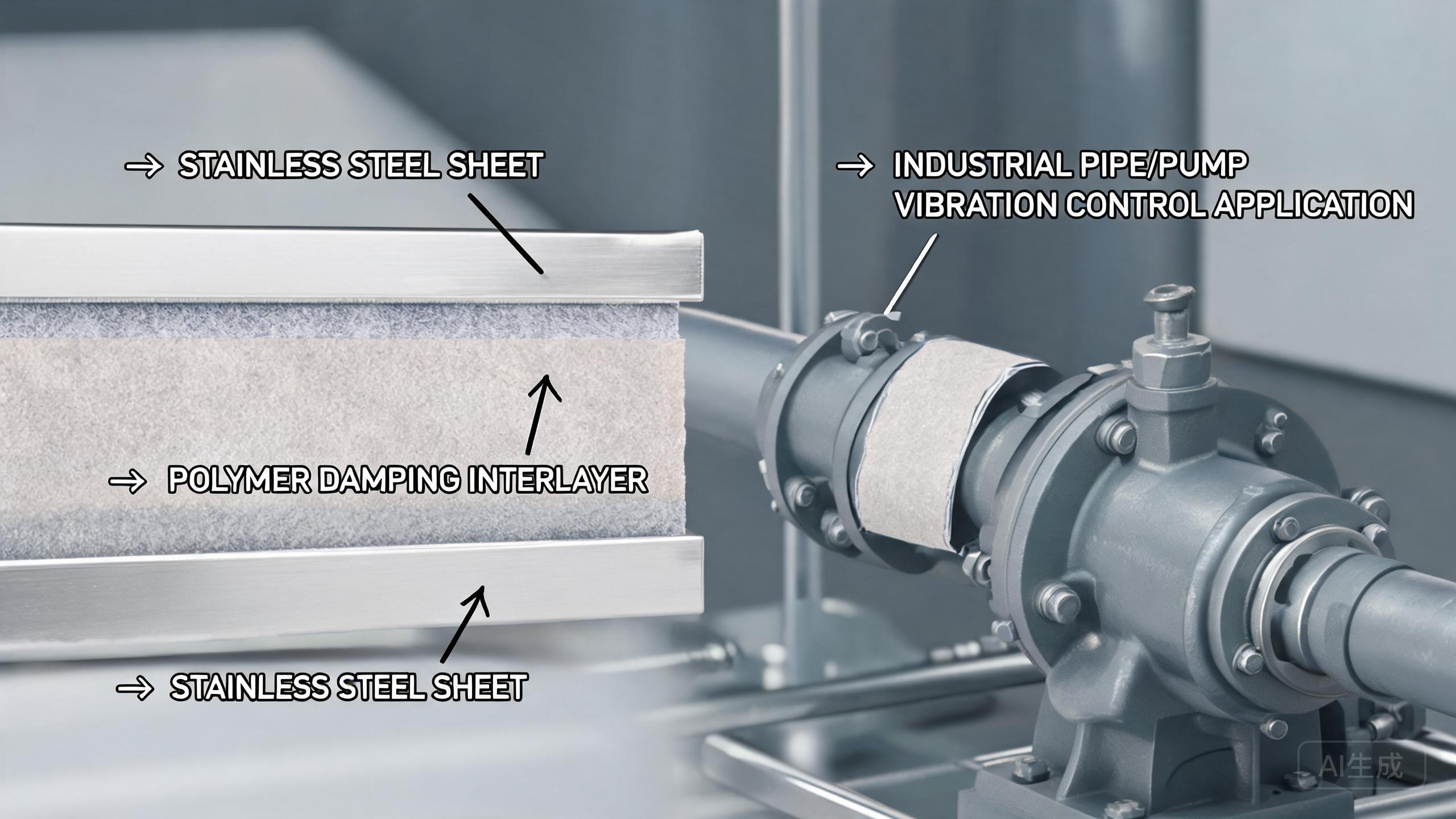
If your stainless steel component is resonating at audible frequencies — compressor housings, ship deck plates, precision machinery bases, or electric motor casings — standard 304 will ring like a bell. Vibration-damping stainless steel solves this with two approaches: homogeneous 0Cr18Cu (1-2% copper addition, damping coefficient ~0.03-0.05) for broadband damping across 50-2,000 Hz, and Constrained Layer Damping (CLD) (two stainless skins + viscoelastic core, damping coefficient ~0.1-0.2) for high-frequency (>500 Hz) resonant noise. The copper in 0Cr18Cu creates internal friction that converts vibration energy to heat. CLD’s polymer core shears to dissipate energy. Both cost 20-40% more than standard 304, but deliver 15-100x better noise reduction in critical applications.
Quick Comparison
| Parameter | Standard 304 | 0Cr18Cu Damping | CLD (304 + Polymer + 304) | Carbon Steel CLD |
|---|---|---|---|---|
| Damping Coefficient | ~0.002 | 0.03-0.05 | 0.10-0.20 | 0.05-0.15 |
| Frequency Range | N/A | 50-2000 Hz | 500-5000 Hz | 200-3000 Hz |
| Corrosion Resistance | Excellent | Excellent | Good (facesheets only) | Poor |
| Max Service Temp | 800°C | 700°C | 120°C | 100°C |
| Tensile Strength | ~500 MPa | ~450 MPa | ~500 MPa (per facesheet) | ~400 MPa |
| Thickness Range | 0.1-200mm | 0.5-50mm | 1.0-6.0mm total | 1.0-6.0mm total |
| Price Premium | Base | +20-30% | +30-40% | +10-15% |
| Fabrication | Easy | Easy | Complex (edge seal required) | Moderate |
| Typical Uses | General fabrication | Compressor housings, ship decks, motor casings | Precision machinery, aerospace panels | Automotive, consumer appliances |
What Buyers Should Evaluate
- Vibration frequency spectrum. Measure the dominant frequencies of your application. If below 500 Hz (most industrial machinery), choose homogeneous 0Cr18Cu. If above 500 Hz (high-speed compressors, ultrasonic equipment), CLD may be more effective.
- Maximum operating temperature. Homogeneous damping stainless handles up to 700°C; CLD is limited to 120°C by the polymer core. Engine components or exhaust systems must use homogeneous grades.
- Fabrication requirements. CLD requires edge sealing after cutting to prevent moisture ingress. Homogeneous damping stainless can be welded, bent, and formed like standard 304.
- Thickness tolerance. 0Cr18Cu damping stainless is produced by Chinese mills in Jiangsu and Liaoning. Confirm thickness tolerance per ASTM A240. CLD panels use standard 304 facesheets bonded to polymer cores — facesheet tolerance is the critical parameter.
- China-specific note. Tsingtao Iron & Steel and TISCO both produce 0Cr18Cu damping stainless per GB/T 1220-2020. CLD composites are available from specialized manufacturers in Guangdong and Zhejiang.
Common Purchasing Mistakes
Mistake: Specifying “damping stainless” without identifying the type. A Shanghai compressor manufacturer ordered 5 tons of “vibration-damping stainless steel” in 2023 and received standard 304 with a thin polymer coating (a non-standard, ineffective solution). The delivered material had damping coefficient ~0.005 — barely better than regular 304. Fix: always specify the exact grade: “0Cr18Cu (UNS S30430-type damping stainless)” or “CLD: two ASTM A240 304 sheets + 0.1mm viscoelastic core.”
Mistake: Chinese factory trick — fake damping stainless with polymer coating. Some mills in Shandong sell standard 304 with a sprayed-on rubber coating, labeling it “damping stainless steel.” These coatings delaminate during forming or after 6-12 months of thermal cycling, leaving plain 304 with zero damping capability. Solution: PMI (Positive Material Identification) spectroscopy — genuine 0Cr18Cu must show 1.0-2.0% copper content. If copper is absent, it’s just coated 304. Insist on EN 10204 3.1 mill test certificates that list Cu content explicitly. Additionally, run a simple tap test: hold the plate vertically and strike it with a rubber mallet — damping stainless produces a dull thud that dies in <0.2 seconds; coated or fake material rings like a bell.
Mistake: Ignoring CLD edge sealing. CLD composites cut without edge sealing absorb moisture into the polymer core, causing delamination within 2-3 years in humid or coastal environments. Specify that all cut edges must be sealed with a silicone or epoxy compound per the CLD supplier’s specification.
Mistake: Over-estimating CLD performance at off-resonance frequencies. CLD’s damping is frequency-dependent and peaks at the core material’s glass transition temperature. At frequencies far from the peak, damping can drop to near-zero. Always measure or model your application’s vibration spectrum and match to the CLD supplier’s damping curve.
Recommended RFQ Wording
Grade Option 1 (Homogeneous): GB/T 1220 0Cr18Cu damping stainless (UNS S30430-type)
  - Cu: 1.0-2.0%, Cr: 17.0-18.5%, C: ≤0.08%
  - Damping coefficient ≥0.03 measured per ASTM E756
Grade Option 2 (CLD): Two layers of ASTM A240 304 + viscoelastic polymer core
  - Facesheet thickness: [0.5mm each]
  - Core thickness: [0.1mm]
  - Total thickness: [1.1mm]
  - Edge seal required after cutting
  - Damping coefficient ≥0.10 at [specified frequency range]
Form: [plate / sheet / coil]
Thickness: [exact mm]
Surface: 2B mill finish
Application: [compressor housing / ship deck / precision machine base]
Operating temp range: [min - max °C]
Quantity: [metric tons or m²]
Certification required:
  - EN 10204 3.1 mill test certificate (Cu content listed)
  - PMI spectroscopy on every heat
  - Damping coefficient measurement report per ASTM E756
  - Fabrication test report (weld / bend sample)
FAQ
What makes vibration-damping stainless steel different from standard 304?
Vibration-damping stainless steel (typically 0Cr18Cu or proprietary grades like Hitachi’s Damping Stainless) contains 1-2% copper added to the standard 17-18% chromium composition. The copper-rich precipitation phases within the austenitic matrix dramatically increase internal friction, converting vibration energy to heat instead of resonating noise. Standard 304 has a damping coefficient of ~0.002; damping grades hit 0.03-0.05 — 15-25x better.
When should I choose constrained layer damping (CLD) over homogeneous damping stainless?
CLD — a sandwich of two stainless steel sheets bonded to a viscoelastic polymer core — offers even higher damping (coefficient ~0.1-0.2, 50-100x 304) at specific vibration frequencies. Choose CLD for high-frequency applications (>500 Hz) where resonant modes are well-defined. Use homogeneous 0Cr18Cu for broadband vibration damping across wide frequency ranges, or where fabrication complexity makes CLD impractical.
Is vibration-damping stainless steel as corrosion-resistant as regular 304?
Homogeneous damping stainless (0Cr18Cu) has comparable corrosion resistance to standard 304 — similar chromium content and PREN values. CLD composites have the same corrosion resistance on the stainless facesheets, but the polymer core limits maximum service temperature to ~120°C (vs 800°C for homogeneous damping grades).
CTA + Technical References
Send your grade, dimensions, annual volume and application to vip@still-steel.com, or contact us. We supply both homogeneous 0Cr18Cu damping stainless and CLD composites per ASTM A240 for noise and vibration control applications.
References:
- GB/T 1220-2020: Stainless steel bars
- ASTM A240 / A240M: Standard specification for chromium and chromium-nickel stainless steel plate, sheet, and strip
- ASTM E756: Standard test method for measuring vibration damping properties of materials
- See also: 304 vs 304L vs 304H comparison
Technical References
- ASTM A240M - Standard Specification for Chromium and Chromium-Nickel Stainless Steel Plate, Sheet and Strip
- EN 10088-2 - Stainless steels. Technical delivery conditions for sheet/plate and strip
- ASM International - Handbook Series, Volume 1: Properties and Selection: Irons, Steels, and High-Performance Alloys