Short answer: Stainless steel grade substitution is acceptable only when the proposed material meets the governing product standard, the required chemistry and mechanical condition, the finish and tolerance, and the end-use risk. A trade name such as “304 equivalent” is not proof. What buyers accept should be decided in writing before shipment, supported by an EN 10204 3.1 certificate for the actual heat and PMI results for the elements that control corrosion.
This guide is written for purchasing teams, sourcing managers and engineers who receive offers such as “1.4301 instead of 304”, “316L instead of 316”, or “200-series instead of 304”. The goal is a repeatable approval decision rather than a one-off email argument.
Quick Comparison
| Offer received | Accept when | Reject or escalate when |
|---|---|---|
| 304 vs 1.4301 vs SUS304 | Certificate is dual-certified; chemistry, form and finish match the PO | Only a trade-name statement; no heat number or standard listed |
| 316L offered for 316 | Corrosion is the governing requirement; carbon limit is acceptable | High-temperature strength or a specific 316 condition is required |
| 304 offered for 316L | Never for chloride, coastal or chemical service | Only with a documented engineering waiver and lower-risk end use |
| 201 or 204Cu offered for 304 | Almost never for wet, food-contact or deep-drawn parts | Any offer described as “same look, lower price” |
| Thickness or temper change | Mechanical property and forming trial confirm fitness | Wall thickness, stiffness or spring temper is already marginal |
The table is a commercial starting point. The final decision belongs to the governing standard, the drawing and the service environment, not to the label on the offer.
What Buyers Should Evaluate
The governing standard, not the trade name
ASTM A240/A240M, EN 10088-2 and JIS G4304/G4305 describe overlapping but not identical grade ranges. 304 and 1.4301 are close, yet the certified chemistry limits and the applicable product standard still matter. A certificate that says “304 equivalent” without naming the standard and heat number is not a certificate for the material you ordered.
Chemistry that controls the failure mode
For 304 and 316 families, chromium, nickel and molybdenum drive corrosion resistance. A 200-series offer may look bright and pass a magnet test while carrying much lower nickel and higher manganese. For 316L, molybdenum is the element that separates it from 304; the grade range is typically 2.0–3.0% Mo, and a certificate without Mo values should be treated as incomplete. For 304L, the carbon limit is typically 0.03% maximum.
Carbon is equally important when someone offers 304L for 304, or 316L for 316. Hand-held XRF does not measure carbon reliably. Use optical emission spectroscopy (OES) or the mill’s certified chemical analysis when the carbon limit is part of the acceptance decision.
Product form, temper and finish
A grade name does not describe condition. Check whether the offer is coil, sheet, strip or plate; hot-rolled or cold-rolled; annealed, 1/4 hard or full hard; 2B, BA, No.4 or another finish. Substituting a mill-edge coil for a slit-edge coil, or a 2B finish for a BA finish, is a specification change even when the grade is correct.
Certification and traceability
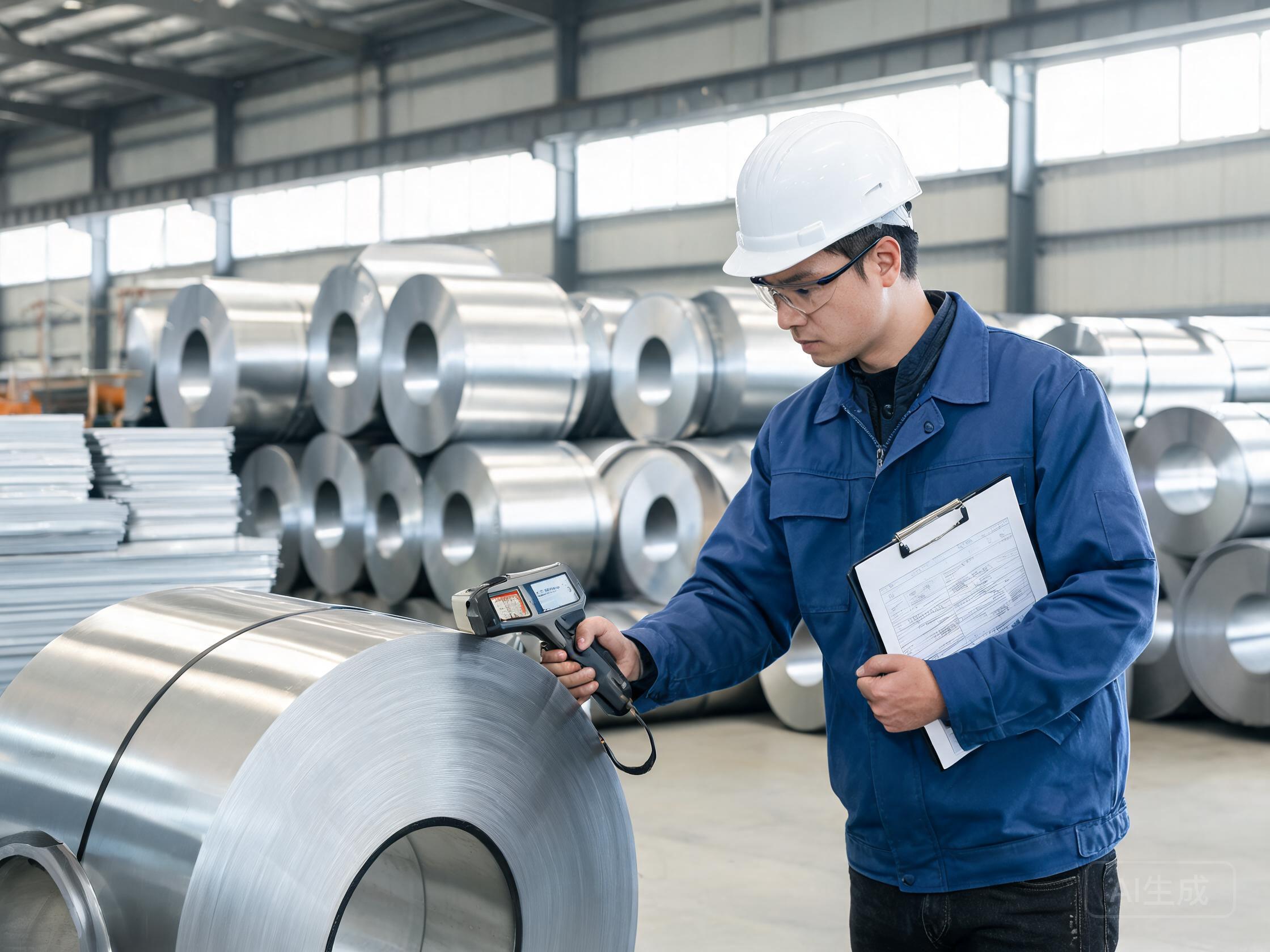
Require an EN 10204 3.1 mill test certificate that names the heat number, the product standard and the actual test results. The heat number on the certificate should match the coil tag, bundle tag and packing list. For critical orders, add a third-party inspection or a pre-shipment PMI check.
Commercial and end-use risk
A substitution that saves a few percent per tonne can create a warranty claim, a failed certification audit or a production stoppage. Check whether the end customer, notified body or product standard prohibits substitution. If the part is visible, the finish and color must also match, not only the chemistry.
Common Purchasing Mistakes
- Accepting a verbal “equivalent grade” offer. The phrase often hides a different standard, a different nickel content or a different mill. Ask for the proposed grade, standard and heat number in writing.
- Treating 201 as a cheap 304. Some suppliers describe 200-series material as “304 replacement” because it is magnetic and takes a similar polish. In wet or chloride-bearing service it can pit much earlier, and its forming behavior differs.
- Approving 316L for 316 without checking the duty. 316L is usually the safer corrosion choice, but its lower carbon content can reduce elevated-temperature strength. For load-bearing hot parts, the substitution is an engineering decision, not a purchasing convenience.
- Skipping molybdenum verification on 316. A certificate that lists only Cr and Ni is incomplete for a molybdenum-bearing grade. PMI the Mo value and compare it with the grade range.
- Using XRF to separate 304 from 304L. XRF cannot measure carbon, so it cannot prove the low-carbon condition. Require OES or the mill’s certified chemistry.
- Letting a downgrade arrive as a “shipping upgrade”. If 304 arrives where 316L was ordered, the shipment is nonconforming even if the price is unchanged. Quarantine it and issue the claim before processing.
The practical countermeasure is consistent: write the no-substitution clause into the PO, require EN 10204 3.1 for every heat, and PMI the delivered goods for Cr, Ni and Mo. Add OES when carbon defines the grade.
Recommended RFQ Wording
Copy and adapt this clause:
Grade: 304 per ASTM A240/A240M. Substitution of grade, standard, temper, finish or edge condition is not permitted without written buyer approval before shipment. Each heat must be identified by heat number and accompanied by an EN 10204 3.1 mill test certificate showing actual chemistry and mechanical results. PMI is required for Cr, Ni and Mo; carbon shall be verified by OES or certified mill analysis. No 200-series or 204Cu substitution. Any proposed deviation must be declared in the quotation, not at shipment.
For 316L orders, add: “Mo content to be reported and verified; certificates without Mo values will be rejected.” For visible parts, add: “Finish code, Ra range and approved master sample apply to every lot.”
FAQ
Is 1.4301 exactly the same as 304?
They are close but come from different standards. 1.4301 is an EN grade and 304 is an ASTM grade; their chemistry ranges overlap but are not identical. Accept the substitution only when the mill certificate is dual-certified and the product form, mechanical condition and finish meet the order.
Can a mill supply 316L instead of 316?
Often yes, because 316L has a lower carbon limit and similar corrosion resistance. Check elevated-temperature strength, the required product standard and certificate wording first; low-carbon grades are not always a like-for-like upgrade for high-temperature load-bearing parts.
Is 201 an acceptable substitute for 304?
No for wet, food-contact, coastal or formed parts that need 304 corrosion and ductility. 201 uses manganese and lower nickel, so it can pit earlier and behave differently in deep drawing. Treat any 200-series offer as a different material, not a grade substitution.
What evidence should accompany a substitution request?
A written request before shipment, the proposed grade and standard, heat-number traceability, an EN 10204 3.1 certificate for the actual heat, and PMI results for Cr, Ni and Mo. Carbon needs OES or a mill certificate because hand-held XRF cannot measure it reliably.
Technical References
- ASTM A240/A240M — chromium and nickel stainless steel plate, sheet and strip
- ASTM A480/A480M — general requirements for flat-rolled stainless steel
- EN 10088-2 — stainless steels: technical delivery conditions for sheet and strip
- EN 10204 — types of inspection documents, including 3.1
- ASTM A751 — chemical analysis of steel products
- ISO 3506 — mechanical properties of stainless steel fasteners, where relevant
Next Step
Send the proposed substitute grade, its standard, heat number and certificate to vip@still-steel.com for a document review before you approve the shipment. You can also send your specification through our contact form or message us on WhatsApp at wa.me/8613867898840.
Ningbo Wanguang Stainless Steel Material CO., LTD. · Still Steel