
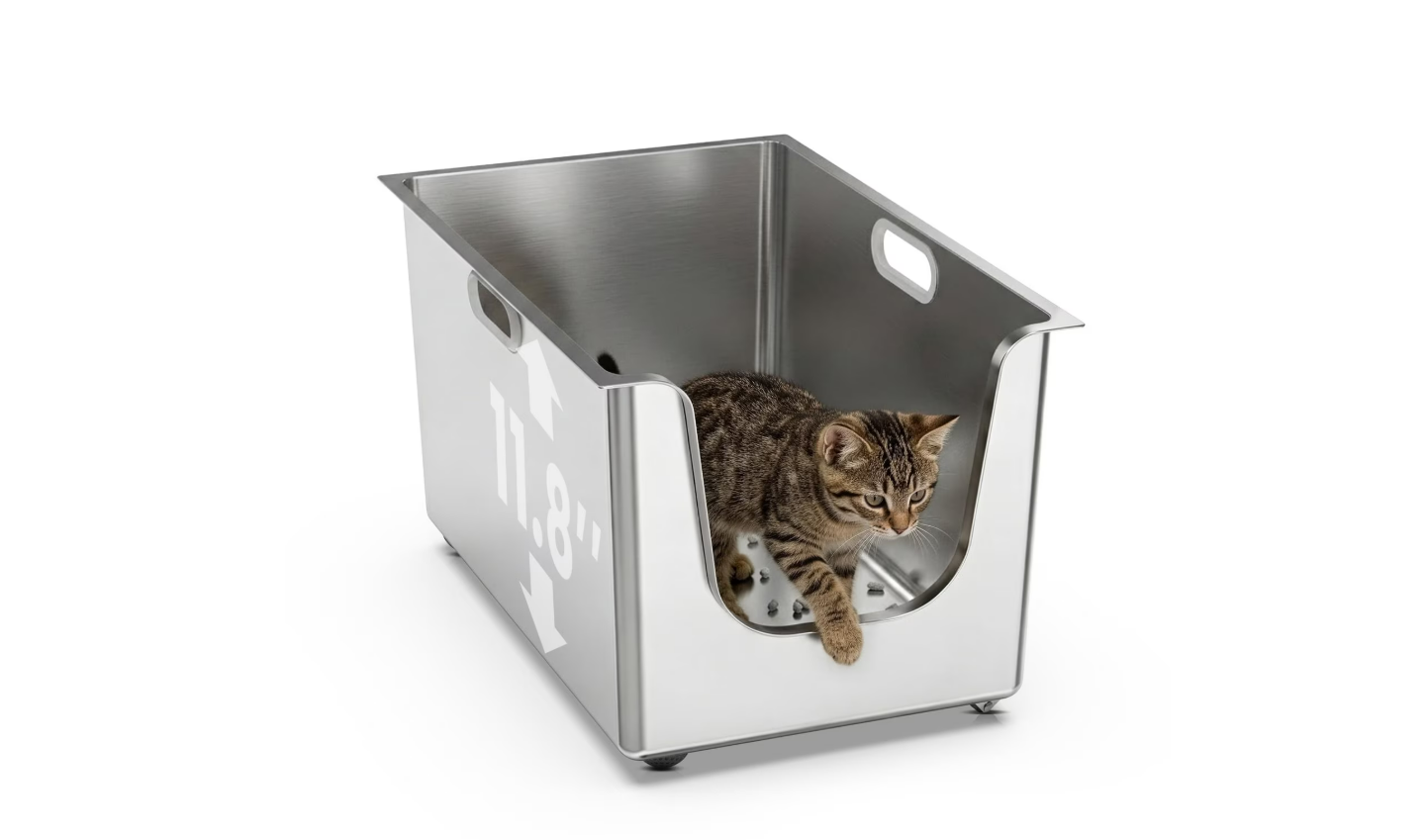
Short answer: The reason pet owners are moving from plastic to stainless steel comes down to one thing — plastic can’t stay clean. It scratches, stains, traps odor and grows bacteria; stainless steel does not. This guide compares the two head-to-head, adds what real owners actually say after switching, and gives the spec (304 at 1.2mm) for brands building steel pet products.
This guide is written for pet-product buyers, sourcing teams, OEMs and private-label brands. The goal is not to argue that plastic is useless, but to show where the materials diverge in real, everyday use — and why that gap decides what buyers now expect.
The Pattern Owners Keep Reporting
Look at any discussion where owners compare a stainless steel litter box to the plastic one they replaced, and the complaint about plastic is always the same: no matter how often you wash it, a plastic pan eventually smells, stains and looks grimy. Stainless steel, by contrast, wipes clean and stays that way.
This isn’t a fringe opinion. In a recent r/Catownerhacks thread titled “METAL LITTER BOXES VS PLASTIC” — which gathered 137 upvotes and dozens of replies — the consensus leaned overwhelmingly toward steel, with owners volunteering exactly the failure modes they saw in plastic. A smaller r/Pets thread (“stainless steel litter box”, 37 comments) told the same story from the other side: people describing the moment their plastic box became unsalvageable.
That single observation — plastic stops being clean even when you clean it — is what drives the switch. The rest of this article explains why, in material terms, and lets owners speak for themselves.
Stainless Steel vs Plastic: Head to Head
| Factor | Stainless steel | Plastic |
|---|---|---|
| Odor retention | Non-porous; does not trap smells | Porous; absorbs urine and odor over time |
| Stains & scratches | Resists staining; smooth surface stays clean | Scratches easily; micro-grooves hold grime |
| Bacteria / hygiene | Sanitizes clean; no bacterial reservoir | Scratches become bacterial reservoirs; linked to feline acne on bowls |
| Cleaning effort | Wipes clean in seconds | Needs scrubbing; never fully restored |
| Durability | Lasts for years | Warps, cracks, needs replacing |
| Lifetime cost | Higher upfront, lower over time | Lower upfront, repeated replacement |
The table is a starting point. Actual performance depends on grade, delivered condition, dimensions, surface finish and service environment.
In Pet Owners’ Own Words
The quotes below are excerpted from public Reddit discussions (r/Pets, r/Catownerhacks) and reflect individual owners’ experiences. They are reproduced as written.
On why plastic fails:
“My plastic ones were stained with crusty urine and I have not had that problem after [switching].” — u/FernX02, r/Pets
“That’s exactly why I switched too — my old plastic one was getting nasty no matter how much I cleaned it. Stainless doesn’t hold onto the smell at all.” — u/One-Donut-1857, r/Pets
“It’s kind of the same thing with old kitchen cutting boards and the bacteria that lingers in the crevices if the plastic boards are washed/scrubbed.” — u/RoyalClient6610, r/Catownerhacks
On why steel stays clean:
“The best part about stainless steel litter pans is that cats can’t scratch it and thus have pee stuck in grooves. It’s only as clean as the litter that’s inside.” — u/gfdoctor, r/Pets
“Switching to stainless steel litter boxes was the best decision ever. I only regret not switching sooner. Stupid easy to clean and smells better!” — u/aerosimpsons, r/Catownerhacks
“Zero regrets, clumps come unstuck easily, you can hose it down and bleach it.” — u/mishenka_1999, r/Catownerhacks
“Switched to metal and never going back to plastic.” — u/swollenlugnutz, r/Catownerhacks
On the honest objections:
“Stainless steel boxes tend to be 1) harder to find, less options; and 2) way more expensive up front.” — u/Fit_Change3546, r/Catownerhacks
“I told myself ‘buy once, cry once’ and also used the concept of the poor man’s boots.” — u/HolyBidetServitor, r/Catownerhacks
“Someone recommended rectangular stainless steel pans they use for catering and I purchased one of those. Cheaper than an actual litter box!” — u/1isudlaer, r/Catownerhacks
“I feel like people are recommending stainless constantly on the cat subs. That said, I’ve also heard some cats don’t like them, especially cats that scratch the sides of the box to ‘dig’.” — u/leslieknope38, r/Catownerhacks
“The only problem I’ve had with the stainless is certain clumping litters can clump and stick to the pan. You have to find the right balance of litter type, depth, and scooping frequency.” — u/Sleepy-Flamingo, r/Pets
One dissenting note is worth keeping for fairness — not every owner sees a dramatic difference:
“Have plastic and stainless. They both seem about the same to clean and our cats use both regularly.” — u/Spock-1701, r/Pets
The pattern across both threads is clear: the people who switched almost uniformly praise the cleanliness and odor control, while the main caveats are upfront price, the occasional cat that dislikes the feel, and clumping litter that needs the right routine. None of those caveats are material defects — they are buying-decision factors a good spec addresses.
Why Plastic Can’t Stay Clean
Plastic fails at cleanliness for a structural reason, not a maintenance one:
- It is porous. Urine, oils and food residues seep into the surface and are never fully removed. As one owner put it, it’s the same problem as bacteria lingering in the crevices of a scrubbed plastic cutting board.
- Scratches become reservoirs. Every scoop and scrub adds micro-grooves that trap bacteria and odor. The more you clean it, the more places grime can hide.
- It stains permanently. Yellowing and dark patches set in and will not wash out.
- It links to skin problems. Plastic food and water bowls are a well-known trigger for feline chin acne, because bacteria colonize the scratched surface.
In short: with plastic, cleaning slows the decline but cannot stop it.
Why Stainless Steel Stays Clean
- Non-porous surface. Nothing soaks in, so odor and residue stay on the surface where they can be wiped away.
- Passive protective layer. 304 stainless steel forms a chromium-oxide film that resists corrosion, odor and bacterial buildup.
- Sanitizable. It tolerates hot water, common cleaners and dishwashers without degrading — owners literally hose it down and bleach it.
- No taste or smell transfer. It does not retain flavors or scents between uses.
If You Build Steel Pet Products: The Spec
For brands manufacturing or private-labeling stainless steel pet gear, the material question resolves to a simple, repeatable spec:
- Grade: 304 (AISI 304 / EN 1.4301). Food-safe, corrosion-resistant, and the right economics for indoor pet environments. Reserve 316 only for coastal or heavy-salt service. Specifying genuine 304 also sidesteps the rust complaints that trace back to off-spec metal.
- Thickness: 1.2mm. Keeps high-sided litter boxes rigid and dent-resistant without adding unnecessary weight or shipping cost. Thinner gauges warp; thicker adds cost with little benefit for home use.
This spec is what turns the “steel stays clean” advantage into a product buyers can trust — and what avoids the warranty and review problems that come from thin or rusting units.
What Buyers Should Evaluate
- Confirm the grade certificate (304 / EN 1.4301) and the standard it is supplied to.
- Specify thickness per part (for example, 1.2mm for litter-box walls, lighter gauges for small bowls).
- Validate surface finish — brushed, mirror or film-laminated for protection during fabrication.
- Confirm destination-market food-contact and packaging requirements before production.
For production orders, share the end use rather than requesting a grade in isolation. A supplier can then review corrosion exposure, forming severity, welding, visual requirements and packing before material is cut.
Common Purchasing Mistakes
- Choosing a thin gauge to save cost, then seeing walls warp and units feel cheap.
- Using plastic where buyers now expect stainless steel.
- Leaving surface finish unspecified, causing inconsistent appearance across a production run.
- Buying off-spec “stainless” that rusts — always verify the grade certificate.
Sourcing Note
We supply cold-rolled 304 stainless steel in the thicknesses pet-product manufacturing needs, with slitting, leveling and surface options (including film-laminated and brushed finishes) to fit your production line. If you are specifying stainless steel for pet applications, share your part drawings and volumes so we can propose the right gauge and finish.