
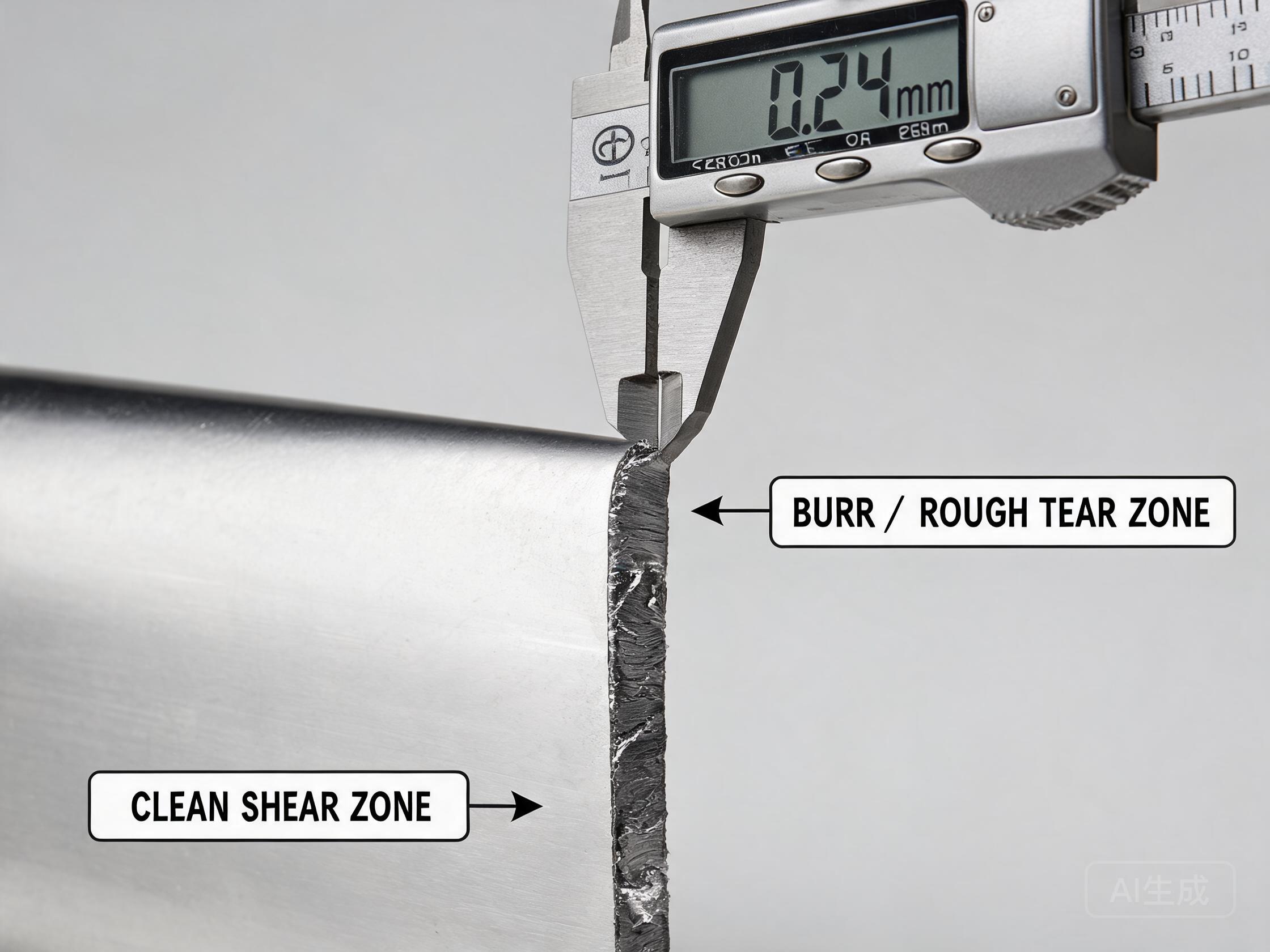
Short answer: Stamping burrs happen because stainless steel deforms before it fractures — the punch pushes past the material’s elastic limit, the grain stretches, and when it finally tears it leaves a tail. 304 produces taller burrs than 430 because it has higher ductility and strain hardening. Control burr height by using the right die clearance (8–12 % of thickness for annealed 304), keeping the shear-to-tear ratio above 60–40, and re-coating or re-sharpening the punch at 8,000 hits.
You stamp 500 blanks, 100 of them have burrs tall enough to cut your finger, and every blank jams in the next forming operation because the burr catches on the guide rail. Burrs cost money — secondary deburring, scrap, tool wear, and missed delivery dates. Most stamping shops treat burrs as a nuisance to fix with a tumble barrel at the end. But the real fix starts at the die clearance setting and the material you buy.
Quick Comparison
| Grade | Annealed burr height (% t) | Optimal clearance (% t per side) | Shear zone target |
|---|---|---|---|
| 304 / 304L | 8–12 % | 8–12 % | ≥ 60 % |
| 304 1/4H | 10–15 % | 10–14 % | ≥ 55 % |
| 316 / 316L | 8–12 % | 8–12 % | ≥ 60 % |
| 430 | 4–7 % | 6–10 % | ≥ 65 % |
| 201 | 6–10 % | 7–11 % | ≥ 60 % |
All burr height percentages assume correct clearance. Clearance error of ±2 % per side changes burr height by roughly ±3 %.
What Buyers Should Evaluate
- Specify burr height limit and shear-to-tear ratio on the drawing, not just “no burr.” “No burr” is subjective; “burr height ≤ 0.1 mm and shear zone ≥ 60 % of thickness” is measurable and enforceable.
- Confirm the die material and coating with the stamping supplier. D2 or SKD11 steel at 58–60 HRC with a TiCN or CrN coating will run 8,000–12,000 hits before needing sharpening. Uncoated D2 runs 2,000–3,000 hits. A dull punch produces a 2x taller burr.
- Ask how they set die clearance. Do they measure it with shim stock? Do they run a 10-blank trial and measure the shear zone before releasing volume? A serious stamping shop will have a clearance log for every die.
- If you stamp multiple hole diameters in one operation, remember that clearance needs to be the same percentage of thickness regardless of hole size. Many shops set the same absolute clearance for every hole and get great burrs on large holes and terrible burrs on small ones.
Common Purchasing Mistakes
- Specifying “no burr” as a rejection criterion without defining it. The Chinese stamping supplier stamps 500 parts, looks at them, says they are fine, and ships them. You open the box and every part has 0.25 mm burrs. Specify burr height ≤ 0.10 mm and shear zone ≥ 60 %, and demand that 10 parts be measured and documented with a toolmaker’s microscope before shipment.
- Buying 304 1/4H temper for a stamping application because “1/4H is more rigid.” 1/4H 304 has yield 350–400 MPa, which means 20–40 % taller burrs than annealed 304 at the same clearance. You spend more money on deburring to clean up taller burrs than you saved on the cheaper 1/4H material. Use annealed 304 and temper after forming.
- Using 2B surface without specifying surface roughness Ra. A 2B surface with Ra = 0.8 μm (common from budget Chinese mills) has more surface asperities that catch on the punch edge and produce taller burrs than Ra = 0.3 μm. Specify Ra = 0.3–0.5 μm and demand a surface roughness measurement report with EN 10204 3.1.
- Letting burrs run until the die is completely dull before re-sharpening. Dullness is gradual — burrs grow by 1–2 % of thickness every 2,000 hits. Sharpen the punch at 8,000 hits (304) or 10,000 hits (430) and you keep burrs flat. Sharpen at 15,000 hits and you get 3x taller burrs for the rest of the run.
Recommended RFQ Wording
Grade 304L (Werkstoffnummer 1.4307), annealed temper, 2B surface, Ra 0.3–0.5 μm, thickness 0.8 mm ±0.015 mm, width 1250 mm coil. Stamping requirement: rectangular blank 200 × 150 mm with four 20 mm diameter holes. Burr height ≤ 0.10 mm max on all edges and holes, shear zone ≥ 60 % of thickness (0.48 mm), measured with toolmaker’s microscope on 10 samples from every shift. Die: D2 (SKD11) powder metallurgy, 58–60 HRC, TiCN coating ≥ 2 μm, clearance 10 % of thickness per side. EN 10204 3.1 certificate with PMI, tensile and surface roughness report.
How Still Steel Supports the Project
Still Steel supplies cold rolled stainless steel sheet and strip in 304/304L/316/316L/430/201 with tight gauge and temper control. We provide pre-annealing, skin-pass and level-flatten processing to improve forming performance before you stamp, draw or bend. Send the grade, gauge, form (sheet or strip) and your specific forming problem to vip@still-steel.com, or discuss on WhatsApp.
Frequently Asked Questions
What die clearance should I use for stainless steel stamping?
For 304 / 304L annealed, use 8–12 % of material thickness per side (so 16–24 % total clearance). For 304 1/4H temper, increase to 10–14 %. For 430 annealed, 6–10 % works. The rule: the higher the yield strength, the larger the clearance needed. Too small a clearance causes double shear (a second fracture line) and a wide burr; too large creates a tall burr and a visible tear zone on the blank face. Start at 10 % per side for annealed 304 and tune by 1 % increments.
Why does 304 produce taller burrs than 430?
Austenitic 304 has higher ductility (elongation ≥ 55 %) and a strain hardening exponent n = 0.32, which means the material deforms more plastically before the shear fracture propagates. Ferritic 430 has lower ductility (elongation 35–40 %) and n = 0.22, so the shear fracture starts earlier and runs straighter through the thickness. Result: 304 typically produces 8–12 % of thickness burr height, 430 produces 4–7 %. 201 falls in between at 6–10 %.
What is the shear vs tear zone ratio and why does it matter?
Shear zone is the straight cut face formed by the punch shearing through the blank. Tear zone is the rough, fractured section that forms when the material necked before fracturing. A good stamping result has a shear zone covering 60–70 % of the thickness and a tear zone of 30–40 %. If the tear zone is above 50 %, the blank has a rough face that causes galling in subsequent forming operations. Control the ratio with clearance: increase clearance to reduce tear zone, decrease it to reduce burr height.
Technical References
- EN 10088-2 Stainless steels — Part 2: Material chemical composition and physical properties
- ASTM A666/A666M Standard specification for austenitic stainless steel sheet and strip for forming
- ASTM A480/A480M Standard specification for flat-rolled stainless and heat-resisting steel plate, sheet, and strip
- AISI D2, SKD11 tool steel datasheets
- Werkstoffnummer 1.4307 (304L), 1.4016 (430)
Reference documents support general selection and fabrication principles. The final material decision must follow the applicable contract, standard, regulation and engineering review for the specific product.