
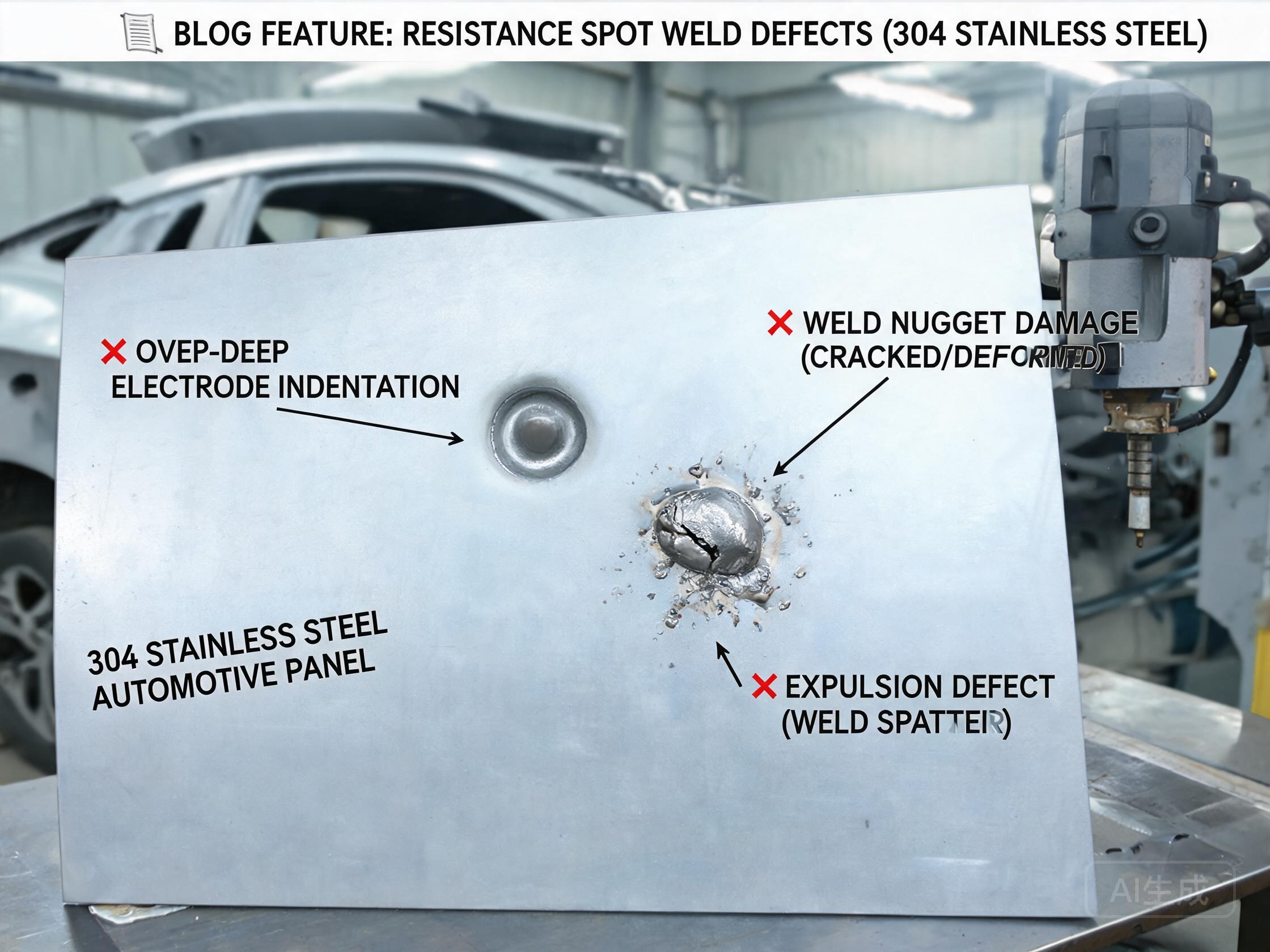
Short answer: Spot welding stainless steel is nothing like spot welding mild steel. 304 needs 2-3x more current, wears electrode tips 3-5x faster, and produces welds that are more sensitive to zinc contamination and poor electrode alignment. Get the current setting wrong and you get either a weak weld or a burned-through hole. The fix is current tuned per grade, frequent tip dressing, and strict zinc-free material handling.
Spot welding is the go-to for appliance panels, automotive trim, electronics housings and cookware handles. But most fabricators use the same settings they use for mild steel, then wonder why 304 spot welds fail in fatigue testing or break during assembly. Stainless steel’s electrical and thermal properties are fundamentally different. Treat it differently.
Quick Comparison
| Material | Current multiplier vs mild steel | Electrode tip life | Approx shear strength (1mm sheets) | Zinc contamination risk |
|---|---|---|---|---|
| Mild steel | 1.0× (baseline) | 5000-10000 welds | 4-6 kN/spot | Low |
| 430 ferritic stainless | 1.5× | 2000-4000 | 4-6 kN/spot | Medium |
| 304 austenitic | 2.0× | 1000-3000 | 6-8 kN/spot | High |
| 316 austenitic | 2.5× | 500-1500 | 5-7 kN/spot | High |
| 2205 duplex | 2.0× | 1000-2500 | 8-10 kN/spot | High |
316 needs slightly less shear strength per spot than 304 because molybdenum increases weld ductility. The higher current multiplier for 316 compensates for molybdenum’s lower melting point and helps produce a consistent weld nugget.
What Buyers Should Evaluate
- Has the fabricator calibrated their spot welder for stainless steel specifically, or do they use mild steel settings?
- Do they dress electrode tips on a schedule (every 1000 welds for stainless) or just when welds start failing?
- Do they require incoming stainless material to be free of zinc contamination (from galvanized pallets, zinc-plated tooling)?
- Has weld shear strength been tested and documented — or is it “we’ve always run these settings”?
- Can they show electrode tip condition photos from their daily QC check?
A worn or misaligned electrode tip is the number one spot welding defect cause. The tip face must be flat, parallel to the sheet, and free of pitting. Worn tips cause 30-50% lower shear strength and inconsistent nugget size.
Common Purchasing Mistakes
- A China factory trick: the fabricator runs mild steel current settings on 304 to “save electricity” and blames material quality when shear strength fails. 304 needs 2x more current — skip this and you get cold spots with shear strength 50% below spec. Specify a minimum shear strength per spot and require destructive testing of every 100th weld.
- Using zinc-contaminated stainless material without knowing it. If your cold rolled sheets were stacked on galvanized steel pallets during shipping, tiny zinc particles transfer to the surface. During spot welding, zinc vaporizes and creates weld porosity and reduced nugget size. Specify “zinc-free handling: pallets, tooling and work surfaces shall be non-galvanized” and require incoming inspection for zinc particles.
- Ignoring the electrode material specification. Standard Cu-Cr electrodes work for 304 but wear fast on 316. For 316 and duplex, specify Cu-Zr (copper-zirconium) or W-Cu composite electrodes — they last 2-3x longer than Cu-Cr. The price difference per electrode (¥50 vs ¥30) is trivial compared to the time saved from fewer changeovers.
- Specifying spot welding on duplex stainless steel without preheat. Duplex (2205/2507) has high nitrogen content and is prone to intermetallic phase formation at spot welds without 100-150°C preheat. Many fabricators skip preheat because “spot welding is fast,” but brittle sigma phase in the nugget causes welds to crack under load.
Recommended RFQ Wording
“Please supply cold rolled 304L or 316L stainless steel sheet per EN 10088-2, zinc-free handling required (non-galvanized pallets, tooling, work surfaces). Provide EN 10204-3.1 test reports. Spot welding specifications: Current: 2.0× mild steel baseline for 304, 2.5× baseline for 316 (documented via welder calibration). Electrode tips: Cu-Cr for 304, Cu-Zr for 316/duplex. Tip dressing every 1000 welds minimum. Hold time: 20-30 cycles. Squeeze time: 40-60 cycles. Shear strength acceptance: 6 kN minimum per spot for 304 (1mm sheets), 5 kN for 316 (1mm sheets). Destructive shear test on first article and every 100th weld thereafter.”
Frequently Asked Questions
Why does 304 stainless steel need more spot welding current than mild steel?
Stainless steel has higher electrical resistance (304 ρ = 72 µΩ·cm vs mild steel ρ = 12 µΩ·cm) and lower thermal conductivity (304 k = 16 W/mK vs mild steel k = 50 W/mK). Higher resistance means heat concentrates at the weld interface faster, but lower conductivity means heat does not spread to surrounding metal. You need 2-3x more current for stainless steel to achieve the same weld nugget size and shear strength as mild steel.
How long do spot welding electrode tips last on stainless steel?
On mild steel, a standard Cu-Cr electrode tip lasts 5000-10000 welds before dressing. On 304 stainless steel, tip life drops to 1000-3000 welds because of the higher heat and pressure required. On 316 (higher Mo content), expect 500-1500 welds. Dress tips every 1000 welds for stainless — use a diamond dresser to maintain a flat tip face. Worn tips cause bad welds and increased weld variability.
What weld shear strength should I expect from spot welded stainless steel?
For two 1mm thick 304 sheets properly spot welded, shear strength per spot is approximately 6-8 kN. For 430 (ferritic), expect 4-6 kN per spot. Calculate required spot count based on total shear load: divide maximum load by 7 kN (304 average) and add 20% safety factor. AWS D1.6 clause 13 has complete spot welding shear strength tables.
How Still Steel Supports the Project
Still Steel supplies cold rolled stainless steel sheet and strip with pre-cut edges, beveling and pre-weld cleaning services so your fabricator can start welding immediately. We stock matching filler wires (ER308L, ER316L, ER2209) and provide material traceability via EN 10204-3.1 test reports. Send your weld joint design, grade and thickness to vip@still-steel.com, or discuss on WhatsApp.
Technical References
- AWS D1.6/D1.6M Clause 13: Resistance Spot Welding of Stainless Steel
- AWS C1.1/C1.1M: Recommended Practices for Resistance Welding
- ASME IX QW-464: Resistance Spot Welding Qualification
- EN 1011-3: Arc welding of stainless steels — spot welding guidance