
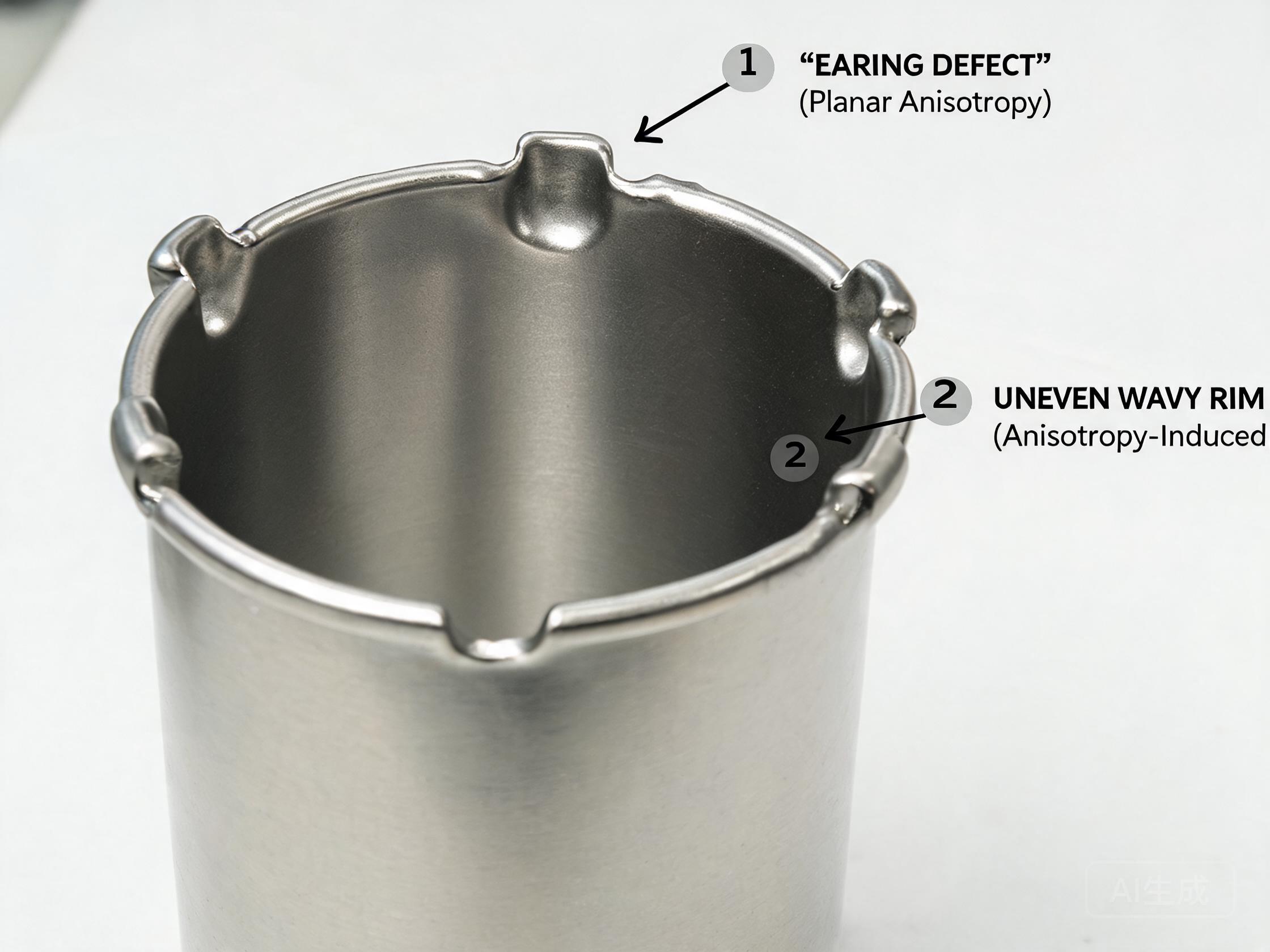
Short answer: Earing is the four-lobed rim that sticks up on a deep drawn cup — it happens because stainless steel deforms differently depending on which direction you pull it. The culprit is planar anisotropy Δr, which comes from the crystal texture left by cold rolling and incomplete annealing. You cannot eliminate earing completely, but you can minimize it by specifying a high-temperature anneal (1050–1100 °C for 304), buying coil stock instead of sheets, and checking the Δr value before accepting the material.
You run the same die, same blank diameter, same BHF as last week. This week’s cups come out with 3 mm ears that have to be trimmed off — wasting material, slowing the press, and creating a secondary operation that the customer never asked for. The first question is what changed in the material.
Quick Comparison
| Grade | Typical Δr (annealed) | Earing height expected | Annealing fix |
|---|---|---|---|
| 304 / 304L | −0.10 to +0.10 | 1–2 mm | 1050–1100 °C, rapid cool |
| 316 / 316L | −0.08 to +0.08 | 0.5–1.5 mm | 1080–1120 °C |
| 430 | −0.20 to +0.20 | 2–4 mm | 820–870 °C, slow cool |
| 201 | −0.12 to +0.12 | 1.5–2.5 mm | 1020–1070 °C |
| 1/4H 304 | −0.15 to +0.15 | 3–5 mm | Anneal first |
Average r value (r̄) also matters: a material with r̄ ≥ 1.5 will draw deeper without tearing even if Δr is non-zero. Annealed 304 targets r̄ = 1.8–2.2, which is good.
What Buyers Should Evaluate
- Ask the supplier to provide the Δr value and average r̄ from a tensile test coupon cut at 0°, 45° and 90° to rolling direction. If they cannot supply this, demand a 5 kg sample for Erichsen deep drawing and earing measurement at your lab.
- Specify annealing temperature on the RFQ, not just “annealed.” A continuous bright anneal line at 1050 °C produces far better texture control than batch annealing at 980 °C.
- For high-volume symmetrical parts (cans, cookware bottoms), prefer coil stock and align the blank layout to the rolling direction so that any residual Δr produces minimal earing.
- If your deep drawing press has variable BHF control, use it to compensate for Δr — apply slightly higher force at the 45° directions (or 0°/90°, depending on the sign of Δr) to constrain the flange more where it wants to flow.
Common Purchasing Mistakes
- Accepting “annealed” 304 without checking the actual annealing temperature and microstructure. Chinese mills run their continuous annealing line at 980 °C when energy prices are high — the coil is technically soft enough to form, but the chromium carbides have not fully dissolved and Δr climbs to 0.20, doubling the earing height. Demand a micrograph showing 100 % recrystallized austenite (no carbide stringers) in the EN 10204 3.1 package.
- Buying individual sheets instead of coil to “save the slitting cost.” A batch-annealed sheet has Δr = +0.20 on one edge and −0.15 on the opposite edge because the furnace does not heat uniformly, and every cup comes out with a different earing pattern. The trimming cost adds up fast. For runs over 500 parts, coil is always cheaper total cost.
- Blaming the die design for earing when the material Δr is 0.20. A good die can compensate for Δr up to 0.15, but beyond that, the only fix is better material.
- Specifying 430 for earing-sensitive parts “because it is cheaper.” 430 has the worst Δr of common grades, up to ±0.25, and ears so badly that most applications require trimming the entire rim. The material savings are eaten by the trimming operation.
Recommended RFQ Wording
Grade 304L (Werkstoffnummer 1.4307), annealed temper, annealing temperature 1050–1100 °C continuous bright anneal, 2B surface, thickness 0.6 mm ±0.015 mm, width 1250 mm coil. Forming data required: Δr ≤ ±0.10, average r̄ ≥ 1.8, m value ≥ 0.010. EN 10204 3.1 certificate with tensile coupons at 0°/45°/90° to rolling direction and micrograph of recrystallized microstructure. Application: 2-pass deep drawn 500 ml beverage cans, target earing height ≤ 1.5 mm.
How Still Steel Supports the Project
Still Steel supplies cold rolled stainless steel sheet and strip in 304/304L/316/316L/430/201 with tight gauge and temper control. We provide pre-annealing, skin-pass and level-flatten processing to improve forming performance before you stamp, draw or bend. Send the grade, gauge, form (sheet or strip) and your specific forming problem to vip@still-steel.com, or discuss on WhatsApp.
Frequently Asked Questions
What is planar anisotropy Δr and how does it cause earing?
The r value (normal anisotropy) is the ratio of width strain to thickness strain during a uniaxial tensile test: r = εw / εt. Planar anisotropy Δr = (r0 + r90 − 2·r45) / 2. When Δr > 0, ears form at 0° and 90° to rolling direction; when Δr < 0, ears form at 45°; when Δr ≈ 0, no earing. Annealed 304 typically has Δr = −0.15 to +0.15, 316L −0.10 to +0.10, 430 −0.25 to +0.25. Every non-zero value creates a visible ear on the drawn cup.
What annealing temperature minimizes earing in 304?
For 304 / 304L, target 1050–1100 °C with a hold of 1–2 minutes per mm of thickness, followed by rapid cooling. This dissolves chromium carbides and produces a recrystallized austenite grain with near-random texture, which drives Δr closer to zero. Chinese mills sometimes anneal at 980–1020 °C to save energy — the resulting coil still shows faint carbide lines and Δr = ±0.20, producing 2–3 mm high ears. Always specify the annealing temperature and demand a microstructure photo in the EN 10204 3.1 package.
Is coil stock better than individual sheets for earing control?
Yes, for two reasons. First, coil stock is annealed in a continuous line under controlled tension, which produces uniform texture across the entire width. Individual sheets are often batch annealed in stacks with uneven temperature — the edges and the center of a sheet can have Δr values differing by 0.1, meaning ears are higher on one side. Second, coil stock lets you nest blanks to account for the rolling direction, whereas sheet stock has fixed grain orientation that you often cannot optimize.
Technical References
- EN 10088-2 Stainless steels — Part 2: Material chemical composition and physical properties
- ASTM A666/A666M Standard specification for austenitic stainless steel sheet and strip for forming
- ISO 10113 Metallic materials — Sheet and strip — Determination of plastic strain ratio
- ISO 10275 Metallic materials — Sheet and strip — Determination of tensile strain hardening exponent
- Werkstoffnummer 1.4307 (304L), 1.4404 (316L), 1.4016 (430)
Reference documents support general selection and fabrication principles. The final material decision must follow the applicable contract, standard, regulation and engineering review for the specific product.