
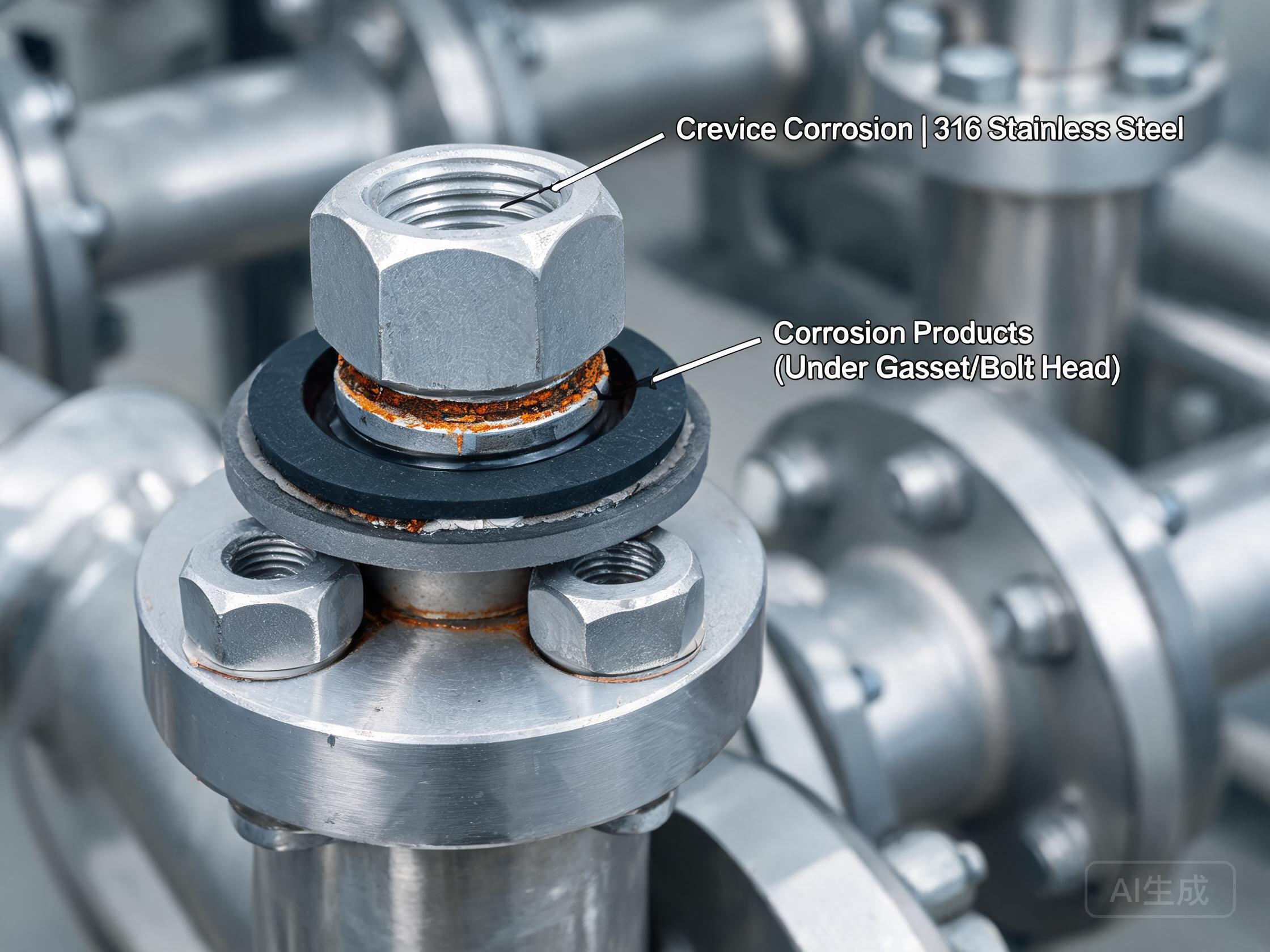
Short answer: Crevice corrosion eats stainless steel from the inside of joints you cannot see. Bolt holes, gasket gaps, lapped joints and even scale deposits create a tight space where oxygen cannot reach, while chlorides concentrate 10-100× higher than in the bulk fluid. The fix is simple: keep gaps above 1mm, use PTFE gaskets, and do not use 304 if your process runs above 5 °C with any chloride present.
A crevice is not a hole. It is a narrow gap — typically 0.01mm to 0.5mm — between two surfaces. Inside that gap, the liquid becomes stagnant. Oxygen gets consumed by the small area of exposed metal, and the passive Cr2O3 film breaks down. The result is a hidden corrosion cell that propagates until the joint leaks or the wall fails. In cold rolled sheets, crevice corrosion under a gasket can perforate a 1mm thick plate in 12 months if the chloride is 500 ppm and the temperature is 40 °C.
Quick Comparison
| Grade | Typical PREN | Critical Crevice Temp (CCT) ASTM G48 D | Gasket recommendation |
|---|---|---|---|
| 304 / 304L | 18 – 19 | 0 – 5 °C | PTFE only, < 20 °C service |
| 316 / 316L | 24 – 28 | 10 – 20 °C | PTFE or EPDM, < 35 °C service |
| 317L | 30 – 34 | 25 – 30 °C | PTFE, < 50 °C service |
| 2205 duplex | 35 – 40 | 30 – 40 °C | PTFE or spiral-wound |
| 2507 super duplex | 40 – 45 | 50 – 60 °C | PTFE or spiral-wound |
Critical Crevice Temperature (CCT) is always lower than Critical Pitting Temperature (CPT) for the same grade. A grade that passes pitting at 30 °C may still crevice-corrode at 20 °C.
What Buyers Should Evaluate
- Measure every joint gap in your design. Any gap between 0.01mm and 0.5mm is a crevice risk.
- Pick gasket material by absorption rate. PTFE absorbs < 0.01% water; EPDM absorbs up to 1% and swells, creating tighter gaps over time.
- Specify CCT on the grade, not just PREN. ASTM G48 method D is the standard crevice test.
- For lap joints, specify a minimum 1mm gap filled with sealant, or use continuous welding instead of bolting.
Common Purchasing Mistakes
- Using EPDM or silicone gaskets with 304. EPDM absorbs water, swells, and tightens the crevice gap to 0.05mm. At 30 °C with 300 ppm Cl⁻, 304 under an EPDM gasket crevice-corrodes in 6 months.
- Specifying “316” without a Mo minimum. A Chinese mill can ship 316 with only 1.8% Mo instead of 2.0%. The PREN drops by 0.6 and the CCT drops by 5 °C — and you will never know until the joint leaks.
- Buying cheap spiral-wound gaskets with steel filler instead of PTFE. Steel filler creates a galvanic crevice and accelerates corrosion on the stainless mating face.
- Assuming a smooth 2B surface prevents crevice corrosion. The crevice is between two surfaces, not on the surface itself. Surface finish matters less than gap geometry and gasket material.
Recommended RFQ Wording
“Cold rolled stainless steel sheet, grade 316L (EN 10088-2, ASTM A240). Mo minimum 2.0%, PREN minimum 25, CCT minimum 15 °C per ASTM G48 method D. Surface 2B. Thickness 1.0mm. Gasket specification: PTFE sheet gaskets only, minimum thickness 2mm, no EPDM or silicone. Joint gap minimum 1mm, filled with PTFE sealant. Application: chemical tank joints, 500 ppm Cl⁻, operating temp 40 °C.”
How Still Steel Supports the Project
Still Steel supplies cold rolled stainless steel in 304/304L/316/316L/317L/2205/2507/904L with full EN 10204-3.1 material test reports. We verify PREN, Mo, Cr and Ni content by PMI before dispatch and match the grade to your corrosion environment (chloride level, temperature, pH). Send your corrosion data and grade requirement to vip@still-steel.com, or discuss on WhatsApp.
Frequently Asked Questions
What crevice gap causes crevice corrosion?
Gaps between 0.01mm and 0.5mm are the worst for crevice corrosion. The narrow space traps electrolyte and prevents oxygen from reaching the metal surface, creating a differential aeration cell. Wider gaps (>1mm) allow flow and do not corrode as fast.
Which gasket material is best to prevent crevice corrosion?
PTFE (Teflon) gaskets are the best choice because they are non-absorbent, resist most chemicals, and do not leave crevice-forming residues. EPDM and silicone absorb water over time and can create tight crevices. For high-temperature, use compressed PTFE or 316L spiral-wound with PTFE filler.
What is critical crevice temperature?
Critical Crevice Temperature (CCT) is the lowest temperature at which crevice corrosion initiates under standard test conditions (ASTM G48 method D). For 304, CCT is around 0 °C; for 316L, around 15 °C; for 2205, around 35 °C.
Technical References
- ASTM G48 Standard Test Methods for Pitting and Crevice Corrosion
- EN ISO 17628 Corrosion of metals and alloys — Determination of crevice corrosion resistance
- NACE SP0178 Design considerations for pitting and crevice corrosion
- EN 10088-2 Chemical composition data sheets
Reference documents support general selection and fabrication principles. The final material decision must follow the applicable contract, standard, regulation and engineering review for the specific product.