
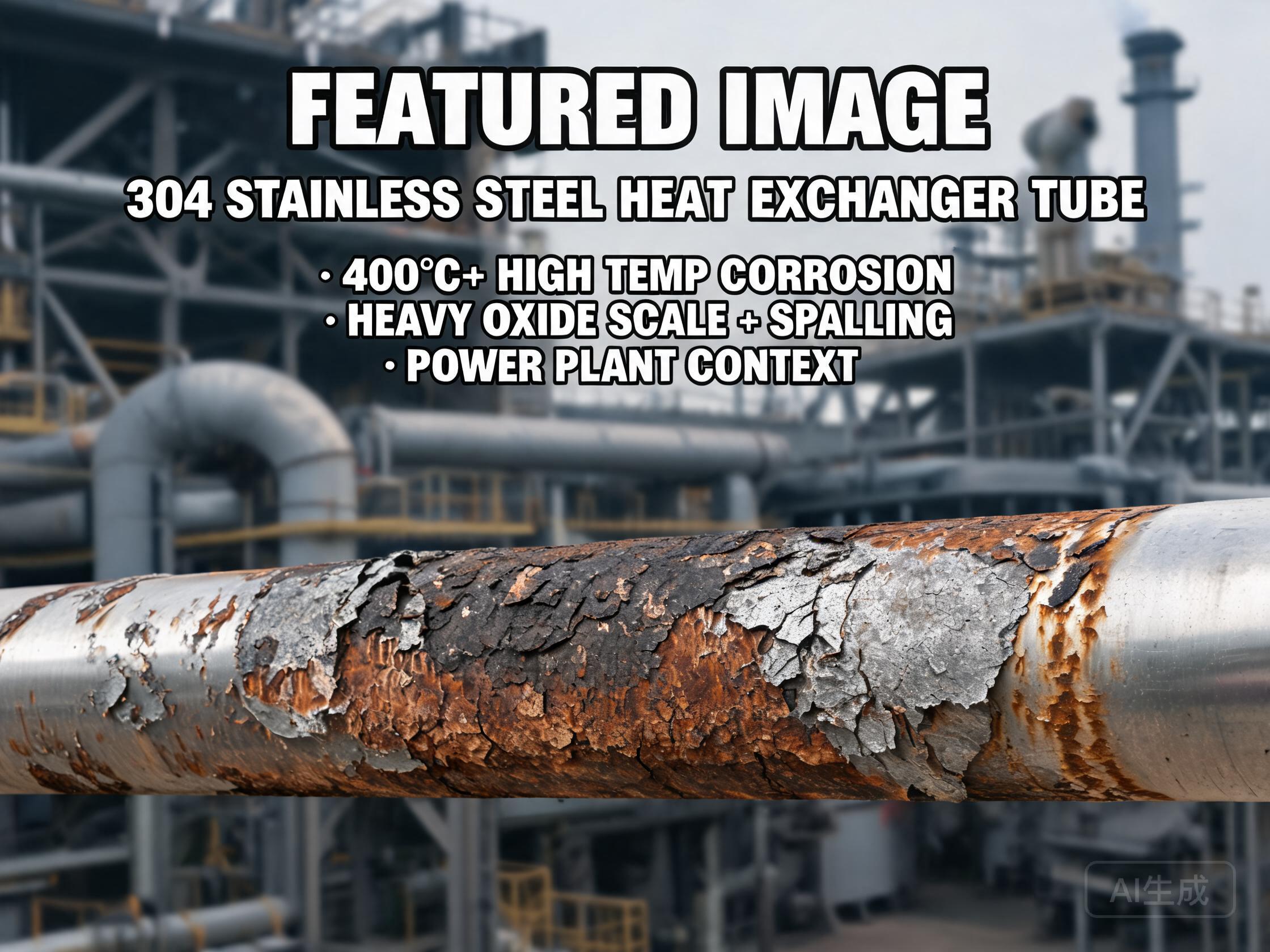
Short answer: Cold rolled 304 stainless steel fails at high temperature for three reasons: oxidation scaling, sensitization, and chloride attack. At 400 °C, 304 begins to sensitize. At 600 °C, it forms a thick, flaking oxide scale. Add 50 ppm chloride and the corrosion rate jumps to 1-5 mm/year — the sheet perforates in weeks. For service above 400 °C with any chloride present, 310S is the minimum grade you should buy.
Fireproofing panels, flue gas ducts, and oven liners are the common high-temperature 304 applications. Most buyers do not realize that even “clean” flue gas carries trace chlorides from fuel combustion. A cold rolled 304 flue duct at 550 °C with 30 ppm HCl in the gas atmosphere corroded through a 2mm wall in 8 months. A 310S duct in the same location has been running for 8 years.
Quick Comparison
| Grade | Max continuous temp (no chloride) | With 50 ppm chloride | Sensitization risk at 400 °C | Oxidation resistance |
|---|---|---|---|---|
| 304 / 304L | 870 °C (intermittent) | < 400 °C | 304: High; 304L: Low | Poor — scales at 600 °C |
| 316 / 316L | 870 °C (intermittent) | < 450 °C | 316: High; 316L: Low | Poor — scales at 600 °C |
| 309S | 980 °C | 550 °C | Low (stabilized) | Good |
| 310S | 1050 °C | 600 °C | Low | Very good |
| 330 | 1150 °C | 650 °C | None | Excellent |
| 2205 duplex | 950 °C | 500 °C | None | Good |
Chloride limits are approximate for flue gas applications. Higher temperatures reduce the chloride tolerance further.
What Buyers Should Evaluate
- Get the maximum operating temperature and chloride level in the gas or fluid from your process engineer. Do not assume temperature and chloride are low.
- For cold rolled sheet that will be held at 400-800 °C for more than 1 hour, start at 316L minimum (low C to avoid sensitization). For temperatures above 600 °C, use 309S or 310S.
- If both high temperature and high chloride (>100 ppm) are present, stainless steel grades stop working at about 500 °C — you need a nickel alloy.
- Specify a bright annealed or solution annealed surface finish, not cold rolled mill finish. A clean oxide-free surface oxidizes slower at high temperature.
Common Purchasing Mistakes
- Using cold rolled 304 for a wood-burning stove flue or biomass boiler duct. Flue gas from biomass contains 50-200 ppm Cl from the fuel. The flue runs 400-600 °C. Cold rolled 304 sensitizes and corrodes through a 1.5mm wall in 6-12 months. Specify 310S minimum.
- Ordering “annealed” 304 from a Chinese mill for high-temperature service and getting a 700 °C anneal instead of 1050 °C. The sheet looks bright but is fully sensitized. When it heats to 400 °C in service, the Cr23C6 stays precipitated and intergranular corrosion propagates on cooling. Demand annealing temperature ≥1050 °C on the EN 10204 3.1 cert.
- Confusing “fireproofing grade” with “fire-resistant grade.” True fireproofing (insulation support in steel structures) must survive 30 minutes at 1000 °C. 304 loses 50% of its strength at 550 °C and fails the fire test. 310S passes. Check the standard (EN 13381, ASTM E119) before specifying.
- Using 316L when 309S or 310S is needed. 316L oxidizes at 600 °C because its Cr content is too low (16-18%). 309S has 22-24% Cr and 310S has 24-26% Cr. The extra Cr forms a protective Cr2O3 scale that adheres and does not flake.
Recommended RFQ Wording
“Cold rolled stainless steel sheet, grade 310S (EN 10088-2, ASTM A240). Chemical: C ≤ 0.08%, Cr 24-26%, Ni 19-22%. Bright annealed surface finish. Wall thickness 1.5mm. Annealing temperature ≥1050 °C recorded on EN 10204 3.1 certificate. Application: biomass boiler flue gas duct, max temp 550 °C, flue gas chloride 80-150 ppm. Fire resistance per EN 13381-8 test.”
How Still Steel Supports the Project
Still Steel supplies cold rolled stainless steel in 304/304L/316/316L/317L/2205/2507/904L with full EN 10204-3.1 material test reports. We verify PREN, Mo, Cr and Ni content by PMI before dispatch and match the grade to your corrosion environment (chloride level, temperature, pH). Send your corrosion data and grade requirement to vip@still-steel.com, or discuss on WhatsApp.
Frequently Asked Questions
What happens to 304 stainless steel at 400 °C?
At 400 °C, 304 stainless steel undergoes two problems simultaneously: (1) sensitization — Cr23C6 precipitates at grain boundaries, depleting Cr in a 5 μm wide zone and causing intergranular corrosion on cooling, and (2) if any chloride is present (even 1 ppm), the passive Cr2O3 film breaks down and corrosion rate accelerates 10-100× compared to ambient temperature.
Is 304L better than 304 for high-temperature service?
304L (C ≤ 0.03%) does not sensitize as easily as 304 (C ≤ 0.08%) at 400 °C, because there is not enough C to form significant Cr23C6. But 304L still oxidizes and pits at high temperature with chlorides present. Low C helps with sensitization, not with high-temperature corrosion kinetics.
What grade should I use for high-temperature corrosion with chlorides?
310S (25-20 austenitic stainless, C ≤ 0.08%, Cr 24-26%, Ni 19-22%) is the standard choice for temperatures 800-1050 °C with intermittent chloride exposure. For temperatures above 1050 °C, 309S or 330 are preferred. For continuous chloride exposure above 500 °C, you need a nickel alloy (Hastelloy C-276, Inconel 625) — no stainless grade survives.
Technical References
- ASTM A240 Standard Specification for Chromium and Chromium-Nickel Stainless Steel Plate, Sheet, and Strip
- EN 10088-2 Chemical composition of stainless steel grades
- NACE SP0472 Test methods for high-temperature corrosion
- ASME B31.3 Process Piping code for high-temperature materials
Reference documents support general selection and fabrication principles. The final material decision must follow the applicable contract, standard, regulation and engineering review for the specific product.