
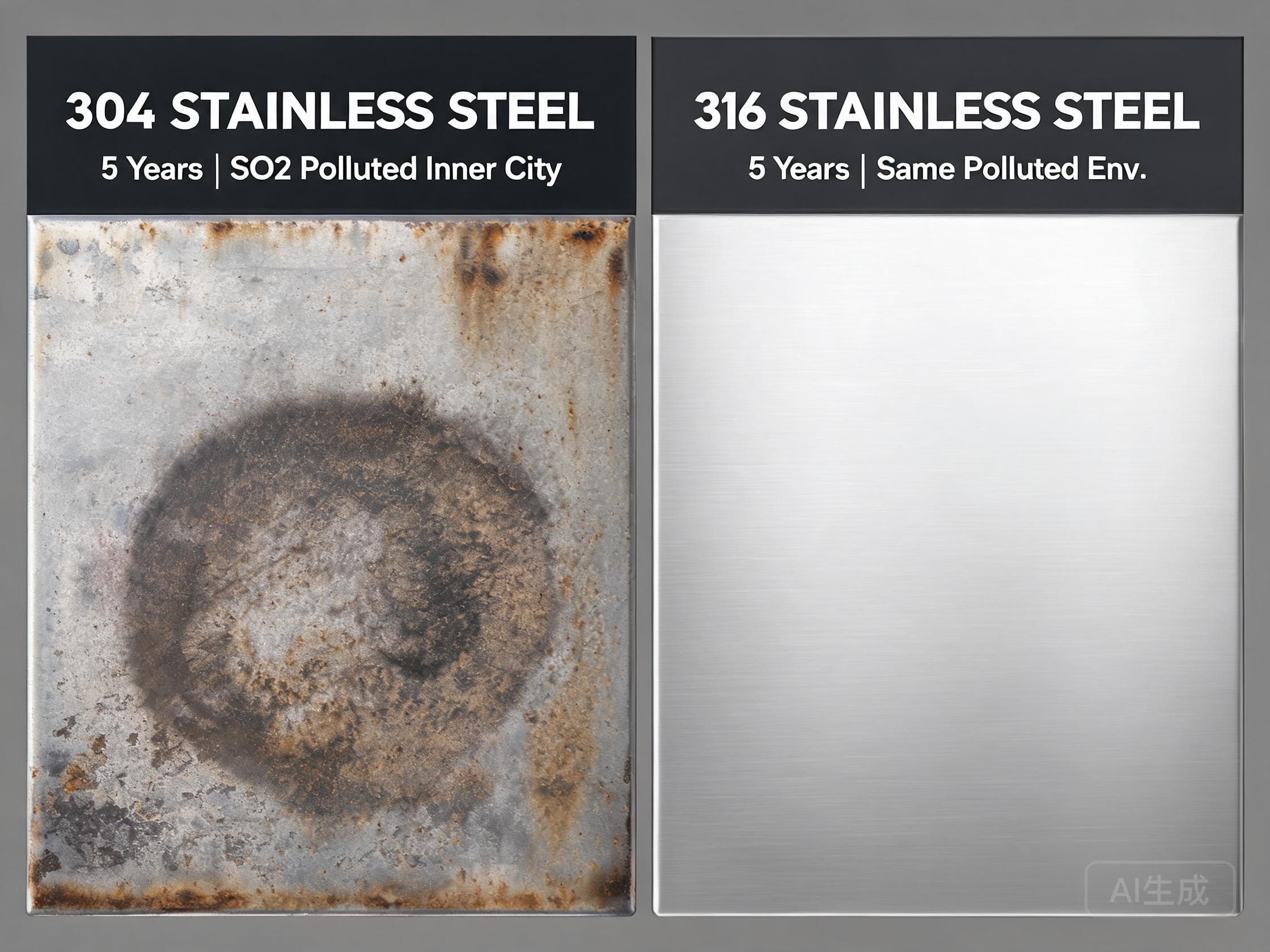
Short answer: Cold rolled 304 stainless steel rusts in city air — even “stainless” stains. Inner city pollution brings SO2, NOx, and road salt into the atmosphere. These react with rainwater to form sulfuric and nitric acids that attack the Cr2O3 passive film. 316 survives 3× longer than 304 in polluted cities because Mo specifically resists sulfuric acid attack.
Architectural cladding, rooftop equipment, and street furniture are the victims. A cold rolled 304 facade in downtown Shanghai or Milan develops brown tea stains within 5 years. By year 15, pitting is visible along the lower edges where dust collects. Switch to 316 for the same location and the facade still looks new after 15 years.
Quick Comparison
| Grade | Rural (C2) μg/cm²/year | Urban/Industrial (C3-C4) μg/cm²/year | Marine (C5-M) μg/cm²/year | Expected life (2mm CR sheet) |
|---|---|---|---|---|
| 304 | 0.05 – 0.1 | 0.3 – 0.5 | 0.5 – 1.0 | 15 – 20 years (C3) |
| 316 / 316L | 0.01 – 0.05 | 0.08 – 0.15 | 0.3 – 0.5 | 40 – 60 years (C3) |
| 2205 duplex | < 0.01 | < 0.05 | 0.1 – 0.2 | 80+ years (C3-C5) |
| 2507 super duplex | < 0.01 | < 0.01 | < 0.05 | 100+ years |
Data from ISO 9226 atmospheric corrosion testing program. μg/cm²/year converts directly to μm/year (divide by density, approximately 0.5 μg/cm²/year = 1 μm/year).
What Buyers Should Evaluate
- Classify your site using ISO 9223. Get SO2, NOx, and chloride deposition numbers from local data. C3 is typical inner city; C4 is heavy industrial; C5-M is coastal within 1 km of the shore.
- For facade panels or cladding in C3-C4 zones, start at 316L minimum. For coastal C5-M, use 2205 duplex or 316L with a PVD or powder coating top layer.
- Specify a surface finish that allows easy cleaning. 2B or BA finish is better than No. 4 (brushed) for urban environments because it does not trap dust and pollution particles.
- Include a maintenance schedule: annual cleaning with pH-neutral detergent. Regular cleaning doubles the effective life of any stainless grade in polluted air.
Common Purchasing Mistakes
- Using cold rolled 304 for urban architectural cladding and expecting it to stay clean. SO2 in city air forms sulfuric acid when it dissolves in dew and rain. The acid breaks through the passive film and causes “tea staining” — brown surface discoloration that clients complain about within 3 years. Specify 316L minimum for urban facades.
- Confusing “low-carbon 304L” with “316L atmospheric grade.” The L designation only means low carbon (C ≤ 0.03%). It does not add Mo. 304L corrodes in city air at the same rate as 304. You need Mo for atmospheric sulfur resistance.
- Specifying a brushed No. 4 finish for inner-city rooftop equipment. Brush lines trap dust and pollution. Each brush line becomes a crevice where acid concentrates. 2B smooth finish collects 60% less surface contamination.
- Skipping local corrosion data and using a European grade spec in an Asian city. SO2 levels in some Chinese or Indian inner cities can be 5-10× higher than European C3 classification. Your 316L that lasts 50 years in Frankfurt may corrode in 10 years in Guangzhou without Mo content verification.
Recommended RFQ Wording
“Cold rolled stainless steel sheet, grade 316L (EN 10088-2, ASTM A240). Mo minimum 2.0%. Surface finish 2B (cold rolled, pickled, passivated). Thickness 1.5mm. Site classification per ISO 9223: C3 (urban industrial, SO2 0.1 mg/m³, NOx 0.05 mg/m³). Expected atmospheric corrosion rate ≤ 0.15 μm/year per ISO 9226. Annual maintenance cleaning specified. EN 10204-3.1 certificate required.”
How Still Steel Supports the Project
Still Steel supplies cold rolled stainless steel in 304/304L/316/316L/317L/2205/2507/904L with full EN 10204-3.1 material test reports. We verify PREN, Mo, Cr and Ni content by PMI before dispatch and match the grade to your corrosion environment (chloride level, temperature, pH). Send your corrosion data and grade requirement to vip@still-steel.com, or discuss on WhatsApp.
Frequently Asked Questions
Does 304 stainless steel corrode in city air?
Yes. Clean rural air (0.01 mg SO2/m³) gives 304 an annual corrosion rate of about 0.01 μm/year — essentially permanent. But inner-city air with 0.1 mg SO2/m³ and 0.05 mg NOx/m³ pushes the rate to 0.3-0.5 μm/year. After 10 years, that is 3-5 μm of metal loss. After 20 years, the passive film breaks down and visible rust appears.
What is the difference between 304 and 316 for atmospheric corrosion?
316 has 2-3× the atmospheric corrosion resistance of 304. In the same polluted inner city, 316 runs about 0.1 μm/year vs 0.3 μm/year for 304. That means 316 lasts 3× longer before requiring cleaning or replacement. The Mo addition in 316 specifically resists the sulfuric acid formed from SO2 pollution.
How do I determine the atmospheric corrosion zone for my site?
ISO 9223 defines five atmospheric corrosion categories from C1 (rural, indoor) to C5-M (marine, industrial). Get the local SO2 and chloride deposition data from your environmental agency, or ask a corrosion engineer to classify your site. For most inner cities, expect C3 or C4 classification.
Technical References
- ISO 9223 Corrosion of metals and alloys — Classification of corrosivity of atmospheres
- ISO 9226 Corrosion of metals and alloys — Determination of corrosion rates
- ASTM G1 Standard Practice for Preparing, Cleaning, and Evaluating Corrosion Test Specimens
- EN 10088-2 Chemical composition and atmospheric corrosion data sheets
Reference documents support general selection and fabrication principles. The final material decision must follow the applicable contract, standard, regulation and engineering review for the specific product.