
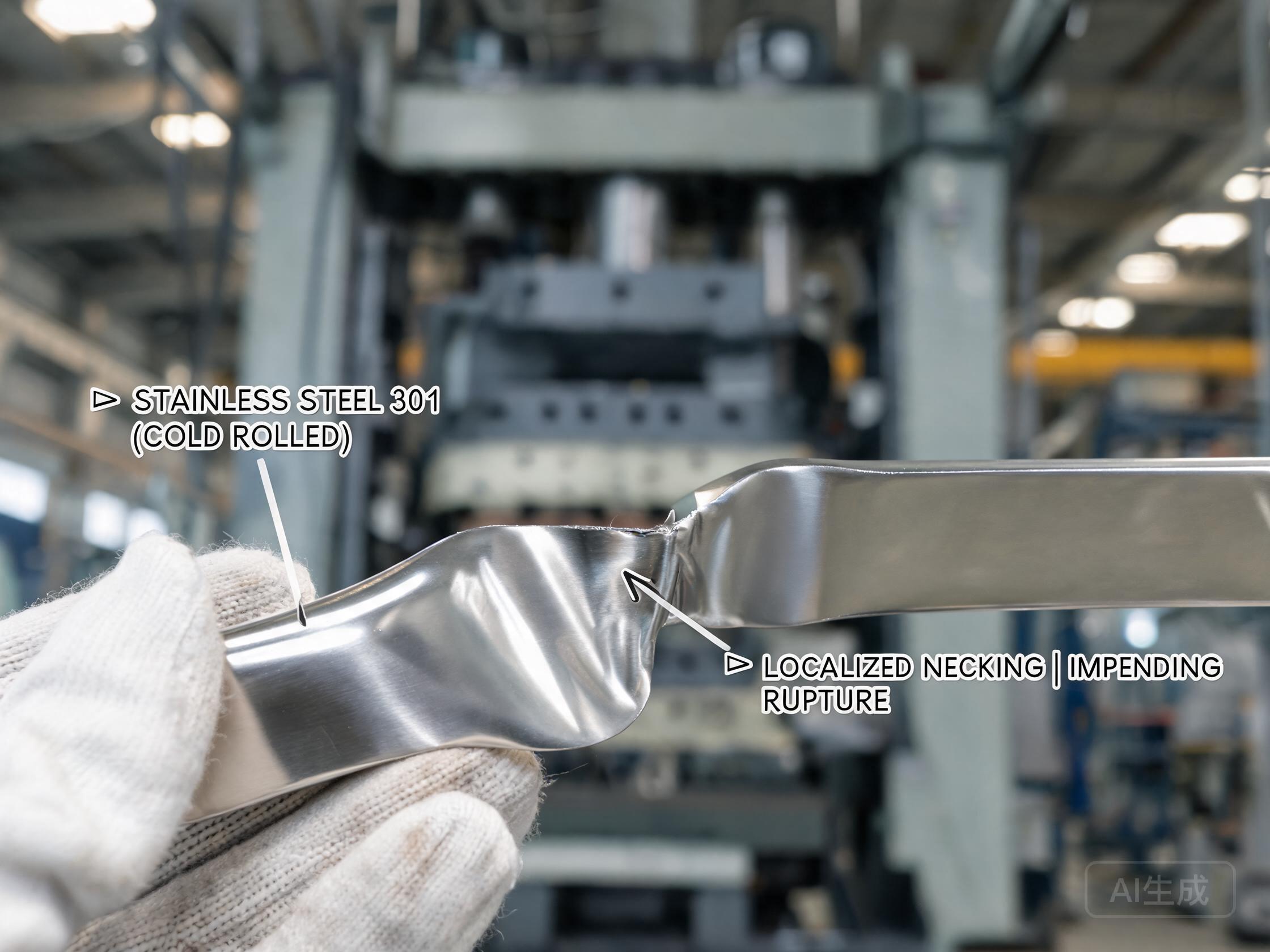
Short answer: Stretch forming defects are almost always necking — a local thinning that runs into a crack — and the two big causes are using the wrong temper and overestimating the limit stretch ratio. 301 full hard temper has only 0.05–0.08 strain hardening exponent, so it cannot distribute strain and necking happens at 5 % stretch. Annealed 304 / 304L with n = 0.30 handles 15–20 % stretch without necking. Pick the temper that matches the stretch, not the strength the product needs.
Stretch forming is how you make automotive body panels, appliance door skins and architectural fascia — you clamp the blank around its edges and pull it over a die until it conforms. It is the most unforgiving forming operation because there is no room for the metal to flow sideways. Every percent of stretch has to come from elongation of the local grain structure.
Quick Comparison
| Grade & temper | n value | Typical LSR | Necking at |
|---|---|---|---|
| Annealed 304 / 304L | 0.30–0.35 | 1.15–1.20 | ≥ 20 % uniform strain |
| Annealed 301 | 0.35–0.40 | 1.18–1.25 | ≥ 22 % uniform strain |
| 301 1/4H | 0.15–0.20 | 1.08–1.12 | ≥ 12 % strain |
| 301 full hard | 0.05–0.08 | 1.03–1.06 | ≥ 6 % strain |
| Annealed 430 | 0.20–0.25 | 1.08–1.12 | ≥ 15 % strain |
n value = strain hardening exponent. Higher n = better strain distribution = less necking at the same total strain. 301 annealed actually has better stretch formability than annealed 304 because of the slightly higher n value, but it costs more.
What Buyers Should Evaluate
- Calculate the actual stretch ratio from your blank layout before ordering material. Draw the blank, then draw the final part, measure the difference in surface area along the critical path, and divide by the original area. That is your LSR. If your LSR is 1.18, you need annealed 301 or annealed 304 — 301 hard temper will neck.
- Ask the supplier for the n value, not just “annealed.” Two coils both labeled “annealed 304” can have n values of 0.28 and 0.35, and the first one will neck at 18 % stretch while the second one handles 22 %. Demand a n value ≥ 0.30 for annealed 304.
- Check the blank’s flatness and internal stress. A coil with residual stress from rolling will show uneven stretch — one side stretches 3 % more than the other and develops orange peel or a kink. Specify level-flatten processing and a 24-hour aging period before stretch forming.
- Use the right lubrication. For stretch forming, a PTFE film or a dry lubricant coating works better than a liquid drawing compound — it maintains consistent friction across the entire die surface, preventing local friction spikes that trigger necking.
Common Purchasing Mistakes
- Buying 301 full hard “because the part needs to be stiff.” A full hard temper has yield 1100 MPa — you cannot stretch it more than 5 % before necking. Stretch form first with annealed 301 (yield 250 MPa, LSR = 1.20), then temper or age harden (if you use 17-4PH / 17-7PH) to get the stiffness you need. Tempering after forming gives you both ductility during forming and strength in the final part.
- Ordering BA surface “because it looks better” for a high-stretch appliance panel. BA has a low Ra that concentrates local strain and triggers orange peel in the center of the panel during stretch. 2B with Ra = 0.3–0.5 μm distributes strain better and gives a more uniform surface. The BA look can be achieved with a final passivation or electro-polishing step after forming.
- Assuming the stretch ratio from one part transfers to a different shape. A smooth convex panel (auto hood) can handle LSR = 1.20, but a deep recessed panel (appliance control box) hits necking at LSR = 1.12 because the sidewalls add constraint. Test a blank with the actual geometry.
- Skipping the n value test on incoming material. A Chinese mill that annealed at 1020 °C instead of 1050 °C will produce a coil with n = 0.25 instead of 0.32, and every part over 15 % stretch will neck. Specify PMI + EN 10204 3.1 with n value data.
Recommended RFQ Wording
Grade 304L (Werkstoffnummer 1.4307), annealed temper, 2B surface, thickness 0.7 mm ±0.015 mm, width 1250 mm coil. Forming data required: n value ≥ 0.32, elongation ≥ 55 %, yield ≤ 240 MPa. Lubrication compatibility: blank to be pre-coated with PTFE dry lubricant, ≥ 1 μm thickness. Flatness ≤ 5 mm/m after level-flatten processing. EN 10204 3.1 certificate with PMI, tensile (0°/45°/90°), n value and forming test data. Application: stretch formed 1-piece refrigerator door skins, target LSR 1.17, zero necking.
How Still Steel Supports the Project
Still Steel supplies cold rolled stainless steel sheet and strip in 304/304L/316/316L/430/201 with tight gauge and temper control. We provide pre-annealing, skin-pass and level-flatten processing to improve forming performance before you stamp, draw or bend. Send the grade, gauge, form (sheet or strip) and your specific forming problem to vip@still-steel.com, or discuss on WhatsApp.
Frequently Asked Questions
How does 301 hard temper affect stretch forming?
301 full hard temper (yield 1000–1200 MPa, tensile 1400–1500 MPa) has an n value of only 0.05–0.08 compared to annealed 304’s n = 0.30–0.35. The n value controls strain hardening, which is the material’s natural defense against necking. Without it, strain localizes in one thin spot and the part cracks at 10–15 % elongation instead of the annealed 301’s 40–45 %. Use full hard 301 only for simple single-curvature stretch forming where the total strain is ≤ 8 %.
What is a reasonable limit drawing ratio for stretch forming stainless steel?
Stretch forming ratio LSR = final blank dimension / original blank dimension. For annealed 304 / 304L, LSR = 1.15 (15 % stretch) without necking, and LSR = 1.20 with good lubrication. For 301 full hard, LSR drops to 1.05 (5 % stretch max). For 430, target LSR = 1.08. A multi-stage stretch forming line can push these higher by annealing between stages, but most buyers overestimate what a single stage can deliver.
Does surface finish 2B vs BA matter for stretch forming?
Yes. BA (bright annealed) has a smooth, featureless surface with very low Ra (0.01–0.05 μm) and uniform grain. 2B has a finely ground surface (Ra 0.3–0.5 μm) and retains more rolling texture. During stretch forming, the 2B texture actually helps distribute strain — it breaks up necking localization — while BA can show orange peel and local thinning if the press alignment is not perfect. For high-stretch automotive panels, 2B with controlled Ra is usually the better choice.
Technical References
- EN 10088-2 Stainless steels — Part 2: Material chemical composition and physical properties
- ASTM A666/A666M Standard specification for austenitic stainless steel sheet and strip for forming
- ISO 10275 Metallic materials — Sheet and strip — Determination of tensile strain hardening exponent
- ISO 10113 Metallic materials — Sheet and strip — Determination of plastic strain ratio
- Werkstoffnummer 1.4307 (304L), 1.4310 (301), 1.4016 (430)
Reference documents support general selection and fabrication principles. The final material decision must follow the applicable contract, standard, regulation and engineering review for the specific product.