
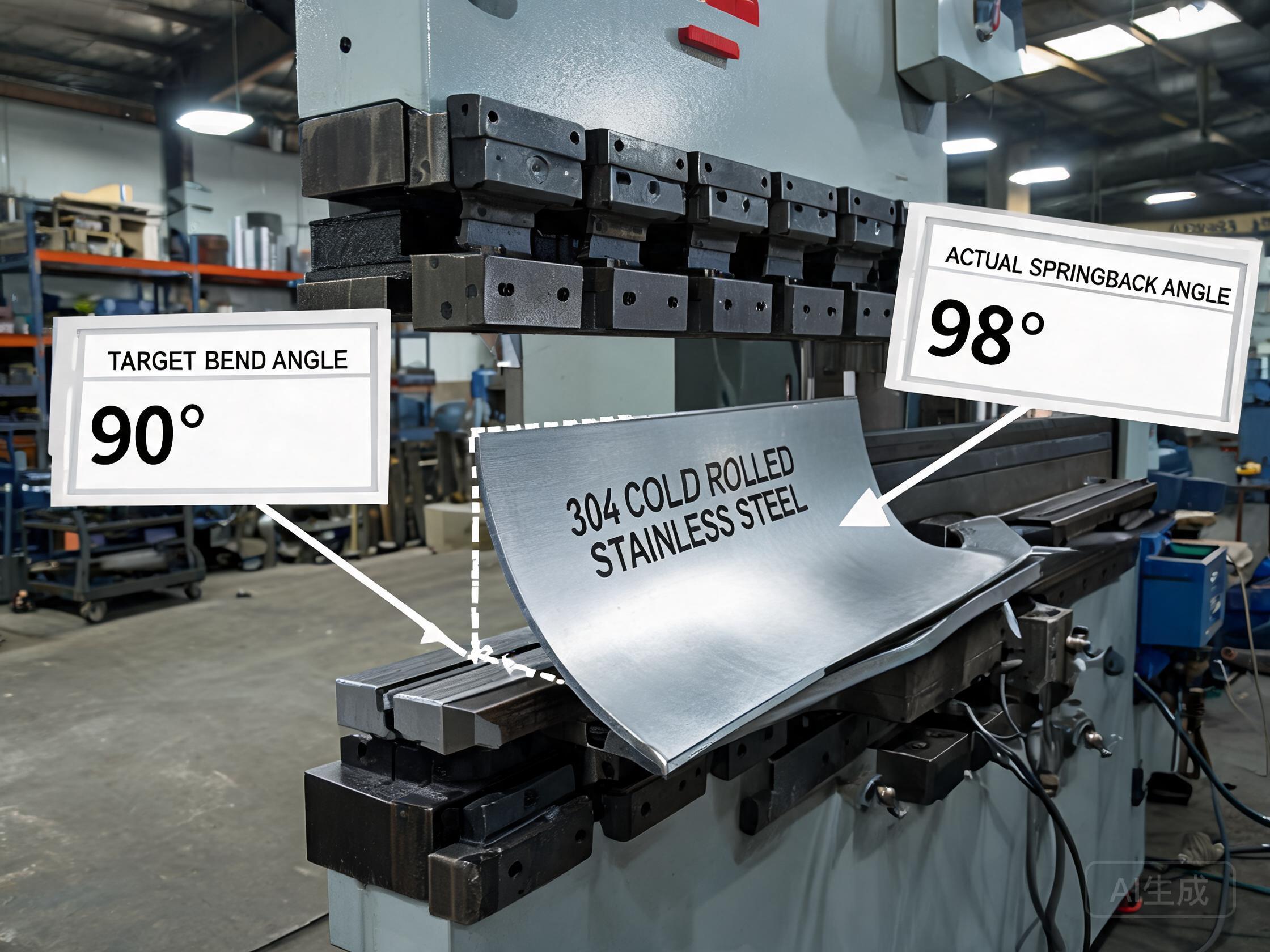
Short answer: Springback is the elastic snap-back that happens after every bend, draw or stake on stainless steel. Austenitic 304 springs back roughly 2–5 % more than ferritic 430, and every step from annealed to 1/2H temper roughly doubles the springback. Control it by choosing the right temper, overbending the punch angle, and specifying the yield strength on your RFQ instead of buying generic “304 sheet.”
You already know this problem: you program the press brake to 90°, the bend bounces to 93°, and every part in the batch is 3° off. The good news is springback is predictable. Measure your blank’s yield strength, estimate the rate, overbend the punch, and the first hit lands where it should.
Quick Comparison
| Material | Typical 90° springback | Key driver | Usual remedy |
|---|---|---|---|
| Annealed 304 / 304L | 2–3 % (87–88° target) | Low yield, high n value | Mild overbend, smaller R |
| 1/4H 304 | 3–4 % | Higher yield from cold work | Overbend + tighter die gap |
| 1/2H 304 | 4–5 % | Cold rolled temper | Anneal first, or use 430 |
| Annealed 430 | 1.5–2.5 % | Lower elastic ratio | Minimal overbend |
| 201 annealed | 3–5 % | Lower Ni content | Same as 304, test first |
Springback is always a function of yield strength, Young’s modulus, bend ratio R/t and strain hardening. Austenitics have a lower yield-to-modulus ratio so they store more elastic energy at the same plastic strain.
What Buyers Should Evaluate
- Specify temper, not just grade: annealed, 1/4H, 1/2H, 3/4H or full hard. Temper directly controls springback through yield strength.
- Ask the supplier to report actual yield strength (MPa) and tensile, not just hardness HRB. Two coils both labeled “annealed 304” can differ by 50 MPa in yield and spring back 1 % differently.
- If you are bending to a tight radius (R < 2t), confirm the material passes an Erichsen or Olsen cupping test on an incoming sample.
- Match bend direction to rolling direction where possible — springback is slightly lower when bending perpendicular to the grain, especially on 430.
Common Purchasing Mistakes
- Buying “cold rolled 304” without specifying temper, then discovering the coil is 1/4H when the drawing needs annealed ductility. Chinese mills may label a 1/4H product as “CR 304” because the chemical is correct — always demand the exact temper wording from EN 10088-2.
- Skipping the incoming mechanical test and trusting a “2B surface” label. Surface finish alone tells you nothing about yield. Specify a PMI (positive material identification) check plus a tensile test with EN 10204 3.1 certificate before acceptance.
- Assuming one springback value works for every gauge. Thicker gauge has a lower R/t ratio in the same die, which changes the plastic zone size and the stored elastic energy.
- Using a 304 full hard temper for a part that only needs mild forming. The extra strength means 4–5 % springback and more press tonnage for zero functional benefit.
Recommended RFQ Wording
Grade 304L, temper annealed (2B surface), thickness 1.0 mm ±0.02 mm, width 1250 mm, coil, with EN 10204 3.1 mill test certificate. On certificate, report yield strength (MPa), tensile strength, elongation and hardness HRB. Material must pass 180° bend test transverse to rolling direction at R = 2t without cracking. Application: press brake bending of cookware handles, target final angle 90°.
How Still Steel Supports the Project
Still Steel supplies cold rolled stainless steel sheet and strip in 304/304L/316/316L/430/201 with tight gauge and temper control. We provide pre-annealing, skin-pass and level-flatten processing to improve forming performance before you stamp, draw or bend. Send the grade, gauge, form (sheet or strip) and your specific forming problem to vip@still-steel.com, or discuss on WhatsApp.
Frequently Asked Questions
What is the springback rate of 304 vs 430 stainless steel?
304 austenitic stainless typically shows 2–5 % springback from 90° bends, while 430 ferritic runs lower at 1.5–3 %. The exact value depends on gauge, temper and bend radius. Softer annealed material springs back less than 1/4H or 1/2H temper. Always test on your exact gauge and temper instead of assuming a standard number.
Does temper affect springback?
Yes. Every temper step up (1/4H → 1/2H → 3/4H → full hard) raises yield strength, which raises springback. Annealed 304 has yield around 210 MPa; 1/2H temper can reach 520 MPa, and full hard 1100 MPa. The formula springback ≈ 1 − Rs/σy tells you why: lower yield means less stored elastic energy to release after forming.
What bend angle formula should I use for stainless steel?
For a target final angle αf, bend to a punch angle αp where αp = αf · (1 − springback). A 90° bend on annealed 304 with 3 % springback means bending to 87.3°. Add an overbend of 2–4° for 304 and 1–2° for 430 as a starting point, then tune with one test blank before production.
Technical References
- EN 10088-2 Stainless steels — Part 2: Material chemical composition and physical properties
- ASTM A240/A240M Standard specification for chromium and chromium-nickel stainless steel plate, sheet, and strip
- ASTM A666/A666M Standard specification for austenitic stainless steel sheet and strip for forming
- Werkstoffnummer 1.4301 (304) and 1.4016 (430) mechanical property ranges
Reference documents support general selection and fabrication principles. The final material decision must follow the applicable contract, standard, regulation and engineering review for the specific product.