
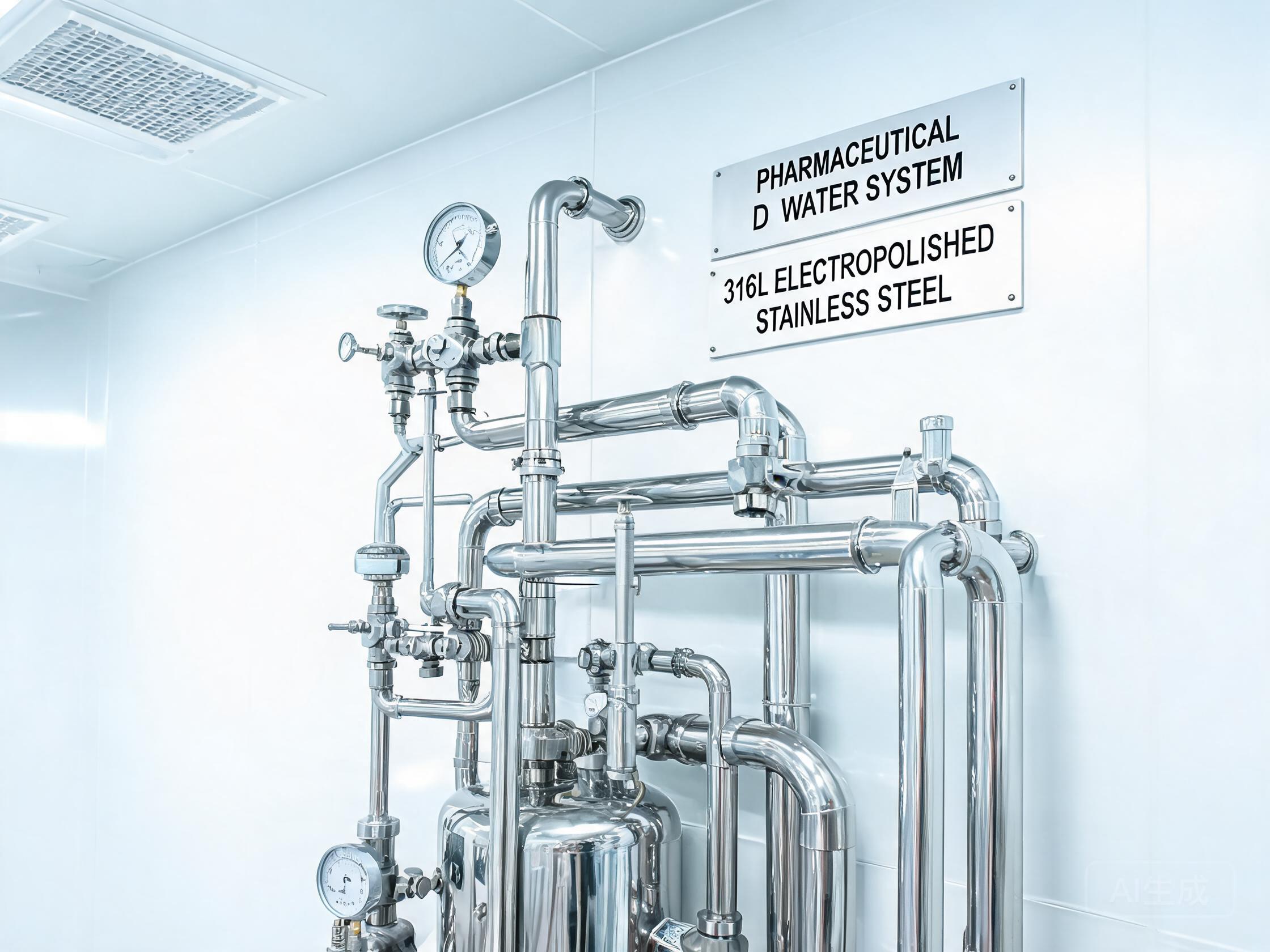
Short answer: Pharmaceutical DI water at 18.2 MΩ·cm and WFI (Water for Injection) will corrode 304 stainless steel in three months. Use 316L only — cold rolled, electropolished to Ra ≤0.4 μm, and passivated after every weld. ASME BPE and the FDA do not make exceptions. If your supplier quotes 304 because “DI water is clean,” walk away. You will spend more re-polishing and re-passivating a 316L system that is wrong than you ever saved on grade.
Pharmaceutical water systems are the single most audited piece of equipment in a GMP facility. The FDA checks surface roughness. EMA checks passivation records. PIC/S checks weld IDs and PMI reports. When the auditor runs a conductivity test and finds 17.8 MΩ·cm instead of 18.2, or swabs a patch of biofilm where a weld was not polished flush, your batch hold costs one million euros. The root cause is almost always the wrong cold rolled stainless steel sheet.
Quick Comparison
| Parameter | 304 cold rolled | 316 cold rolled | 316L cold rolled | 316Ti cold rolled |
|---|---|---|---|---|
| DI water suitability | Not acceptable | Good | Excellent | Good |
| WFI suitability | Not acceptable | Fair, weld risk | Excellent | Good |
| Pitting resistance equivalent (PRE) | 19 | 25 | 25 | 24 |
| Carbon content | ≤0.08% | ≤0.08% | ≤0.03% | ≤0.08% |
| Weld corrosion risk | High | Medium | Low | Medium |
316L is the only grade ASME BPE accepts for WFI tanks and piping. The low carbon stops intergranular corrosion after welding — the problem that ruins 316 and 304 welds in six months of DI water service. 316Ti uses titanium stabilization but is not recognized by ASME BPE for WFI.
What Buyers Should Evaluate
- Grade first. Only 316L. Confirm PRE ≥25. Reject anything with PRE below 24.
- Surface finish: electropolished Ra ≤0.4 μm. ASME BPE allows a maximum of 0.5 μm, but push your supplier to deliver 0.3 μm or better. Get the roughness report with every coil.
- Passivation: cold rolled sheet should arrive pre-passivated, but you must re-passivate after welding. Verify corrosion potential ≤+200 mV SCE after passivation.
- Weld preparation: the cold rolled sheet must be formable without work hardening. Ask for a bend test report. Your fabricator will TIG weld every joint — the 316L must not crack at the bead.
- Documentation: EN 10204-3.1 with full chemical analysis, PMI report, surface roughness report, passivation report, and a copy of the mill’s ASME BPE compliance statement.
Common Purchasing Mistakes
- Accepting 316 when you ordered 316L. A Chinese mill will stamp 316L on a 316 coil because the carbon difference is 0.04% and they save 800 USD per tonne. The weld corrodes in six months of WFI. Specify “316L, carbon ≤0.030% by EN 10204-3.1” and run a PMI on the first coil.
- Ordering mechanical polished No.8 instead of electropolished. The mill says “same mirror finish.” It is not. Mechanical polishing leaves embedded abrasive grains and iron particles that passivation does not remove. Your corrosion potential stays above +300 mV.
- Skipping the roughness measurement. “Electropolished” means nothing without Ra numbers. One mill’s electropolish is Ra 0.8 μm. Another is Ra 0.2 μm. Specify Ra ≤0.4 μm on the order and get the report.
- Forgetting passivation after installation. Many buyers assume the as-delivered passivation lasts forever. It does not. Every weld, every burr, every scratch removes the passive layer. Passivate after every fabrication step and keep the records for the FDA.
- Specifying thickness but not flatness. DI water tanks use cold rolled sheet that must roll perfectly flat. Wavy sheet causes crevices where biofilm hides. Specify flatness to EN 10088-2 Class B minimum.
Recommended RFQ Wording
Cold rolled stainless steel sheet for pharmaceutical DI water / WFI system, grade 316L only, carbon ≤0.030%, PRE ≥25, thickness 3.0 mm ±0.06 mm, width 1250 mm, electropolished Ra ≤0.4 μm, pre-passivated, EN 10088-2, ASME BPE compliant, EN 10204-3.1 test report with full chemical analysis, PMI report, surface roughness measurement report, passivation corrosion potential report ≤+200 mV SCE, bend test report, quantity 25 tonnes, destination [your factory], delivery within 35 days.
State the water application (WFI, purified water, hot WFI) and the system pressure so the supplier can confirm the thickness and PRE. Put the carbon content cap and the PRE minimum on the order — these are non-negotiable.
Frequently Asked Questions
Why is only 316L cold rolled stainless steel acceptable for pharmaceutical DI water and WFI systems?
304 leaches iron, chromium and nickel into high-purity water. 316L adds molybdenum which stops pitting and lowers the corrosion rate. The L (low carbon) stops carbide precipitation during welding, so the weld zone stays corrosion-free. ASME BPE mandates 316L for WFI.
What surface finish and roughness do I need for DI water contact?
Electropolished to Ra ≤0.4 μm (maximum 0.5 μm per ASME BPE). Electropolishing removes the free iron layer and smoothes the peaks where bacteria would attach. Mechanical polishing alone leaves embedded grit and does not lower the corrosion potential below +200 mV SCE.
Do I need passivation after electropolishing?
Yes. Electropolishing does not replace passivation. Use a 30% nitric acid passivation per ASTM A380 or citric acid per ASTM AMS 2700. Confirm the passivation reduced the corrosion potential. Re-passivation is required every two years or after any welding or mechanical damage.
How Still Steel Supports the Project
Still Steel supplies cold rolled stainless steel sheet and strip in the right grade and thickness for your pharmaceutical DI water and WFI systems with EN 10204-3.1 test reports. We provide slitting, cut-to-length, electropolishing, passivation and protective film application so you receive process-ready material. Send your specification and quantity to vip@still-steel.com, or discuss on WhatsApp.
Technical References
- ASME BPE Bioprocessing Equipment standard (2025 edition)
- EN 10088-2 cold rolled stainless steel sheet and strip
- EN 10204-3.1 metallic materials — types of inspection documents
- ASTM A240 / A240M flat-rolled stainless steel
- ASTM A380 passivation of stainless steel parts
- ASTM AMS 2700 citric acid passivation
- FDA 21 CFR Part 211 Current Good Manufacturing Practices
- EMA Annex 4 Manufacturing of water for pharmaceutical use
- PIC/S GMP Guide Annex 7
Reference documents support general selection and fabrication principles. The final material decision must follow the applicable contract, standard, regulation and engineering review for the specific product.