
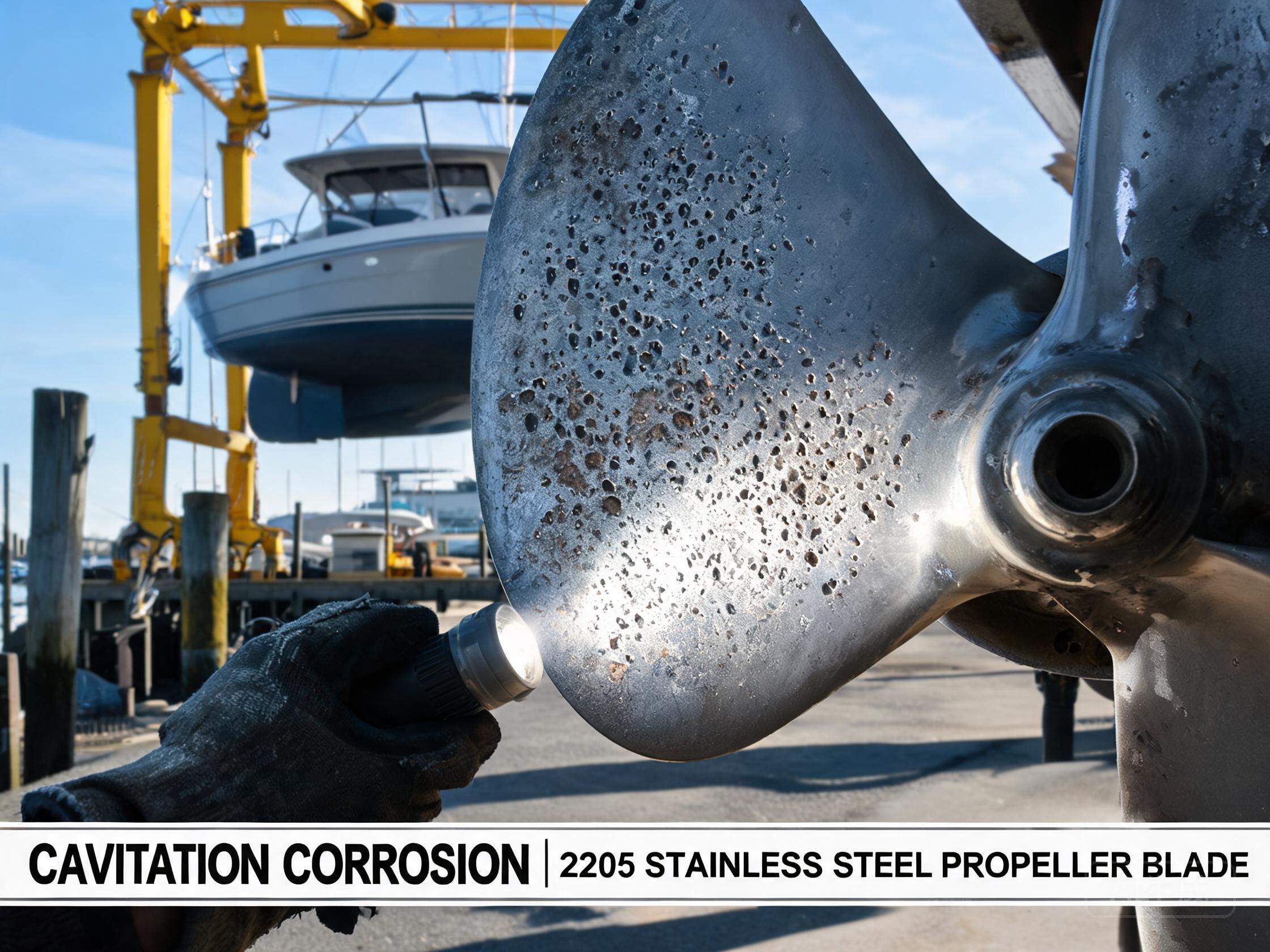
Short answer: Marine propeller cavitation is not a cosmetic problem. It erodes cold rolled stainless steel blades at 0.5–2 mm per year above 25 m/s tip velocity. 2205 duplex is 5x more resistant than 316L. If your vessel runs warm water or exceeds 25 m/s tip speed, skip 316L entirely. Specify 2205 duplex cold rolled plate, minimum 10 mm thickness with 2 mm corrosion allowance, and get ABS or DNV marine approval before you cast.
Commercial shipping, high-speed ferries, naval vessels and offshore support craft all push their cold rolled stainless steel propellers past the cavitation threshold. When bubbles form and collapse near the blade surface, the shock wave hits 1500 MPa — harder than the steel’s tensile strength. Pitting forms. Erosion accelerates. Fuel consumption rises 8%. The captain schedules a dry dock. Every dry dock is $200,000 minimum.
Quick Comparison
| Grade | PRE | ASTM G32 cavitation rate | Velocity threshold | Repair weld filler | Approval |
|---|---|---|---|---|---|
| 316L cold rolled | 25 | 8 μm/hour | 18 m/s | 316L | ABS, DNV |
| 2205 duplex cold rolled | 35 | 1.6 μm/hour | 25 m/s | 2209 | ABS, DNV, LR |
| 2507 super duplex | 40 | 0.8 μm/hour | 30 m/s | 2594 | DNV, ABS |
| 904L super austenitic | 40 | 2.0 μm/hour | 22 m/s | 904L | ABS, DNV |
PRE = Pitting Resistance Equivalent (%Cr + 3.3×%Mo + 16×%N). Higher PRE means better cavitation and salt water resistance. 2205 duplex is the sweet spot — 5x the cavitation resistance of 316L at 1.5x the cost of 316L.
What Buyers Should Evaluate
- Tip velocity first. Calculate it from propeller RPM and diameter. 25 m/s is the decision threshold. Above 25 m/s, 316L will erode through in 3–4 years. 2205 lasts 15+.
- Water temperature. Warm water (30°C+) has lower dissolved gas content. Cavitation starts at 15 m/s in warm water vs 18 m/s in cold water.
- Thickness: minimum 10 mm for propeller blades, with 2 mm corrosion allowance on the pressure face. Specify flatness and grain direction — cold rolled plate has better cavitation resistance parallel to the rolling direction.
- Surface finish after casting: Ra ≤1.6 μm maximum. Rough cast surfaces cavitate 3x faster than polished. Specify post-cast polishing in the propeller purchase order.
- Marine approval: ABS or DNV certificate required. The classification society audits the mill and the propeller foundry before you cast.
Common Purchasing Mistakes
- Buying 316L because it is 35% cheaper and running at 28 m/s tip velocity. Erosion rate is 2 mm/year. Dry dock every 18 months. You spend more on repairs in five years than the 2205 premium cost.
- Specifying “duplex stainless” without PRE number. A Chinese mill can label a 20% Cr, 4% Mo lean duplex (PRE 28) as “duplex.” Cavitation rate is 4 μm/hour — worse than 2205. Specify PRE ≥35.
- Ordering 8 mm thickness to save weight. Corrosion allowance is only 0.5 mm. At 0.4 mm/year erosion, the blade is gone in 3.5 years. Add 2 mm minimum corrosion allowance.
- Skipping the grain direction specification. Cold rolled stainless steel has a rolling texture. Cavitation resistance parallel to the rolling direction is 30% higher than across it. State the grain direction on the drawing.
- Repair welding with 316L filler on a 2205 blade. The weld has PRE 25 vs PRE 35 for 2205. Cavitation starts at the weld immediately. Use matching filler metal only.
Recommended RFQ Wording
Cold rolled stainless steel plate for marine propeller casting, grade 2205 duplex, PRE ≥35, thickness 12 mm ±0.3 mm, width 1500 mm, surface 2B, grain direction parallel to blade length, EN 10088-2, ASTM G32 cavitation test report ≤2 μm/hour, ABS or DNV material approval, EN 10204-3.1 test report with full chemical analysis including nitrogen, PMI report, quantity 30 tonnes, destination [your foundry], delivery within 60 days.
State the vessel type, design speed, propeller RPM, tip velocity and operating water temperature so the supplier can confirm the grade and thickness before rolling. Put the PRE minimum and the ASTM G32 test requirement on the order — lean duplex substitutes are common.
Frequently Asked Questions
Which cold rolled stainless steel grade is better for a marine propeller — 2205 duplex or 316L?
2205 duplex. Its PRE is 35 (vs 25 for 316L) and its cavitation erosion rate per ASTM G32 is 1/5 that of 316L. If your vessel exceeds 25 m/s tip velocity or runs in warm salt water, 2205 is non-negotiable.
What is the velocity threshold where cavitation becomes a problem?
Cavitation begins at 18 m/s tip velocity in cold water and 15 m/s in warm water. Severe erosion accelerates above 25 m/s. If your propeller tip velocity exceeds 25 m/s, 316L will erode 2 mm per year. 2205 erodes 0.4 mm per year.
Can I repair cavitation damage on a stainless steel propeller with welding?
Yes, but use matching grade filler metal. 2205 requires 2209 filler. 316L requires 316L filler. Pre-heat to 150°C for 2205 to avoid cold cracking. Post-weld grind flush and polish to Ra ≤1.6 μm. Unpolished repair welds cavitate faster than the original blade.
How Still Steel Supports the Project
Still Steel supplies cold rolled stainless steel sheet and strip in the right grade and thickness for your marine propellers with EN 10204-3.1 test reports. We provide slitting, cut-to-length, surface finishing and protective film application so you receive process-ready material. Send your specification and quantity to vip@still-steel.com, or discuss on WhatsApp.
Technical References
- ASTM G32 standard test method for cavitation erosion
- ASTM A240 / A240M flat-rolled stainless steel
- EN 10088-2 cold rolled stainless steel sheet and strip
- ABS Rules for Building and Classing Marine Vessels
- DNV Rules for Classification of Ships
- ISO 15614-1 qualification of welding procedures
Reference documents support general selection and fabrication principles. The final material decision must follow the applicable contract, standard, regulation and engineering review for the specific product.