
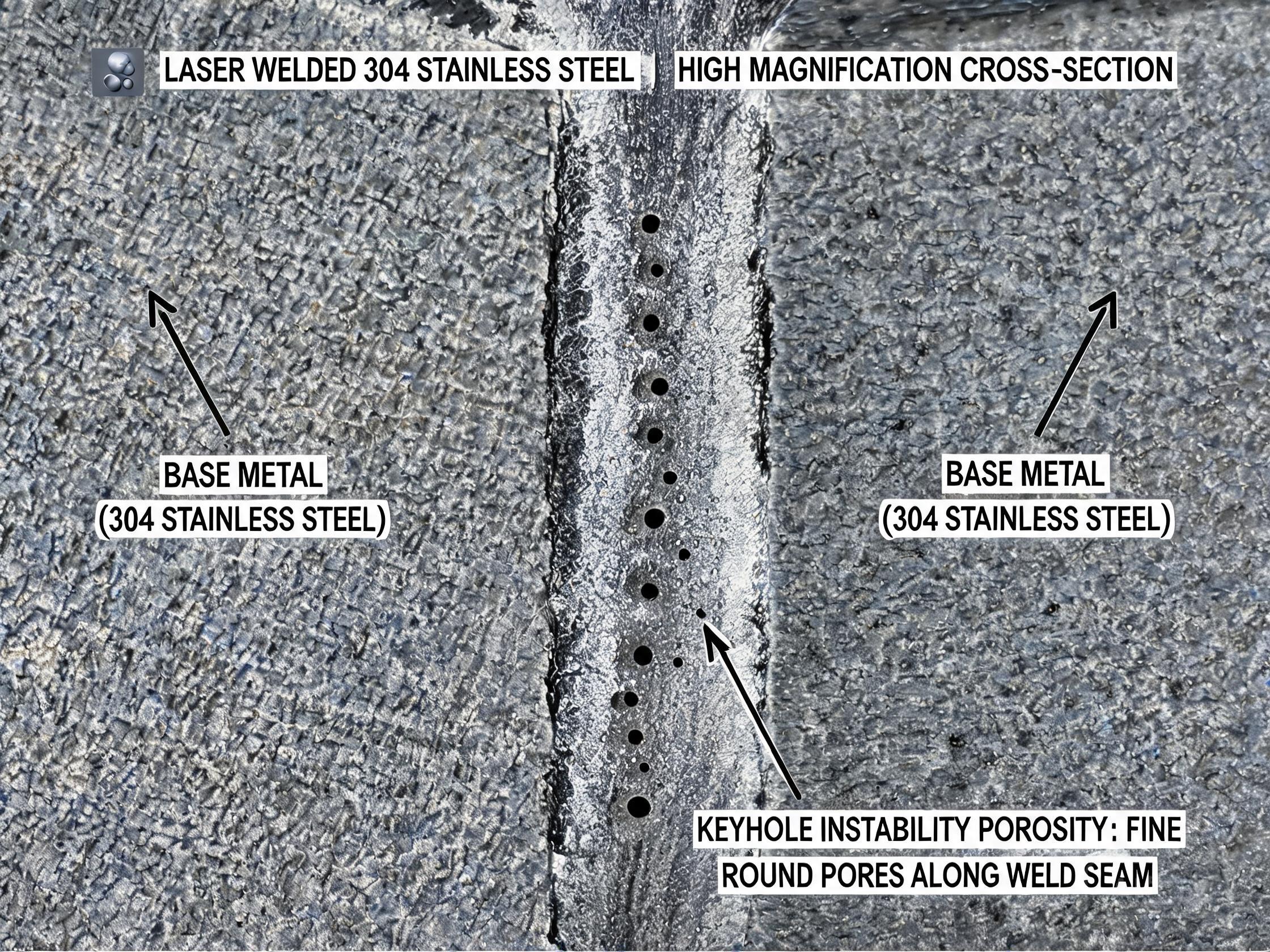
Short answer: Laser welding porosity in stainless steel looks like perfectly round gas holes — different from TIG porosity which is irregular. It happens when the laser’s keyhole collapses and traps vapor or air. The fix is shielding gas at 99.995% argon, travel speed tuned per grade (slower for 316 because of molybdenum vapor), and root-side gas flow. Get these three right and porosity drops from 10-20 pores per weld to zero.
Laser welding is 5-10x faster than TIG, produces 80% less distortion, and creates narrow welds with no filler wire needed. But it has one fatal flaw: keyhole instability. The deep vapor cavity that gives laser welding its deep penetration can collapse unpredictably, trapping gas. Many fabricators blame “bad material” when the real problem is gas purity or travel speed.
Quick Comparison
| Parameter | 304 Laser Weld | 316 Laser Weld | Duplex 2205 Laser Weld |
|---|---|---|---|
| Travel speed (1mm sheet) | 1.5-2.0 m/min | 1.2-1.5 m/min | 1.0-1.2 m/min |
| Shielding gas | 100% Ar 99.995% | 90% Ar + 10% He preferred | 100% Ar 99.995% |
| Top gas flow | 20 L/min | 25 L/min | 20 L/min |
| Root gas flow | 10 L/min | 15 L/min | 15 L/min |
| Porosity rate (optimal) | <1 pore/m | <1 pore/m | <1 pore/m |
| Porosity rate (poor setup) | 10-20 pores/m | 20-40 pores/m | 30-50 pores/m |
316 with molybdenum and duplex with high nitrogen content both have higher porosity risk. Nitrogen in duplex can also cause porosity if the keyhole collapses — duplex laser welding typically needs a nitrogen-argon mix for shielding to prevent nitrogen loss.
What Buyers Should Evaluate
- Does the fabricator’s laser have a gas sensor that continuously monitors O2 and N2 levels in the shielding gas, or just a pressure gauge?
- Do they run a test weld and inspect for porosity before starting production?
- What is their travel speed — and do they have data to back it up? A fabricator that says “we run 2 m/min for everything” is wrong for 316.
- Do they have root-side shielding gas delivery for every weld, or only on thicker material?
- Can they show you high-speed camera footage of the keyhole — stable keyhole = no porosity, collapsing keyhole = porosity coming?
Keyhole stability is the root cause. If the keyhole wobbles, contracts rapidly or collapses, porosity follows. A stable keyhole has a consistent diameter and depth as the laser travels.
Common Purchasing Mistakes
- A China factory trick: running 99.9% argon (cheaper) instead of 99.995% and calling porosity a “laser characteristic.” The 0.095% impurity difference is ¥20 per cylinder but costs you ¥2000 in rejected parts. Specify minimum 99.995% argon and require a gas purity certificate with each cylinder.
- Skipping root-side shielding gas for thin sheet. Even 0.5mm sheet needs root shielding — the laser fully penetrates, and the underside of the weld oxidizes and picks up nitrogen from shop air. Root porosity from nitrogen is invisible on VT but shows up on RT. Add “root shielding gas: argon, 10+ L/min” to your laser welding spec.
- Assuming laser welding can weld dissimilar stainless grades as well as TIG can. 304 laser welded to 316 will have porosity at the transition because of different thermal conductivity and vaporization behavior. Use a transition filler (ER309L) with TIG for dissimilar joints, not laser.
- Ignoring nitrogen content in the base metal. Stainless steel with nitrogen ≥0.12% (found in high-N duplex or some modified 316 grades) has higher porosity risk in laser welding. Check the EN 10204-3.1 certificate for N content and adjust shielding gas accordingly.
Recommended RFQ Wording
“Please supply cold rolled 304L or 316L stainless steel sheet per EN 10088-2 with EN 10204-3.1 test reports including nitrogen content. Fabrication: laser welding with continuous wave (CW) fiber laser, wavelength 1064nm. Shielding gas: 99.995% minimum argon (top and root), 90% Ar + 10% He for 316 welds. Top flow: 20 L/min, root flow: 15 L/min. Travel speed: 1.5 m/min for 304, 1.2 m/min for 316, ±10% adjusted after test weld. Gas purity verified with O2 sensor <10 ppm. Porosity acceptance: zero for food-contact, AWS D1.6 clause 8 for others. First article test weld with radiography inspection required.”
Frequently Asked Questions
Why is laser welding more prone to porosity than TIG welding?
Laser welding creates a deep, narrow vapor keyhole in the weld pool. When the laser moves forward, the keyhole can collapse behind it, trapping shielding gas, air or metal vapor as the weld metal solidifies. TIG welding has a wider, shallower weld pool with no keyhole, so gas escapes naturally. Laser porosity is round and uniform — different from the irregular porosity you see in TIG/MIG from moisture or oil.
Why does 316 have more laser porosity than 304?
316 contains 2-3% molybdenum for pitting corrosion resistance. Molybdenum has a lower boiling point (4639°C) than iron (2862°C) or chromium (2671°C). During laser welding, Mo can vaporize within the keyhole, creating additional vapor bubbles. When the keyhole collapses, these Mo vapor bubbles become trapped porosity. Use slightly slower travel speed for 316 (1.2-1.5 m/min vs 1.5-2.0 m/min for 304) to allow vapor to escape.
What shielding gas and parameters should I specify for stainless laser welding?
Shielding gas: pure argon (99.995% minimum) for top and root shielding, at 15-25 L/min top and 10-15 L/min root. For 316, consider a 90% argon + 10% helium mix — helium’s higher thermal conductivity stabilizes the keyhole. Travel speed: start at 1.5 m/min for 304, 1.2 m/min for 316, adjust ±10% after test welds. Focus position: 0.5-1mm below the sheet surface for maximum keyhole stability.
How Still Steel Supports the Project
Still Steel supplies cold rolled stainless steel sheet and strip with pre-cut edges, beveling and pre-weld cleaning services so your fabricator can start welding immediately. We stock matching filler wires (ER308L, ER316L, ER2209) and provide material traceability via EN 10204-3.1 test reports. Send your weld joint design, grade and thickness to vip@still-steel.com, or discuss on WhatsApp.
Technical References
- AWS D1.6/D1.6M Clause 8: Porosity Acceptance Criteria
- ASME IX QW-422: Laser Beam Welding Variables
- ISO 15614-11: Qualification test of welding procedures — Laser beam and electron beam welding
- Laser Welding for Stainless Steel, AWS Welding Journal Supplement, October 2022