
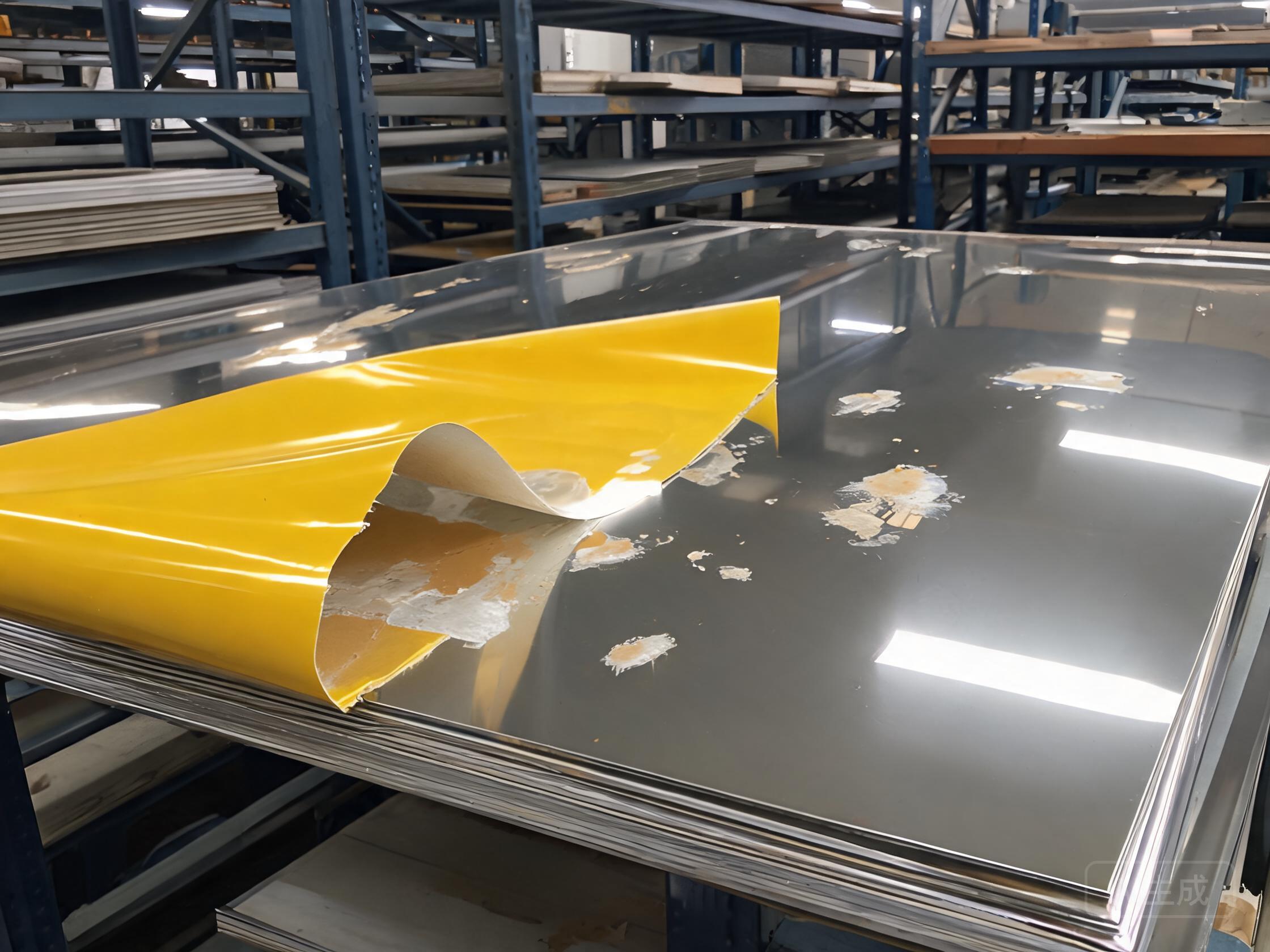
Short answer: Protective film residue on stainless is not a cleaning problem — it is a film selection and storage timing problem. If your 316 8K panels arrived from China and peeled their film leaving gooey brown streaks, the mill used the cheapest domestic acrylic film and the sheet sat in a hot warehouse for 11 months. Specify Korean or Japanese film on the PO, and enforce a 6-month max storage rule for film-covered sheet.
Kitchen appliance OEMs in Europe have been dealing with this for years. A batch of 304 8K fridge doors ships from China in June, sits in a Rotterdam warehouse through the summer, and arrives at the assembly line in September. The operator peels the protective film, and every single door has a sticky yellow-brown outline where the film edges were. Three weeks of production shut down while they strip residue with isopropanol and acetone. The mill says “storage is your problem.” They are half right — you should have specified better film.
Quick Comparison
| Film grade | Origin | Shelf life (indoor, < 30 °C) | Shelf life (hot, 35–40 °C) | Price premium |
|---|---|---|---|---|
| Generic domestic acrylic | China | 6–9 months | 2–3 months | Baseline (1×) |
| Mid-grade PE | China (branded) | 9–12 months | 4–6 months | 1.5× |
| Hanwha / LG | Korea | 12–18 months | 6–8 months | 2.0× |
| Nitto / Toyobo | Japan | 18–24 months | 8–12 months | 2.5–3× |
| Laser-cut specific | Korea/Japan | 12 months | 6 months | 2.0× |
Laser-cut specific film is important if you will laser-cut the sheet with the film still on. Generic acrylic film melts during laser cutting and bonds permanently to the edge — impossible to remove without grinding.
What Buyers Should Evaluate
- Name the film brand on the PO. Do not accept “protective film” as a spec. Hanwha SR-5300 or Nitto SPV-600 are standard for stainless.
- Specify film thickness: minimum 100 µm for 8K or BA surfaces, 80 µm for 2B. Thinner film tears easily and is harder to peel uniformly.
- Require the mill to print the film brand and production date on the sheet edge label. If the film is older than 12 months when you receive it, reject it.
- For PVD-colored or powder-coated surfaces, specify a low-tack film (25–50 g/25 mm peel strength). High-tack film (> 100 g/25 mm) can pull off thin coatings when peeling.
Common Purchasing Mistakes
- Accepting a quote that includes “protective film” with no brand specified. Every mill in China has a warehouse with leftover rolls of cheapest domestic acrylic film — they will use it unless you say otherwise. The cost difference between generic acrylic and Hanwha is about 1 RMB (0.14 USD) per m². The residue cleanup cost is 20 RMB (2.80 USD) per m². Do the math.
- Ordering 8K mirror sheet and asking for “laser-cuttable film” without knowing what that means. Generic acrylic film melts under laser cutting, leaves black tar on the cut edge, and your fabricator will spend hours grinding it off. Laser-specific film (e.g. Hanwha SR-300) melts cleanly and peels off without residue.
- Storing film-covered stainless in a hot or sunlit warehouse for 12+ months. Even the best Japanese film will degrade under constant 40 °C heat. Set a 6-month max storage rule, and if you exceed it, peel the film, inspect, and re-wrap before shipping.
Recommended RFQ Wording
Grade: AISI 304 / EN 1.4301, cold rolled, 8K mirror surface Gauge: 0.8 mm ± 0.015 mm, width 1000 mm Protective film: Hanwha SR-5300 or equivalent Korean/Japanese low-tack PE film, ≥ 100 µm Shelf life: Film production date within 3 months of shipment, max 12 months at time of receipt Peel strength: 25–50 g/25 mm (low-tack, no residue after 6 months at 25 °C) Packaging: Sheets stacked with film-to-film contact, acid-free separators, wooden crate with desiccant Certificate: EN 10204 3.1 + film brand and production date on pack list
How Still Steel Supports the Project
Still Steel supplies cold rolled stainless steel sheet and strip in 304/304L/316/316L/430 with 2B, BA, No.4 and 8K surfaces. We handle pickling passivation, electropolishing and PVD coating under one roof so your surface tolerance stays consistent. Send the grade, gauge, width and your specific surface problem to vip@still-steel.com, or discuss the requirement on WhatsApp.
Frequently Asked Questions
Why does protective film leave a sticky residue on stainless steel after peeling?
Cheap protective film uses a low-quality acrylic adhesive that undergoes polymer decomposition when exposed to heat, UV radiation or prolonged storage. After 6–12 months the adhesive breaks down into low-molecular-weight compounds that leach onto the stainless surface and cannot be wiped off with a dry cloth. The fix: use high-quality film with cross-linked adhesive, and do not store film-covered stainless beyond the manufacturer’s shelf life (usually 12 months).
Is Korean or Japanese protective film better than Chinese domestic film for stainless steel?
Yes, consistently. Top Korean (Hanwha, LG) and Japanese (Nitto, Toyobo) films use 100 µm+ thick polyethylene with cross-linked butyl rubber adhesive that degrades far slower than Chinese generic acrylic film. They cost 2–3× more per m² but are worth it for 8K mirror, BA or PVD-colored panels where any residue shows. For 2B industrial panels where film is peeled within 3 months, good Chinese film is adequate.
How long can stainless steel sheet stay covered with protective film before residue risk?
It depends on film quality, temperature and sunlight. High-quality film (Korean/Japanese) lasts 12–18 months indoors at < 30 °C. Chinese generic acrylic film: 6–9 months indoors, 3 months or less if the crate is in a hot warehouse or direct sun. If you are storing stainless for more than 6 months, peel the film, inspect for residue, and re-wrap with new film before shipment.
Technical References
- ASTM A240/A240M flat-rolled stainless steel sheet
- PE protective film industry standard QB/T 4539 (China)
- Hanwha SR-5300 technical data sheet
Reference documents support general selection and fabrication principles. The final material decision must follow the applicable contract, standard, regulation and engineering review for the specific product.